Flights Olga Tokarczuk
Translated by Jennifer Croft
Riverhead Books 2018
Reviewed by Bob Wake
The risk reward ratio can be perilous for both reader and writer when embarking on something nebulously described as a “fragmentary novel.” Flights is a win-win. Olga Tokarczuk builds her novel thematically. “Constellation, not sequencing, carries truth,” she writes. Disparate narrative pieces cohere around the theme, or constellation, of travel and dislocation. One strand tells a mystery that unfolds like an Antonioni film. A husband grows frantic when his wife and son fail to return from a morning walk during a family vacation on the Croatian island of Vis. The story line itself disappears for pages at a time while other narrative threads emerge. Later, the mystery returns with the husband searching photographic evidence for signs and clues.
There are deadpan sections of Flights outlining in utterly plausible detail an academic pursuit referred to as travel psychology, whose practitioners meet in airports for their conferences and workshops. “Practical travel psychology investigates the metaphorical meaning of places,” we’re told. Another recurring element of Flights investigates the human body itself as a landscape of infinite inward exploration. The history of phantom pain and the embalming of bodies for medical study are discussed at length. The encyclopedic flurry of anatomical and geographical info must have presented a challenge for Jennifer Croft, who translated the novel with evident eloquence from Olga Tokarczuk’s Polish. No surprise that Croft shared with Tokarczuk the 2018 Man Booker International Prize for Flights. A masterful literary work that feels like a contemporary classic in the making.
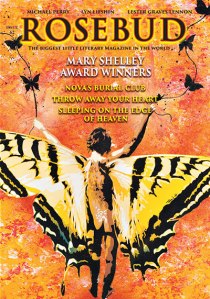
Rosebud 62 has arrived! There’s much to celebrate, beginning with Tai Taeoalii, the American/Samoan artist and filmmaker whose pop art surrealism graces the front and back cover as well as appearing generously throughout the issue. “These are deep waters, in which thought and feeling morph in mysterious ways,” writes Rosebud editor Rod Clark in his interview with the artist, whose work is both fanciful and nightmarish. Just like the five winning short stories in the magazine’s sixth biennial Mary Wollstonecraft Shelley Award for Imaginative Fiction. Taking first place and $1,000 is Patricia Lundy’s gothic horror tale, “Nova’s Burial Club.” Lundy will disturb your sleep with sentences like this: “I found her face down at the table, her hair dipping into the meat sauces.”
Readers of Rosebud 62 are also treated to the first two chapters from a new novel, James Joyce 1906-1907: The Ambiguity of Epiphanies, by Giuseppe Cafiero, and translated from the Italian by Simon Knight. A kind of noirish psychological study of Joyce and his work, the excerpt is narrated by a private detective hired by a publisher to shadow the modernist writer whose “incorrigible arrogance and effrontery” have given birth to stories that “dwell on matters not acceptable in polite society, possibly unlawful and certainly deserving of disapproval.”
Further rounding out issue 62: poems from Lyn Lifshin (“Remembering Later it’s the Anniversary of When My Mother and Father Eloped”), Lester Graves Lennon (“Uncle Scott”), and George Eastburn (“More than Ferlinghetti or Ginsberg”); writer and cartoonist P. S. Mueller’s apocalyptic meetup with God in “The Big Shiny” (“When God spoke, he really did sound like Orson Welles bellowing into a highly amplified public address system centered in a tiled men’s room the size of an airplane hangar”); and Mike Baron’s “Trail of the Loathsome Swine,” a scabrous Southern Gothic short story uniquely tailored for the Age of Trump (“Only time I ever had any truck with ’em animal rights people was in the sixth grade, they got permission to come to our school and try to frighten the bejesus out of us with pictures of slaughterhouses and chickens in cages and such”). Oh, there’s more. So much more.
Writers take note: Also included in Rosebud 62 are the guidelines for the ninth biennial X. J. Kennedy Award for Creative Nonfiction. Deadline for submissions is August 15, 2017. I’m pleased to say I’ll be co-judging this year’s contest entries with editor Rod Clark.
All the News I Need Joan Frank
University of Massachusetts Press 2017
Reviewed by Bob Wake
Joan Frank’s fourth novel, All the News I Need, winner of the 2016 Juniper Prize for Fiction from the University of Massachusetts Press, is a deep dive into the heart of friendship, of memory and regret, of aging and loss. Frances Ferguson, former newspaper columnist and book reviewer, is widowed after sixteen years of marriage. She’s fifty-eight and living alone in the novel’s lushly depicted wine region of Northern California. Oliver Gaffney, retired San Francisco preschool teacher, is gay and single at sixty-two. He’s prone to fatalism and panic attacks.
Human beings getting on one another’s nerves. Joan Frank has long been a master at showing how the best among us can entertain on occasion the worst of thoughts. All the News I Need is told through vivid third-person intimate narration that toggles between Frances and Oliver. Fran and Ollie. Ollie was close friends with Fran’s late husband, Kirk. The friendship between Fran and Ollie, minus Kirk, is iffy. By Ollie’s estimation:
Fran practices survivor manners, which is to say, none. She plunks her shod feet on the dining table, laughs with a honk, swears graphically, drinks wine chased by beer from the bottle—lifted high with each swig, as if she were taking aim with a spyglass.
The centerpiece of the novel is a life-shifting excursion to Paris undertaken by Fran and Ollie at Fran’s instigation. They will visit sights she remembers from previous trips with her late husband. There will be mishaps. (“Travel beats the living shit out of you,” Fran at one point muses in italicized exhaustion.) Fran and Ollie will each have opportunities to bless one another with kindness, even share moments of transcendence, while still wondering privately what the hell is wrong with the other person. (“Ollie’s insane, but that was never exactly a revelation,” Fran tells herself.) At unexpected moments the city erupts with a kind of quotidian sensuality and grace:
They march to the Place des Vosges, through the shadowy arched entry into the pale sunlight of the square: a time-travel portal. Once through, they stop and stare. Sounds issue at them: splashing water from the fountain, echoes from the cool arcades surrounding the lawn, the demure trees: chatter, music, scents of coffee and roasting meats and fresh bread and perfume, laughter. Couples strewn on the grass, entwined, twirling strands of each other’s hair; mothers and nannies trail young charges who lurch around shrieking, arms in the air, just as they do at the park at home.
At an outdoor Paris cafe, Ollie recalls the AIDS epidemic that took so many of his friends, years during which “he kept two funeral suits in his closet.” Fran talks openly about “the targeted feeling” of sexual harrassment that “never stopped, in one form or another, until, oh, my forties.” Scenes like this give All the News I Need an unvarnished sense of what human dignity under assault looks like and feels like. The relevance is unmistakable. This is not fake news.
“Nobody gives a fuck what we saw or what we ate,” says Fran in morose anticipation of their return home. There will be redemptive and wholly satisfying surprises to come. Joan Frank has gifted us with two unforgettable characters in a novel filled to bursting with hard truths and shimmering beauty.
Tom Connor’s Gift
David Allan Cates
Bangtail Press 2014
Reviewed by Bob Wake
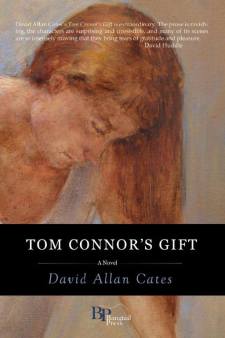
The time frame of David Allan Cates’s bravura new novel, Tom Connor’s Gift, covers roughly three weeks that Janine McCarthy spends alone in a Montana cabin both evading and confronting her grief over her husband Mark’s recent cancer death. Janine, a 49-year-old doctor, is in a bad way, not even certain she wants to join her two grown children for Thanksgiving back at their family farm outside of Madison, Wisconsin. She’s soon drinking more than she should. Smoking cigarettes. Neglecting her appearance. The cluttered cabin begins to smell bad from piled garbage. She can’t muster the energy to name the small dog she’s acquired, simply christening him “Puppy.” Cates fashions a rich and elaborate narrative by recognizing that we are never really “alone” with grief. Memories loom large and become persistent companions. Reality takes on the heightened near-mystical quality of a waking dream.
Consider, for instance, Janine’s standoff with a bear snooping and foraging ever closer to the cabin:
I sit up in bed and turn my feet onto the floor and struggle with my boots. I suddenly remember the terrible, slow breathing of the bear through the door and remember shooting the pepper spray and it feels as if it were a dream. Did I really do that? Did I really have a bear right outside the door and still dare to open the door? Did I spray into the wind?
After all, we experienced the bear at the door too—at least we read about the bear in Janine’s own telling—and the pepper spray blowing back into Janine’s face causing acute distress to her eyes and throat. Pretty much, we’re convinced. But other times, Janine imagines seeing the bear outside in the shadows. On another occasion, the bear’s face appears at the cabin window and morphs into the smiling face of her dead husband. Despite her steely ER-tested nerves, Janine warily muses: “Do dream memories and other memories get stored in the same place? And if you forget which memory is a dream and which is a waking event, does that mean you’re insane?”
Deeply entwined with Janine’s story is the parallel narrative of the novel’s eponymous gift-giver, Tom Connor. They were briefly lovers when Janine was sixteen and Tom was twenty. Sorted into stacks on a table in the cabin are nearly one hundred and fifty letters she subsequently received from Connor—freelance journalist, frustrated novelist, drunkard—through the years. Janine doesn’t merely share many of Connor’s vivid letters with us, she struggles to contextualize them for us and for herself. The violence that Tom Connor is witness to in 1980s Central America—era of the CIA-funded Contras and the civil wars in Guatemala, El Salvador, and Nicaragua—is unflinchingly recounted. (Cates’s work has never shied away from articulating the brutality at the heart of so much U.S. history, most notably in his powerful 2008 novel on the subject of slavery, Freeman Walker.)
David Allan Cates. Photo: Bangtail Press.
Cates is a seasoned storyteller—this is his fifth novel—and Tom Connor’s Gift is awash in stories that are by turns raucous, hair-raising, and heartfelt. The author orchestrates a series of climactic chapters that range across memory and time with breathless page-turning dramatic force. While Cates has spoken of his new novel as completing a “homecoming trilogy” begun with his well-received 1992 debut Hunger in America and 2012’s award-winning Ben Armstrong’s Strange Trip Home, each of these novels can be experienced on their own as satisfying individual works. Taken together, however, they represent a unique and eye-opening expression of epic American themes encompassing landscape and desire, love and loss, social justice and historical accountability.
1997 Northwestern Univ. Press edition of Ashes and Diamonds.
The 1948 Polish novel Ashes and Diamonds by Jerzy Andrzejewski (1909-1983) is probably less appreciated today as a literary work in its own right than as the basis for Andrzej Wajda’s 1958 film adaptation. The wildly entertaining movie, designated an “Essential Art House” choice in Criterion’s DVD catalog, owes more to Orson Welles’s baroque cinematic influence than Andrzejewski’s blend of socialist realism and tragic irony. Both novel and film are compact (239 pgs./103 mins.), while at the same time reflecting a panoramic near-epic cross-section of Poland’s clashing societal and political factions at the close of the Second World War. Neither the novel nor the film have escaped criticism over the years, although for different reasons.
Poet Czeslaw Milosz (1911-2004), who defected from Communist Poland in 1951, wrote a scathing smackdown of his former friend Jerzy Andrzejewski in The Captive Mind (1953), the Nobel Prize-winning poet’s classic study of writers and intellectuals “adapting” themselves to totalitarian regimes. Milosz—who refers to Andrzejewski pseudonymously as “Alpha, the Moralist”—is especially tough on what he sees as pulled-punches in Ashes and Diamonds (discussed at length in The Captive Mind without mentioning the novel’s title). According to Milosz, the novelist was nicknamed “the respectable prostitute” by fellow-writers who saw Andrzejewski as a Stalinist suck-up.
Zbigniew Cybulski in Andrzej Wajda’s Ashes and Diamonds (1958)
Film director Andrzej Wajda, in a fascinating interview included on the Ashes and Diamonds Criterion DVD, talks candidly of having initially refused to read the novel because of its state-sanctioned popularity in the 1950s. In the notes to a 2007 translation of Andrzejewski’s earlier novel, Holy Week, commentator Oscar Swan writes: “The year 1954 found Andrzejewski politically sanitizing a new edition of Ashes and Diamonds, which had become required reading in the schools.”
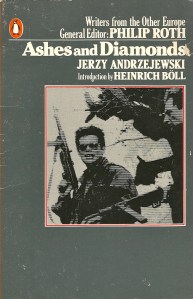
1980 Penguin paperback edition of Ashes and Diamonds.
German writer Heinrich Böll (1917-1985), like Milosz a recipient of the Nobel Prize for Literature, is altogether kinder to Ashes and Diamonds in his introduction written for the 1980 Penguin “Writers from the Other Europe” paperback edition of the novel, and reprinted in the 1997 Northwestern University Press edition. Almost as an aside, Böll notes that “the reader feels” that Andrzejewski “has a sense of kinship” with the novel’s “young Socialist and Communist functionaries.”
While both the Penguin and NUP editions of Ashes and Diamonds use D. J. Walsh’s 1962 British translation (with its battle-hardened Polish adults and nihilistic teenagers alike saying “cheerio” and “bloke” and “rotter” to one another), only the NUP edition includes five pages of previously deleted text. No explanation is given as to whether this was perhaps material removed by censors or, more likely, added in later to placate censors (possibly for the 1954 “sanitized” edition). A long speech by Stefan Szczuka, the sympathetically portrayed Communist Party official marked for assassination by the Polish underground, goes on and on for a mind-numbing two full pages of Soviet-era boilerplate:
For only those truly die who believe in isolation or who serve false truths which are illusory and incompatible with the one great truth of our time. Future generations will only despise them and will blame them or condemn them to oblivion. Those people, however, who have understood the forces of history and who have been in solidarity with their comrades, will discover in the future the praise of soldiers fighting for humanity, for one’s own fatherland and for mankind, for the world order.
Wajda sharpened the book’s edges by infusing the film with the Catholic iconography of Polish nationalism and by emphasizing the charged performance of Zbigniew Cybulski as the Home Army resistance fighter tasked with assassinating Szczuka. The combined effect was a cleverly coded rebuke to the postwar Soviet control of the country. Although the movie’s striking visual metaphors have sometimes been criticized as heavy-handed, the stylistic strategy clearly succeeded in Wajda’s intended aim of circumventing Communist Party censorship.
Spent a pleasurable Sunday barnstorming through Nickolas Butler’s buzzworthy debut novel, Shotgun Lovesongs. My baby boomer sensibilities detected a Big Chill for Millennials familiarity to some of the material, but this was always offset by Butler’s keen eye for rural Wisconsin seasonal detail (“The October air filled with corn dust enough to make each sunset a postcard, with colors like a benign nuclear explosion”), and, above all, the novel’s clever use of the mythology that’s grown up around the music of Bon Iver’s Justin Vernon, who shares with Butler the hometown of Eau Claire.
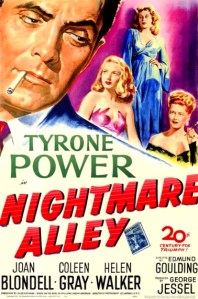
Copyright litigation kept Nightmare Alley (1947) out of circulation and generally unavailable for home viewing until a much-heralded DVD release in 2005. Since then, its reputation has grown from cult favorite to film noir classic. Running nearly two hours with a generous budget and A-list cast, Nightmare Alley is an anomaly for its genre (defined by crime novelist James Ellroy, in his introduction to The Best American Noir of the Century, as “cheap novels and cheap films about cheap people”). Swashbuckling matinee idol Tyrone Power leveraged his stardom to lobby for the starring role as carny con artist Stanton Carlisle, whose sole redemptive quality is his genuine bafflement—“I wonder why I’m like that?”—as to why he’s compelled again and again to act on his most ruthless instincts. The sexual heat generated between Tyrone Power and the film’s three supporting actresses is combustible and gives Nightmare Alley its strongest jolt of noir cred: ripe-to-bursting Joan Blondell as sideshow mentalist Zeena; Coleen Gray as Molly, a.k.a. Electra, scandalous to county sheriffs because of the tin-foil two-piece she wears in her sparks-a-flying electric-chair act; and, higher up the social ladder where Stanton longs to dwell, the movie’s femme fatale, Lilith (Helen Walker), a crooked psychotherapist to the wealthy.
Tyrone Power & Joan Blondell in Nightmare Alley.
Even with a prestige director in Edmund Goulding, and lurid expressionistic lighting by cinematographer Lee Garmes, Nightmare Alley was not a success. Tyrone Power subsequently returned to more conventional roles, which is a shame, because he’s clearly enjoying himself here, especially in the opening carnival scenes, all working-class T-shirt and chewing-gum and an oil-drum’s worth of pomade slicking his hair. In his early thirties at the time, Power initially seems beyond the ideal age for the role of Stan Carlisle, who is a youthful twenty-one in the first half of William Lindsay Gresham’s 1946 novel. The actor’s full-on commitment to the role, however, sells the characterization as handily as Stan’s doggedly mastered sleight-of-hand scarf and coin tricks. Power doesn’t evince a comparable set of skills in later scenes that are actually keyed closer to the actor’s age. Stan’s descent into alcoholism feels abrupt and unconvincing, in spite of our having been tipped off and conditioned to expect it. We’re meant to see parallels both to the drunken carny shill Pete Krumbein (played with aching pathos by veteran stage and silent film actor Ian Keith), whose death Stan inadvertently brings about earlier in the film, and the specter of the sideshow geek that so forcefully haunts the novel and the movie.
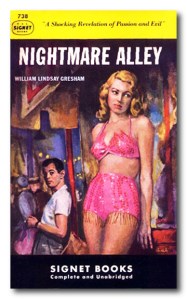
1949 paperback edition of Nightmare Alley by William Lindsay Gresham. Cover art: James Avati.
The geek is a severely alcoholic freak-show performer who earns his daily allotment of booze by savagely biting off the heads of live chickens for the amusement of wide-eyed rubes. Nightmare Alley never for a moment lets us forget the addiction-addled beast that presumably resides within each of us. The geek’s frenzied delirium tremens screams echo subliminally on the soundtrack as if erupting from Stan’s unconscious during several doom-laden moments throughout the movie. Alcohol unleashes monsters in Nightmare Alley. No amount of psychological insight is adequate to quelling or even comprehending our primal depravity. Psychotherapy, like telepathy and spiritualism, is exposed here as just another con game for exploiting human weakness.
William Lindsay Gresham’s novel doesn’t waste its breath suggesting that alcoholic Pete Krumbein might have benefited from taking “the cure,” a plot point added to the movie by ace screenwriter Jules Furthman in all likelihood to soften the story’s cynicism. For every pulled punch in the script adaptation of Gresham’s still shockingly grim novel (Nick Tosches, in his 2010 intro to the reissued book, goes as far as to suggest that Gresham may have been binge drinking while writing it), there is often a compensating layer of irony or ambiguity. At the film’s finish, where viewers usually note a more hopeful outcome than in the novel, our worst expectations are momentarily overturned by a glimmer of rescue—or is it enabling?—in the downward spiral of Stan’s now nightmarish life. In our guts we all know what’s in store for Stanton Carlisle. His fate was sealed the moment he first set eyes on the geek.
A recent painful outbreak of shingles on my left upper torso and back rendered me unfit for much of anything but Vicodin and bed rest for a couple of weeks. Mostly I wanted seclusion, earplugs to blunt neighborhood traffic and lawnmowers, and an enormous all-consuming novel to occupy my focus. I had earlier this year tackled Roberto Bolaño’s extraordinary epic about Mexican border murders and literary obsession, 2666, on my Kindle. I felt cocky and confident I could do the same with William T. Vollmann’s Europe Central, an 800-page 2005 National Book Award-winning novel about the Eastern Front in WWII and, perhaps the most celebrated element of the book, composer Dmitri Shostakovich’s soul-crushing struggle with creative expression under the jackboot of Soviet-era Communism. My Kindle has so spoiled me that although I already own Vollmann’s book in hardback, I downloaded a digital copy and began click-click-clicking away, often late into the night, blissfully dosed on hydrocordone 5/325.
Europe Central combines deeply researched verisimilitude and at times disorienting and highly effective surrealism. (For instance, a chapter titled “Airlift Idylls,” a 47-page Jungian representation of postwar East Germany’s totalitarian “unconscious” personified as Shostakovich’s self-punishing “shadow” assassinating the composer over and over again Groundhog Day-style.) The months’ long Battle of Stalingrad and siege of Leningrad are told from both the German and Russian sides in multiple perspectives, pampered high command to malnourished and frostbitten frontline soldiers to civilians and combatants slaughtered and piled into mass graves. Vollmann writes from character-driven voices—government bureaucrats and secret police hacks with rigid political biases—giving the novel a kind of cognitive dissonance that parallels the conflicted harmonic dissonances of Shostakovich’s most radical musical works (banned or denounced by Soviet authorities as “formalist,” “repulsive” and “ultra-individualist”).
Best listened to in a windowless room, better than best in an airless room—correctly speaking, a bunker sealed forever and enwrapped in tree-roots—the Eighth String Quartet of Shostakovich (Opus 110) is the living corpse of music, perfect in its horror. Call it the simultaneous asphyxiation and bleeding of melody. The soul strips itself of life in a dusty room.
William T. Vollmann at 2005 National Book Awards Ceremony. Photo: Robin Platzer/Twin Images.
The novel is dedicated to the Serbian writer Danilo Kiš (1935-1989), author of A Tomb for Boris Davidovich, a collection of short stories that Vollmann has long prized (he wrote the afterword for a 2001 Dalkey Archive reprint edition). Vollmann’s sensibility is uniquely his own, but it’s not difficult to discern the influence of A Tomb for Boris Davidovich. Kiš’s stories, with their interlocking storylines and recurring characters, are concerned with the blinkered psychological makeup of communist and fascist “true believers” and the ideological masks that excuse and even encourage murderous depravity and anti-Semitism. Both authors provide penetrating insight into the cultural megalomania and racist folklore that underpin the Holocaust. Accepting the 2005 National Book Award for Europe Central, Vollmann said:
I really have tried for many years to read myself into this horrible event and imagine how anyone could have done this, whether I could have done this, and that was what this book was about. I’m very happy that it’s over and I don’t have to think about it any more.
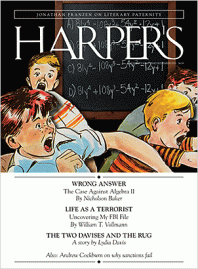
Harper’s Magazine, September 2013
What Vollmann has had to think about and what became the topic of an article the author published last month in Harper’s, “Life as a Terrorist: Uncovering my FBI file” (paywalled online, unfortunately, but the issue is worth seeking out at your local library), is the startling revelation that for years he was under surveillance by the U.S. government. Turns out that—unbeknownst to him at the time—Vollmann was an FBI suspect in the 1990s Unabomber case and, later, a Homeland Security suspect in the 2001 anthrax attacks. While in no way is Vollmann in his Harper’s piece comparing U.S. domestic spying to Russian political repression, it’s impossible not to find his FOIA-obtained (and heavily redacted) FBI file eerily prefigured in the portrait of Shostakovich’s anxiety over surveillance in Europe Central. As Vollmann writes in Harper’s:
Were I to be shown in accurate detail why it was necessary for me to be kept under surveillance, possibly for the rest of my life, I might be able to accept these invasions of my privacy for the collective good. The ostensible purpose of this surveillance is to protect us, and our freedoms, from terrorists. What remains uncertain, since secret, is how terrifying the terrorists presently are, and to what extent rights and liberties may be undermined in order to save us from them.
Photo: B & B Rare Books, Ltd. A 1941 First Edition of The Last Tycoon. Value: $4,000.
Inspired on several fronts (seeing Baz Luhrmann’s film adaptation of The Great Gatsby; rewatching the 1974 Gatsby; revisiting Elia Kazan’s 1976 film of The Last Tycoon), I just finished reading again after many years F. Scott Fitzgerald’s posthumous The Last Tycoon, edited by Edmund Wilson and published in 1941. The Last Tycoon is the title by which I still prefer to think of the novel. There’s an updated 1993 reconstruction by Fitzgerald scholar Matthew J. Bruccoli which uses what Bruccoli believed was Fitzgerald’s choice for the novel’s title, The Love of the Last Tycoon: A Western. Fitzgerald originally floated some curious titles for The Great Gatsby, too. How does Trimalchio grab you? By whatever title, The Last Tycoon is a great novel, even in its incomplete form. (A worthy contemporary comparison: David Foster Wallace’s unfinished but much-admired novel The Pale King, edited by Michael Pietsch and published in 2011.)
Thirty-five-year-old Hollywood producer Monroe Stahr’s obsession with an Englishwoman’s resemblance to his late actress wife might at first seem superficially similar to Gatsby. Fitzgerald in his letters and notes about The Last Tycoon, many of which were famously appended to Wilson’s reconstructed text, writes:
If one book could ever be “like” another, I should say it is more “like” The Great Gatsby than any other of my books. But I hope it will be entirely different—I hope it will be something new, arouse new emotions, perhaps even a new way of looking at certain phenomena.
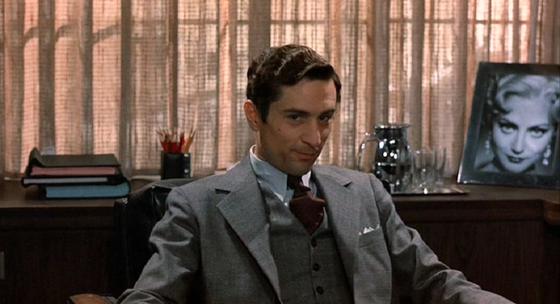
Robert De Niro as Monroe Stahr in The Last Tycoon (1976).
Stahr’s self-awareness evolves over the course of the narrative and differs significantly from Gatsby’s static and deluded nostalgia. This perhaps reflects Fitzgerald’s own battle with despair and loss in the years following Gatsby’s publication. (See Edmund Wilson’s posthumously edited collection of Fitzgerald’s autobiographical essays, The Crack-Up.) The Great Depression coincided with Fitzgerald’s falling fortunes: money woes, ill-health, his wife Zelda’s confinement to a mental hospital, and his career slide into near-obscurity. After living extravagantly as one of the country’s highest paid and most famous writers of the 1920s, he was an out-of-print and largely neglected author by the time he was writing his final novel. The romantic obsession at the core of The Last Tycoon is less about nostalgia than Stahr’s struggle to micromanage a psychological corner of his life while everything else seems to be spiraling beyond his control. As the novel progresses, it becomes clear that the Hollywood that Stahr once dominated as an autocratic whiz-kid producer is becoming decentralized. “At that time the studios feared mob rule,” runs one passage. Stahr’s preparation for a meeting with a communist union organizer has a political edge that signaled the author’s broadening skills as a satirist and social observer:
Afterwards Stahr told me that he prepared for the meeting by running off the Russian Revolutionary films that he had in his film library at home. He also ran off Doctor Caligari and Salvador Dali’s Le Chien Andalou, possibly suspecting that they had a bearing on the matter. He had been startled by the Russian films back in the twenties, and on Wylie White’s suggestion he had the script department get him up a two-page “treatment” of the Communist Manifesto.
Monroe Stahr is wonderfully alive in his sometimes cruel complexity (heightened by the novel’s occasionally spiteful narrator, a rival producer’s daughter secretly in love with Stahr). His confidence is shaken and something new and untested is awakened in him. “I want to show that Stahr left certain harm behind him just as he left good behind him,” Fitzgerald writes in another of the supplemental notes. Stahr isn’t adverse to change, but he wants change on his own terms, unshackled from the studio’s cash-driven bottom line. “For two years we’ve played it safe,” Stahr says at one point to a gathering of suspicious studio heads and money men. “It’s time we made a picture that’ll lose some money.” No dewy-eyed idealist, he adds: “Write it off as good will—this’ll bring in new customers.”
The Last Tycoon was also a reawakening of Fitzgerald’s preternatural talent for writing about romantic infatuation in a manner that manages to embrace clichés while at the same time reinvigorating them:
“I don’t want to lose you now,” he said. “I don’t know what you think of me or whether you think of me at all. As you’ve probably guessed, my heart’s in the grave—” He hesitated, wondering if this was quite true. “—but you’re the most attractive woman I’ve met since I don’t know when. I can’t stop looking at you. I don’t know now exactly the color of your eyes, but they make me sorry for everyone in the world—”
Robert De Niro and Jack Nicholson in The Last Tycoon (1976).
Elia Kazan’s 1976 film of The Last Tycoon never quite catches fire, but it’s a fascinating attempt nonetheless, in its Harold Pinter script (remarkably faithful to the more polished sections of the novel), and many of the performances, especially Robert De Niro’s elusive and darkly internalized portrayal of Monroe Stahr. A notorious flop when released, the movie ended Elia Kazan’s directing career. Kazan devotes seventeen painful pages to the making of the film in his 1988 autobiography, A Life. He was dealing with his mother’s failing health and, finally, her death, during production. Moreover, there were clashes with producer Sam Spiegel. The film deserves reevaluation. It’s never revived or talked about anymore. There’s a strong and richly amusing climactic scene with Jack Nicholson as Brimmer, the novel’s communist union organizer, playing a spirited match of Ping-Pong with De Niro’s Stahr. It’s taken nearly verbatim from the novel and it’s a highlight of the movie. Kazan’s film would make for a great double feature with Last Call, a surprisingly eloquent 2002 Showtime movie based on Francis Kroll Ring’s memoir about working for Fitzgerald during his final days in Hollywood writing The Last Tycoon.











 Coffee Spew