
-
Late Work
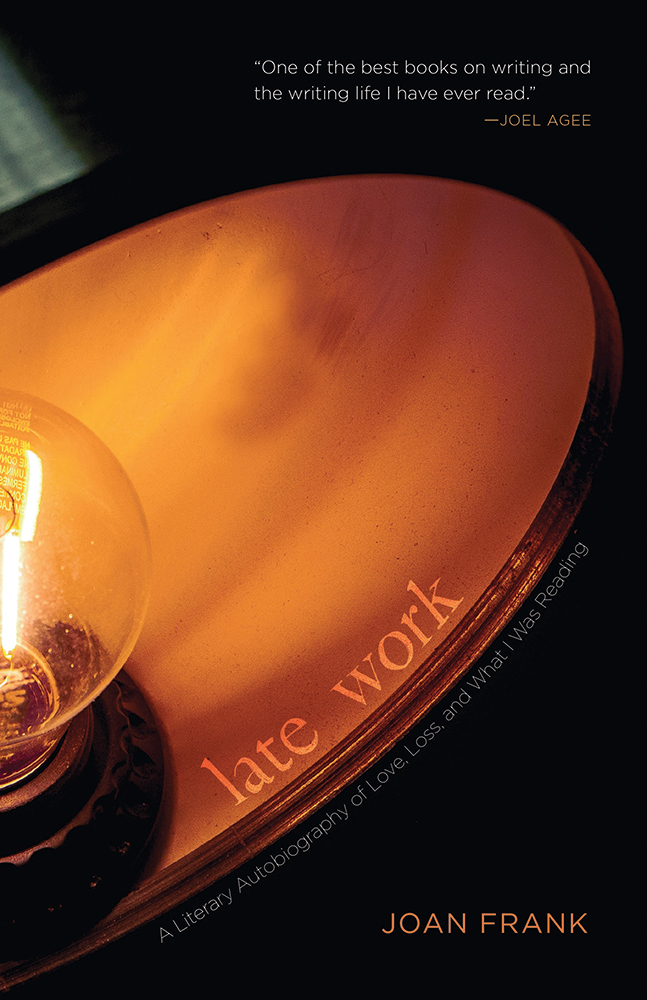
Late Work: A Literary Autobiography of Love, Loss, and What I Was Reading
Joan Frank
University of New Mexico Press 2022Reviewed by Bob Wake
Few writers are as honest and uncompromising about their art as Joan Frank. The essays collected in Late Work: A Literary Autobiography of Love, Loss, and What I Was Reading address “writers who’ve been at it awhile.” Readers and writers at any stage will find it both inspiring and sobering to learn that one of her novels, The Outlook for Earthlings, took fifteen persevering years to find a publisher.
Frank disputes the notion that writers and introverts in general are somehow better equipped to withstand the isolating effects of a global pandemic. In “Make It Go Away,” the COVID lockdowns are depicted in all their hallucinatory disorientation. “We’ve had terrible trouble sleeping,” she writes. “We’ve felt spaced out or angry or glum, tired or twitchy, scared or numb or listless…”
She admits to a post-pandemic loss of “clarity and conviction” (“It Seemed Important at the Time: The New Doubt”) and suggests the feeling may be more widespread than we realize. Her cultural analysis is persuasive. Frank’s New Doubt, like Hunter Thompson’s fear and loathing, portends bad vibes ahead:
Why lie about the sad drooly bony smelly Black Dog plopping down upon one’s chest at all hours, groaning and farting in its nightmare-riddled sleep?
Late Work is wide-ranging. Other highlights include an encomium to the practice of letter-writing (“Just anticipating letter-writing is erotic for me—the way approaching a bloc of private writing time and space is erotic”), and a bookstore reading gone horribly wrong (“Gird yourself, earnest artist. When attention comes it will contain naysayers”).
Two essays are devoted to the “now-classic-but-once-unknown” 1965 novel by John Williams, Stoner, about the struggles and muted transcendence of a Midwestern literature professor. “The novel’s arc feels—like all our very greatest art—inevitable,” Frank writes. “Its particulars shine with the relevance of the universal. It is timeless.”
The advice to writers in her essay “What Are We Afraid Of?” becomes advice to anyone feeling unmoored right now. “Despair can paralyze,” she warns. “If we’re paralyzed, nothing gets made.” We must teach ourselves to “shut out the roar.” Joan Frank offers strategies to help us find our way back to doing the work we care about.
-
The Transcendentalists and Their World
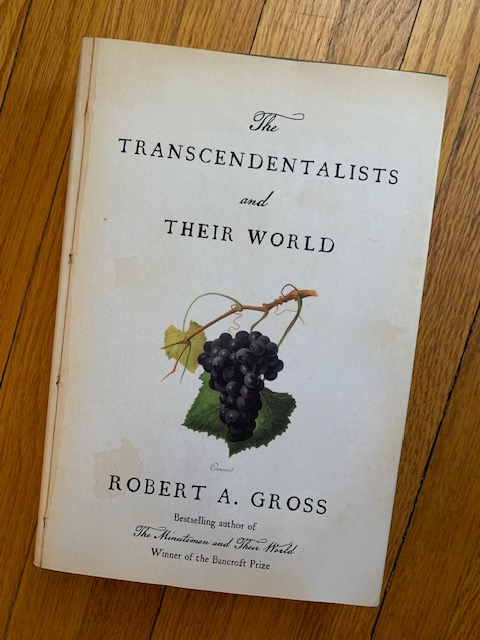
The Transcendentalists and Their World
Robert A. Gross
Farrar, Straus and Giroux 2021Reviewed by Bob Wake
Emphasis on “their world,” meaning Concord, Massachusetts in the first half of the nineteenth century. You will learn tons about manufacturing “the common pencil,” the family business that bored the shit out of Henry David Thoreau. Agricultural and educational reform. Industrialization and railroads. Internecine church discord. The unconscionably slow awakening of the abolitionist movement. Rich in granular census data, court records, diaries, letters. This approach to history—dubbed “new social history” when author Robert A. Gross began championing it in the 1970s—pays bountiful dividends. Transcendentalism’s nonconformity and romantic idealism go nowhere without a receptive “rising generation” seeking countercultural “newness.” Emersonian self-reliance is about bestowing wonderment and dignity upon human consciousness. Gross shows us what was happening on the ground—literally—in Concord (e.g., the cultivation of the Concord grape, and Thoreau’s storied bean-field). The book’s nearly 200 pages of endnotes comprise citation upon citation, and, in the best David Foster Wallace tradition, often include entertaining nested mini-narratives. All of which is to say: Transcendentalism rightfully deserves context, and by God, Gross’s 864-page career-capping masterpiece supplies it.
-
The Power of the Dog
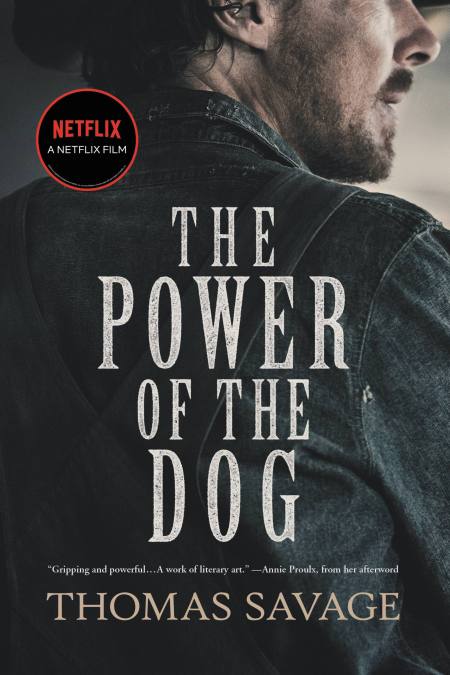
The Power of the Dog
Thomas Savage
Afterword by Annie Proulx
Back Bay Books 2021 [2001]Reviewed by Bob Wake
Back Bay Books’ 2001 reprint of Thomas Savage’s 1967 Western novel, The Power of the Dog, with a laudatory afterword by Annie Proulx, brought serious reconsideration to Savage’s largely forgotten book. (Not unlike the rediscovery of John Williams’ Stoner from 1965, recognized only in the last ten years as a classic American novel.) New Zealand director/screenwriter Jane Campion’s adaptation of The Power of the Dog, and its twelve Oscar nominations, should further burnish the book’s reputation. As Proulx writes, “Savage created one of the most compelling and vicious characters in American literature.” That would be Phil Burbank, played with menacing brio by Benedict Cumberbatch. Montana ranch owner, bully, and sexually repressed homophobe. “He is, in fact, a vicious bitch,” says Proulx. Ahead of its time? Possibly. But as a revisionist Western, even an anti-Western, Savage’s novel precedes Robert Altman’s McCabe & Mrs. Miller (1971) by a mere four years. Campion gets it. Kodi Smit-McPhee, in one of the best fakeout performances in recent years, seems to consciously echo Keith Carradine’s brief but unforgettable role in Altman’s film as a bumpkin out of his depth. What really seals the homage is Carradine’s cameo as the governor in Campion’s film.
-
Sustainable Living

Sustainable Living
Elsa Nekola
Willow Springs Books 2021Reviewed by Bob Wake
Wisconsin writer Elsa Nekola’s debut collection of short stories, Sustainable Living, is so deeply knowing of the Upper Midwest that it functions as a kind of wisdom literature. Granted, the wisdom may not always be welcome. Disillusionment is a recurring theme, as is the fictional town of White Birch, where old habits die hard. A retired supper club owner (“Winter Flame”) can’t quit his mealtime routine of “folding his cloth napkin into a swan.” The betrayal of a fragile summer friendship (“River Through a Half-Burnt Woods”) replays itself in a woman’s memory like a wound that refuses to heal.
Fifteen-year-old Coral, the protagonist of “Oktoberfest,” feels preternaturally at home in the Northwoods, but less so in an adult world of struggling families and economic hardship. Addiction. Unwanted sexual attention. “She’s beginning to think,” we’re told, “that being a woman means staying where you’re needed, not where you want to go.”
Coral, by story’s end, may not know where she wants to go, or where she fits in. But readers will recognize in the achingly fine-tuned descriptions of landscape and wildlife that Coral has a near-mystical connection to her surroundings:
Today, there’s frost on the grass, and a chill that won’t leave the air until April. The mallards and black ducks have begun to court, and in midwinter the hairy woodpeckers will drum on hollow trees.
Nekola is especially good on the complexities of mother-daughter relationships, whether a grown daughter in “Meat Raffle” returning from Chicago to visit her eccentric literary mom in southeastern Wisconsin (“She thinks she’s the first sixty-year-old widow to discover Shakespeare,” fumes the daughter), or the title story’s resourceful fourteen-year-old Myra Pavelka, abandoned to relatives and afternoon barrooms when her mother hastily takes flight under possible criminal circumstances.
Sustainable Living won the 2020 Spokane Prize for Short Fiction from Willow Springs Books, whose top-notch book design compliments the jeweled precision of these stories. Elsa Nekola’s work has appeared in numerous literary journals, from Ploughshares and Passages North, to Rosebud Magazine and Midwestern Gothic.




 Coffee Spew