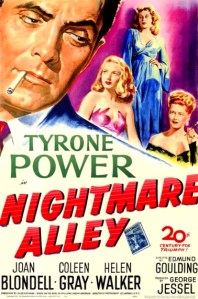
Copyright litigation kept Nightmare Alley (1947) out of circulation and generally unavailable for home viewing until a much-heralded DVD release in 2005. Since then, its reputation has grown from cult favorite to film noir classic. Running nearly two hours with a generous budget and A-list cast, Nightmare Alley is an anomaly for its genre (defined by crime novelist James Ellroy, in his introduction to The Best American Noir of the Century, as “cheap novels and cheap films about cheap people”). Swashbuckling matinee idol Tyrone Power leveraged his stardom to lobby for the starring role as carny con artist Stanton Carlisle, whose sole redemptive quality is his genuine bafflement—“I wonder why I’m like that?”—as to why he’s compelled again and again to act on his most ruthless instincts. The sexual heat generated between Tyrone Power and the film’s three supporting actresses is combustible and gives Nightmare Alley its strongest jolt of noir cred: ripe-to-bursting Joan Blondell as sideshow mentalist Zeena; Coleen Gray as Molly, a.k.a. Electra, scandalous to county sheriffs because of the tin-foil two-piece she wears in her sparks-a-flying electric-chair act; and, higher up the social ladder where Stanton longs to dwell, the movie’s femme fatale, Lilith (Helen Walker), a crooked psychotherapist to the wealthy.
Tyrone Power & Joan Blondell in Nightmare Alley.
Even with a prestige director in Edmund Goulding, and lurid expressionistic lighting by cinematographer Lee Garmes, Nightmare Alley was not a success. Tyrone Power subsequently returned to more conventional roles, which is a shame, because he’s clearly enjoying himself here, especially in the opening carnival scenes, all working-class T-shirt and chewing-gum and an oil-drum’s worth of pomade slicking his hair. In his early thirties at the time, Power initially seems beyond the ideal age for the role of Stan Carlisle, who is a youthful twenty-one in the first half of William Lindsay Gresham’s 1946 novel. The actor’s full-on commitment to the role, however, sells the characterization as handily as Stan’s doggedly mastered sleight-of-hand scarf and coin tricks. Power doesn’t evince a comparable set of skills in later scenes that are actually keyed closer to the actor’s age. Stan’s descent into alcoholism feels abrupt and unconvincing, in spite of our having been tipped off and conditioned to expect it. We’re meant to see parallels both to the drunken carny shill Pete Krumbein (played with aching pathos by veteran stage and silent film actor Ian Keith), whose death Stan inadvertently brings about earlier in the film, and the specter of the sideshow geek that so forcefully haunts the novel and the movie.
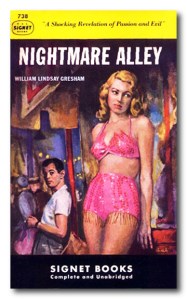
1949 paperback edition of Nightmare Alley by William Lindsay Gresham. Cover art: James Avati.
The geek is a severely alcoholic freak-show performer who earns his daily allotment of booze by savagely biting off the heads of live chickens for the amusement of wide-eyed rubes. Nightmare Alley never for a moment lets us forget the addiction-addled beast that presumably resides within each of us. The geek’s frenzied delirium tremens screams echo subliminally on the soundtrack as if erupting from Stan’s unconscious during several doom-laden moments throughout the movie. Alcohol unleashes monsters in Nightmare Alley. No amount of psychological insight is adequate to quelling or even comprehending our primal depravity. Psychotherapy, like telepathy and spiritualism, is exposed here as just another con game for exploiting human weakness.
William Lindsay Gresham’s novel doesn’t waste its breath suggesting that alcoholic Pete Krumbein might have benefited from taking “the cure,” a plot point added to the movie by ace screenwriter Jules Furthman in all likelihood to soften the story’s cynicism. For every pulled punch in the script adaptation of Gresham’s still shockingly grim novel (Nick Tosches, in his 2010 intro to the reissued book, goes as far as to suggest that Gresham may have been binge drinking while writing it), there is often a compensating layer of irony or ambiguity. At the film’s finish, where viewers usually note a more hopeful outcome than in the novel, our worst expectations are momentarily overturned by a glimmer of rescue—or is it enabling?—in the downward spiral of Stan’s now nightmarish life. In our guts we all know what’s in store for Stanton Carlisle. His fate was sealed the moment he first set eyes on the geek.
A recent painful outbreak of shingles on my left upper torso and back rendered me unfit for much of anything but Vicodin and bed rest for a couple of weeks. Mostly I wanted seclusion, earplugs to blunt neighborhood traffic and lawnmowers, and an enormous all-consuming novel to occupy my focus. I had earlier this year tackled Roberto Bolaño’s extraordinary epic about Mexican border murders and literary obsession, 2666, on my Kindle. I felt cocky and confident I could do the same with William T. Vollmann’s Europe Central, an 800-page 2005 National Book Award-winning novel about the Eastern Front in WWII and, perhaps the most celebrated element of the book, composer Dmitri Shostakovich’s soul-crushing struggle with creative expression under the jackboot of Soviet-era Communism. My Kindle has so spoiled me that although I already own Vollmann’s book in hardback, I downloaded a digital copy and began click-click-clicking away, often late into the night, blissfully dosed on hydrocordone 5/325.
Europe Central combines deeply researched verisimilitude and at times disorienting and highly effective surrealism. (For instance, a chapter titled “Airlift Idylls,” a 47-page Jungian representation of postwar East Germany’s totalitarian “unconscious” personified as Shostakovich’s self-punishing “shadow” assassinating the composer over and over again Groundhog Day-style.) The months’ long Battle of Stalingrad and siege of Leningrad are told from both the German and Russian sides in multiple perspectives, pampered high command to malnourished and frostbitten frontline soldiers to civilians and combatants slaughtered and piled into mass graves. Vollmann writes from character-driven voices—government bureaucrats and secret police hacks with rigid political biases—giving the novel a kind of cognitive dissonance that parallels the conflicted harmonic dissonances of Shostakovich’s most radical musical works (banned or denounced by Soviet authorities as “formalist,” “repulsive” and “ultra-individualist”).
Best listened to in a windowless room, better than best in an airless room—correctly speaking, a bunker sealed forever and enwrapped in tree-roots—the Eighth String Quartet of Shostakovich (Opus 110) is the living corpse of music, perfect in its horror. Call it the simultaneous asphyxiation and bleeding of melody. The soul strips itself of life in a dusty room.
William T. Vollmann at 2005 National Book Awards Ceremony. Photo: Robin Platzer/Twin Images.
The novel is dedicated to the Serbian writer Danilo Kiš (1935-1989), author of A Tomb for Boris Davidovich, a collection of short stories that Vollmann has long prized (he wrote the afterword for a 2001 Dalkey Archive reprint edition). Vollmann’s sensibility is uniquely his own, but it’s not difficult to discern the influence of A Tomb for Boris Davidovich. Kiš’s stories, with their interlocking storylines and recurring characters, are concerned with the blinkered psychological makeup of communist and fascist “true believers” and the ideological masks that excuse and even encourage murderous depravity and anti-Semitism. Both authors provide penetrating insight into the cultural megalomania and racist folklore that underpin the Holocaust. Accepting the 2005 National Book Award for Europe Central, Vollmann said:
I really have tried for many years to read myself into this horrible event and imagine how anyone could have done this, whether I could have done this, and that was what this book was about. I’m very happy that it’s over and I don’t have to think about it any more.
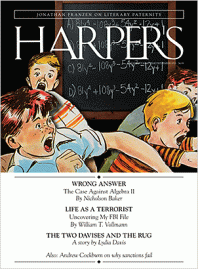
Harper’s Magazine, September 2013
What Vollmann has had to think about and what became the topic of an article the author published last month in Harper’s, “Life as a Terrorist: Uncovering my FBI file” (paywalled online, unfortunately, but the issue is worth seeking out at your local library), is the startling revelation that for years he was under surveillance by the U.S. government. Turns out that—unbeknownst to him at the time—Vollmann was an FBI suspect in the 1990s Unabomber case and, later, a Homeland Security suspect in the 2001 anthrax attacks. While in no way is Vollmann in his Harper’s piece comparing U.S. domestic spying to Russian political repression, it’s impossible not to find his FOIA-obtained (and heavily redacted) FBI file eerily prefigured in the portrait of Shostakovich’s anxiety over surveillance in Europe Central. As Vollmann writes in Harper’s:
Were I to be shown in accurate detail why it was necessary for me to be kept under surveillance, possibly for the rest of my life, I might be able to accept these invasions of my privacy for the collective good. The ostensible purpose of this surveillance is to protect us, and our freedoms, from terrorists. What remains uncertain, since secret, is how terrifying the terrorists presently are, and to what extent rights and liberties may be undermined in order to save us from them.
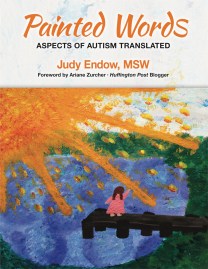
“Working 13 years with students who are diagnosed with severe autism, my colleagues and I have often wanted to visualize and better understand what our students were seeing, feeling and thinking. Judy Endow’s Painted Words takes us on a picturesque journey into the mind of one autistic person through her vivid and breathtaking paintings and sculptures while also explaining in detailed description and poetry what she sees and, via sensory, how she experiences it. Helpful suggestions for working with individuals on the spectrum open a treasure box of insights. Having this ‘backstage pass’ into autism will be priceless for educators, parents and individuals on the autism spectrum.” —Joanna L. Keating-Velasco, educator, and author of A is for Autism, F is for Friend: A Kid’s Book for Making Friends with a Child Who Has Autism.
“Judy Endow combines her art, poetry, and prose to create a thought-provoking book of self-discovery that viscerally captures the essence of a world which only few experience—a world of subtle beauty that can turn too bright, loud, and overwhelming. The practical advice at the end of each chapter has helped me understand and be a better parent to my autistic child. Painted Words is a book to read, reread and share with other parents, educators, physicians, and therapists so they too can learn to appreciate the autistic experience. I’m buying it for all of my friends!” —Debra Hosseini, author of The Art of Autism: Shifting Perceptions.
“Judy gives us a compelling view into her world through words crafted on the page, connected with images that illustrate her experience of being autistic. She encourages the neurotypical world to change their perceptions and assumptions about people with autism, to ask ourselves questions. Painted Words challenges our thinking, leading us to examine beyond what we see on the surface. Your view of autism is bound to shift after experiencing autism through Judy’s words and paintings.” —Maureen Bennie, Director, Autism Awareness Centre, Inc. (www.autismawarenesscentre.com).
“By sharing her paintings and poetry in Painted Words, Judy Endow provides rare insight into a person with autism, including her heightened sensory awareness, her need to establish predictability, her social needs, and much more. This captivating book tempts the reader to learn more about the uniqueness of autism and its neurological impact. Judy shares her experiences, asks thoughtful questions, and challenges the reader, by putting words and visuals to her early childhood. She provides her vision of the world, and her perspective will flood you with emotions and leave you looking through fresh lenses at those with autism. Painted Words is a wonderful gift to us so-called neurotypicals. We may very well feel like we are the ones that are lacking and, thus, not measuring up. Using her own words, I summarize Judy’s contribution with this book by saying, ‘The girl her mastery shows!’” —Danette Schott, M.A., executive editor, special-ism.com.
“Judy Endow has long been one of my finest and clearest teachers when it comes to understanding autism. In Painted Words, Judy takes me into a new, deeper comprehension of her experience of autism using the mediums of poetry, prose and visual expression via her paintings. Her strong activist voice takes no prisoners, requiring me to examine how my own neurotypical arrogance can be a contraindicator in forming relationships with those in my life with autism. This strength is juxtaposed by the clarity of Judy’s paintings, which provides both visual representation and softness, entering my consciousness in a manner completely different than the words that accompany and explain. Judy’s ability to use her own experience to provide ideas and strategies for working with others is a treasure which she shares in each section of the book. Painted Words is a book that will appeal to autistics and neurotypicals alike, as we move forward to bridge the differences in how we experience the world to forge relationships and create better lives for those we love with autism.” —Kate McGinnity, M.S., educational consultant, and co-author of Walk Awhile in My Autism and Lights! Camera! Autism!.
“Judy Endow’s Painted Words is a sensitive and beautiful portal into a life lived with autism. Through evocative paintings and poetry, Judy explores her own experiences and offers invaluable advice to parents, teachers and other professionals who work with people on the autism spectrum. This heartfelt book sparkles and glitters. Highly recommended.” —Jeanette Purkis, author of Finding a Different Kind of Normal: Misadventures with Asperger Syndrome.
“Judy Endow’s Painted Words is an immersive, artful, and educational experience in understanding autism. Judy reveals her autistic neurology or ‘operating system’ by showing her way of perceiving, thinking, and learning. Painted Words is a step up from autism awareness. It is about understanding and accepting diverse minds.” —Jill Jones, filmmaker, currently researching and producing a documentary about autism and sensory perception (www.spectrumthefilm.com).
“Judy has brilliantly demonstrated her skill as a writer and an artist who proudly lives and loves autism. Her candid words and stunning art light up the spectrum as an example of the endless potential of all autistic people.” —Malcolm Mayfield, specialist/consultant, founder of Autism STAR (Autism Spectrum Training, Advocacy and Recruitment), www.autism-star.com.
“Painted Words takes the reader on an unforgettable journey far beyond written text—to a place where visual imagery dances with poetry to provide an intimate understanding of the world of an autistic. Judy Endow’s powerful use of personal art work, poetry, and written text is a must read for every professional working with individuals on the spectrum.” —Ellen E. Eggen, MS LPC ATR-BC, Art Therapist, Director of Planning and Operations, Common Threads Family Resource Center, Madison, Wisconsin.
“What a wonderful book! In combining her talents in both writing and the visual arts, Judy Endow has given us an intimate look into her life with autism that is informative, engaging, beautiful, and thought-provoking. I cannot tell you how much I enjoyed this book.” —Peter Gerhardt, Ed.D., Director of Education, Upper School for the McCarton School, and the Founding Chair of the Scientific Council for the Organization for Autism Research (OAR).
“Judy reveals her unique sensory experience in this generous and compassionate offering. Here, as always, her words provide keys to understanding the autism experience. Yet more remarkably, Painted Words reveals her experience through pristine and seminal art images that open the autism experience in ways that words cannot. The vivid colors and textures of her art invite us into her experience. Her ability to define crucial aspects of the autism experience is matched by precise suggestions to guide neurotypical connection and relationship with persons with autism. I hope Painted Words helps you listen and see with new eyes. Prepare to leave misguided conceptions of autism behind you.” —John B. Thomas, M. Ed., educational consultant, and a principal author of TEACCH Transition Assessment Profile (TTAP).
“Painted Words is an especially valuable book because it weaves together, in a single volume, the prose, poetry, art and sculpting skills of the author with autism demonstrating how they interlink, interact and complement each other. That is an interesting experiential venture in its own right. But the book doesn’t stop there. Additionally, the ‘Considerations When Working With Others’ section at the end of each chapter provides very useful and practical advice distilled from all of the above. These useful hints, tips and pearls are easily understood and applied, put forth in a very reader friendly fashion, for anyone wanting to better understand the differences between autistic and neurotypical thinking and behavior.” —Darold Treffert, M.D., author of Islands of Genius: The Bountiful Mind of the Autistic, Acquired and Sudden Savant, and a consultant on the movie Rain Man (www.savantsyndrome.com).
About the Author
Judy Endow
Judy Endow, MSW, is an author and international speaker on a variety of autism-related topics. She is part of the Wisconsin DPI Statewide Autism Training Team and a board member of both the Autism Society of America, Wisconsin Chapter and the Autism National Committee. In addition, Judy works with the Autistic Global Initiative (AGI), a program of the Autism Research Institute. She maintains a private practice in Madison, Wisconsin, providing consultation for families, school districts and other agencies. Besides having autism herself, she is the parent of three now grown sons, one of whom is on the autism spectrum. Judy’s website is www.judyendow.com.
Photo: B & B Rare Books, Ltd. A 1941 First Edition of The Last Tycoon. Value: $4,000.
Inspired on several fronts (seeing Baz Luhrmann’s film adaptation of The Great Gatsby; rewatching the 1974 Gatsby; revisiting Elia Kazan’s 1976 film of The Last Tycoon), I just finished reading again after many years F. Scott Fitzgerald’s posthumous The Last Tycoon, edited by Edmund Wilson and published in 1941. The Last Tycoon is the title by which I still prefer to think of the novel. There’s an updated 1993 reconstruction by Fitzgerald scholar Matthew J. Bruccoli which uses what Bruccoli believed was Fitzgerald’s choice for the novel’s title, The Love of the Last Tycoon: A Western. Fitzgerald originally floated some curious titles for The Great Gatsby, too. How does Trimalchio grab you? By whatever title, The Last Tycoon is a great novel, even in its incomplete form. (A worthy contemporary comparison: David Foster Wallace’s unfinished but much-admired novel The Pale King, edited by Michael Pietsch and published in 2011.)
Thirty-five-year-old Hollywood producer Monroe Stahr’s obsession with an Englishwoman’s resemblance to his late actress wife might at first seem superficially similar to Gatsby. Fitzgerald in his letters and notes about The Last Tycoon, many of which were famously appended to Wilson’s reconstructed text, writes:
If one book could ever be “like” another, I should say it is more “like” The Great Gatsby than any other of my books. But I hope it will be entirely different—I hope it will be something new, arouse new emotions, perhaps even a new way of looking at certain phenomena.
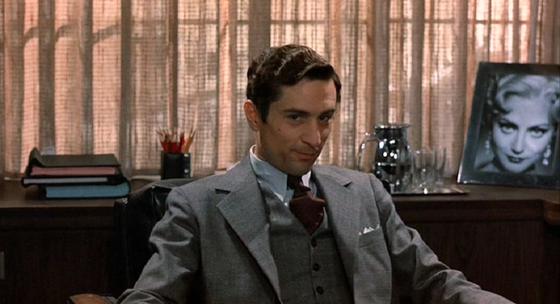
Robert De Niro as Monroe Stahr in The Last Tycoon (1976).
Stahr’s self-awareness evolves over the course of the narrative and differs significantly from Gatsby’s static and deluded nostalgia. This perhaps reflects Fitzgerald’s own battle with despair and loss in the years following Gatsby’s publication. (See Edmund Wilson’s posthumously edited collection of Fitzgerald’s autobiographical essays, The Crack-Up.) The Great Depression coincided with Fitzgerald’s falling fortunes: money woes, ill-health, his wife Zelda’s confinement to a mental hospital, and his career slide into near-obscurity. After living extravagantly as one of the country’s highest paid and most famous writers of the 1920s, he was an out-of-print and largely neglected author by the time he was writing his final novel. The romantic obsession at the core of The Last Tycoon is less about nostalgia than Stahr’s struggle to micromanage a psychological corner of his life while everything else seems to be spiraling beyond his control. As the novel progresses, it becomes clear that the Hollywood that Stahr once dominated as an autocratic whiz-kid producer is becoming decentralized. “At that time the studios feared mob rule,” runs one passage. Stahr’s preparation for a meeting with a communist union organizer has a political edge that signaled the author’s broadening skills as a satirist and social observer:
Afterwards Stahr told me that he prepared for the meeting by running off the Russian Revolutionary films that he had in his film library at home. He also ran off Doctor Caligari and Salvador Dali’s Le Chien Andalou, possibly suspecting that they had a bearing on the matter. He had been startled by the Russian films back in the twenties, and on Wylie White’s suggestion he had the script department get him up a two-page “treatment” of the Communist Manifesto.
Monroe Stahr is wonderfully alive in his sometimes cruel complexity (heightened by the novel’s occasionally spiteful narrator, a rival producer’s daughter secretly in love with Stahr). His confidence is shaken and something new and untested is awakened in him. “I want to show that Stahr left certain harm behind him just as he left good behind him,” Fitzgerald writes in another of the supplemental notes. Stahr isn’t adverse to change, but he wants change on his own terms, unshackled from the studio’s cash-driven bottom line. “For two years we’ve played it safe,” Stahr says at one point to a gathering of suspicious studio heads and money men. “It’s time we made a picture that’ll lose some money.” No dewy-eyed idealist, he adds: “Write it off as good will—this’ll bring in new customers.”
The Last Tycoon was also a reawakening of Fitzgerald’s preternatural talent for writing about romantic infatuation in a manner that manages to embrace clichés while at the same time reinvigorating them:
“I don’t want to lose you now,” he said. “I don’t know what you think of me or whether you think of me at all. As you’ve probably guessed, my heart’s in the grave—” He hesitated, wondering if this was quite true. “—but you’re the most attractive woman I’ve met since I don’t know when. I can’t stop looking at you. I don’t know now exactly the color of your eyes, but they make me sorry for everyone in the world—”
Robert De Niro and Jack Nicholson in The Last Tycoon (1976).
Elia Kazan’s 1976 film of The Last Tycoon never quite catches fire, but it’s a fascinating attempt nonetheless, in its Harold Pinter script (remarkably faithful to the more polished sections of the novel), and many of the performances, especially Robert De Niro’s elusive and darkly internalized portrayal of Monroe Stahr. A notorious flop when released, the movie ended Elia Kazan’s directing career. Kazan devotes seventeen painful pages to the making of the film in his 1988 autobiography, A Life. He was dealing with his mother’s failing health and, finally, her death, during production. Moreover, there were clashes with producer Sam Spiegel. The film deserves reevaluation. It’s never revived or talked about anymore. There’s a strong and richly amusing climactic scene with Jack Nicholson as Brimmer, the novel’s communist union organizer, playing a spirited match of Ping-Pong with De Niro’s Stahr. It’s taken nearly verbatim from the novel and it’s a highlight of the movie. Kazan’s film would make for a great double feature with Last Call, a surprisingly eloquent 2002 Showtime movie based on Francis Kroll Ring’s memoir about working for Fitzgerald during his final days in Hollywood writing The Last Tycoon.
According to the L.A. Times literary blog Jacket Copy, George Saunders chose to leave “Fox 8” out of his recently published collection Tenth of December because he felt it was “asking one stretch too many from the reader.” I get that. In fact, I much prefer reading the occasional Saunders story in The New Yorker rather than compiled in short story collections. His stories, artfully spun and eccentrically self-contained, can seem overly precious and “worked up” when set side by side. That said, he’s written more than his share of masterful short stories. “Fox 8,” which began life as a failed children’s book, is as memorable as anything Saunders has written, which is to say it will stay with you because of qualities it shares with timeless, even mythic storytelling.
George Saunders. Photo: Chloe Aftel.
The story is narrated by a visionary fox struggling to convince his starving den comrades that their only chance for survival is to strike out in quest of food at the newly constructed shopping mall that has displaced their habitat. “Fox 8” is actually an epistolary fable, written as a beseeching letter to the humans whose language Fox 8 has learned, if not precisely mastered, as a kind of earthy Chaucerian Middle English: “Stay in your awesum howses, play your music lowd, however you make it play so lowd, yap your Yuman jokes, sending forth your crood laffter into the nite.” Also worth noting about this very cool 99-cent ebook are the wonderful illustrations by graphic designer Chelsea Cardinal (the sharp cover design is hers as well).
Proposals for the Recovery of the Apparently Drowned
Michael Sheehan Colony Collapse Press 2012
Reviewed by Bob Wake
The four short stories that comprise Michael Sheehan’s Proposals for the Recovery of the Apparently Drowned are ambitious and often darkly amusing fictions that adroitly mesh genre-busting experimental writing and rock-solid literary instincts. While each story succeeds well enough on its own ingeniously devised terms, the title story is perhaps the strongest in the collection. Stripped of the hypertextual footnotes and pop culture references that function as metafictional ballast in the other stories collected here, “Proposals for the Recovery of the Apparently Drowned” is instead a tightly composed narrative about the mounting internalized horror of a woman plunged into a coma-like state of “conscious paralysis” after stumbling and falling outside of a New York dance club. Passages of dryly delivered historical documentation on “suspended animation” are woven directly into the text and add to the story’s powerful effect. Sheehan never pushes the existential metaphor of an unmoored and despairing Beckettian consciousness, allowing us to intimately share the protagonist’s dislocation:
Deep inside herself, willing her body limp and empty and motionless and withdrawing every bit of her true self inside, away, acutely aware of everything around her and through this awareness focused more and more on nothing but staying still, hidden.
Michael Sheehan. Photo: Colony Collapse Press.
The final story, “September,” is the longest in the collection and its hilarious over-the-top self-indulgence is clearly intended as an homage to the influential writer for whom the story is dedicated: David Foster Wallace (1962-2008). Sheehan cleverly glosses aspects of Wallace’s Infinite Jest (the novel’s apocalyptic tennis court game of Eschaton—which also inspired the Decemberists’ video for their “Calamity Song”—becomes an epic round of Civilization in Sheehan’s story). More than mere parody, Sheehan’s “September” finds its own rhythms and drug-fueled conspiratorial compulsions, and the story’s final section (dated September 12, 2008, the date of Wallace’s death) is heartbreakingly beautiful as writing and as eulogy.
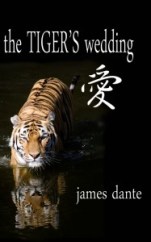
The Tiger’s Wedding
James Dante
Martin Sisters Publishing 2013
Reviewed by Bob Wake
“Moments of conventional bliss had a way of eluding me,” declares Jake St. Gregory, a young American accountant from dreamland, U.S.A.—Burbank, California—working as an English teacher in Seoul, South Korea. Jake, the 30-year-old protagonist and narrator of James Dante’s wry and wise debut novel, The Tiger’s Wedding, will thoroughly test the multicultural limits of convention and bliss by the finish of his tale.
There’s a tangled romance at the heart of The Tiger’s Wedding, with Jake falling in love with a married Korean woman, an aspiring musician with two young children. Dante finds enough page-turning complications and believable twists to both keep the plot percolating efficiently and to largely sidestep cliches. He grounds his story in solid characterization and skillful depictions of cultural and familial conflicts.
James Dante. Photo: Martin Sisters Publishing.
It’s no surprise to learn from his author’s bio that Dante, a Northern Californian by way of New York, spent time teaching in South Korea. The novel is lovingly awash in quotidian details of cuisine and landscape, as well as nightlife high and low. The story avoids lapsing into travelogue while at the same time taking Western readers to locations we’d be curious to see ourselves. Whether or not The Tiger’s Wedding was completed before the viral K-pop YouTube sensation of “Gangnam Style,” Dante’s description of the song’s locale provides an interesting gloss on its Day-Glo milieu:
We rode the subway into Gangnam, a chic section of Seoul. Even below ground, imitation Renaissance statues squirted water into flood-lit pools. Walking from the subway stop to street level involved passing boutiques … I had heard the stories about young Gangnam males who caroused in the nightclubs and eateries, terrorizing the staff and lighting cigarettes with money.
More ominous is Jake’s darkly funny visit to the Korean Demilitarized Zone with a photojournalist (a sardonic American from Columbus, Ohio whose character functions at times as Jake’s bad conscience):
On the other side of the border stood a 500-foot flagpole, which supported a 600-pound North Korean flag. Even with the steady wind, the flag hung limp from its own weight. Amplified rhetoric echoed from the enemy side. Through powerful loudspeakers, North Korea continuously reminded the Southern troops that the North had created a Workers’ Paradise. Big deal. In the South they drove Hyundais and listened to rap.
Dante’s strongest creation is the character of Jae-Min, the 33-year-old working mother and abused wife whom Jake befriends and whose life becomes increasingly enmeshed with his own. Jae-Min’s complexity keeps the story off-balance in a compelling manner: she can’t comfortably resolve the multiple conflicts complicating her life. Dante is at his best in showing us her resilience and allowing us, along with Jake, to second-guess—often with shameful inaccuracy—Jae-Min’s behavior.
Labor protests and a growing anti-Americanism in Seoul heighten the climactic sections of the novel. (“Lines of riot police, resembling a thousand Darth Vaders, pushed back with even greater force, knocking people to the ground.”) There’s much to recommend here, from the novel’s careful attention to detail and the shifting allegiances of its characters, to its cultural and political backdrop. The strong excerpts from The Tiger’s Wedding that ran in Rosebud Magazine have more than fulfilled their promise.
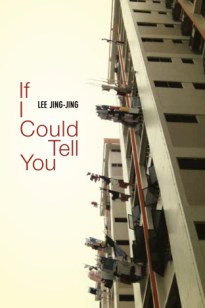
If I Could Tell You
Lee Jing-Jing
Marshall Cavendish Editions 2013
Reviewed by Bob Wake
From neglected children and lost young adults, to the developmentally disabled and the forgotten elderly, If I Could Tell You is narrated by a wide range of multigenerational and multicultural voices. The setting for Lee Jing-Jing’s graceful debut novel is both exotic and excruciating: A condemned public-housing apartment building in Singapore. Most of its residents have been relocated. The skeleton crew of remaining occupants comprise “the old, the poor, people who have had trouble finding a new home.” The novel’s opening pages include a jumper from the upper floors lying dead on the pavement below.
The jumper’s death haunts the neighborhood if not the television news. “I guess it was much too ordinary,” muses a middle-aged unemployed electronics engineer, dismayed by the absence of media coverage. His thoughts return again and again to the tragedy. Soon his dreams are enveloped in apocalyptic imagery:
Then I was on the ground, below the block of flats, looking up while the building leaned to the right, tossing my wife and daughter out of the naked window. The building crashed to the ground like a felled tree, but slowly, silently, as if the weight of it was nothing more than a browned leaf, a scrap of paper. All the while, I just stood and watched and did nothing, my hands hanging by my sides, my feet heavy as rocks. The dream stayed with me the rest of the day. I could hardly look at my wife and daughter during breakfast.
Lee Jing-Jing. Photo: Marshall Cavendish Editions.
Lee Jing-Jing, currently living in Germany, has spoken in a newspaper interview about her public-housing upbringing in Singapore (the book’s cover photo, taken by the author, depicts a now-demolished block of apartments where her aunt once lived). While If I Could Tell You immerses us in poverty and broken lives, nothing here is sensationalized or made mawkish. The unwavering matter-of-factness of the storytelling yields enormous narrative and dramatic power as the novel unfolds.
Language barriers add to the isolation of some characters, such as an eighty-year-old Cantonese-speaking Chinese woman known in the neighborhood as “Cardboard Auntie” because she collects cardboard box scraps and sells them from a cart on the streets. Cardboard Auntie’s impoverished external life masks a roiling internal world of brutal memories (“Tch, I’ve seen worse. When the Japanese were here. Much worse”) and borderline delusional conversations with her deceased husband, whom she addresses as the Old One (“Old One, what do you want for lunch? Fan wat ze jook? Rice or porridge?”).
If I Could Tell You is not without a kind of mordant Hitchcockian humor: the jumper’s falling body is witnessed by multiple characters, often out of the corner of the eye, allowing the author to replay the gruesome event from a variety of subliminal perspectives (“something fell through the air, close enough that they felt and heard the whoosh as it went past them”). It’s a rare debut novel that’s written with such assured mastery of style and tone. The final pages give voice to a character whose despair is so complete that it would be unendurable for most of us. By focusing on the rich inner lives of its societal outcasts, If I Could Tell You tells us plenty: Lee Jing-Jing has written as fine a work of literary fiction as you’re likely to read this year.
Begin with the beckoning title of Wisconsin poet Sarah Busse’s Somewhere Piano. Within its pages, we find the eponymous poem doubling down and rechristened as “Somewhere Piano, Again.” It’s a poem about getting things right, not just on piano or paper, but in our heads:
These are the rehearsal rooms of the brain,
strangely echoed, some, and others
strangely dead. Wander once more
the narrow, ill-lit halls.
There’s no poetic triumphalism here. “Somewhere Piano, Again” suggests a painfully stalled dark night of the soul, a writer’s prayer for illumination:
Rehearsing and rehearsing
on the instrument of haunt, reversing again,
and overheard through walls, muffled,
a someone else, anonymous, not quite
in tune, remembered ever, trying
and trying (how much we want)
to get that passage right.
Busse is a rare species of writer: a secular poet of the sacred. She has found a language to illustrate the all-too-brief moments of revelation that sneak into our days, the instances of what theologian Jean-Luc Marion has called “saturated phenomena,” when we’re astonished by unbidden hints of connectedness. Busse’s poem “Flicker,” for instance, begins:
This morning a flock of flickers—flash of red,
flash of yellow at my feet—rose and flew
past the blue turkey-foot, the prairie dropseed.
The grasses nodded their purple heads, bronzed,
lazy in their affirmation … until the wind blew.
Although the moment evaporates in a September breeze, the poet’s own “feathered heart,” in the second stanza, has been altered by the experience: a quickened recognition of “how the honey locust / shivers down its gold and gilds my driveway …” By the third and final stanza, following the trail from prairie to driveway, the poet arrives home with a renewed reverence that continues to draw its airborne imagery from the bird flock seen that morning: “My children toss leaves up to see them / leap and fall and leap again, laugh and beg for more.”
Busse’s poems have the curious feature—not uncommon in religious poetry from Donne to Dickinson—of never quite being about what they presume to be about. Her work directs our gaze or our contemplation to something beyond the poem’s focus. She’ll grant you a stable ground outside your kitchen window, but then she’ll pull you seductively toward something chaotic and profound, undefined but ecstatically present at any given moment if we choose to engage it, take it on. Here, embedded within a poem framed around her eight-year-old son’s whimsical improvisations on the family piano (“To Robert Cabaste Wind on His Birthday”), a kind of cosmic disturbance invades the morning:
He is playing imagined music for
imagined listeners of imagined radio, the lit
windows of morning kitchens dot the hills
of the Driftless. The music launches,
and a coffee cup suspends, dishes
go unwashed, an argument hangs midair.
Eyes go vacant at the curious passages …
In the final stanza, mirroring her son’s improvised melodies, the poet/mother is inspired to improvise her own morning prayer or hymn, a suburban matins:
Blessings on the marriages of the morning,
blessings on the scrambled kids about to board buses,
the dogwalkers and garbage trucks and gardeners
who will let the music drift over and off
and get on with their variegated days …
Sarah Busse
Busse in the last few years has gained recognition as a tireless proselytizer for poetry, especially in her roles shared with fellow Wisconsin poet Wendy Vardaman, as co-editor of Verse Wisconsin and Cowfeather Press. Verse Wisconsin found its voice—or, to be accurate, voices plural, as in “multitude”—when in the thick of the winter 2011 labor protests in Madison, the magazine’s Facebook page became a living anthology of poets old, new and spontaneously birthed, reacting in real time to a historic political crisis. In January, 2012, Mayor Paul Soglin appointed Sarah Busse and Wendy Vardaman to a four-year term as Madison’s Poets Laureate.
While two chapbooks preceded it—Quiver (Red Dragonfly Press 2009) and Given These Magics (Finishing Line Press 2010)—this is Busse’s first full-length collection. The real success of Somewhere Piano’s diverse and rich selection of 47 poems can be measured by the fact that Busse’s chilling 2012 Pushcart Prize-winning poem, “Silhouettes,” an account of a home-invasion and sexual assault, is but one example of the high level of artistry on display throughout Somewhere Piano.












 Coffee Spew