The Unexploded Ordnance Bin
Rebecca Foust
Swan Scythe Press 2019
Reviewed by Bob Wake
Rebecca Foust’s The Unexploded Ordnance Bin is a ferocious work of poetry. The chapbook’s title and ominous cover design (by artist Lorna Stevens) connote urgency and dread. Its thirty poems, touching on a variety of charged topics and poetic forms, all share Foust’s fierce intelligence, sharpened wit, and an abiding reverence for the natural world and our place in it. The title poem begins like a Hitchcock movie about a family excursion that turns darkly comic with menace:
our son found the hollow shell
snub-nosed & finned
& looking like an Acme cartoon bomb
where we raked for clams
he wanted to keep it
& we wanted to let him
An author’s note chillingly informs us that U.S. coastal regions “harbor millions of pounds of dumped munitions” from military training exercises. The family in the poem visits the local police station to dispose of the shell. The mother is left discomforted. A chain-reaction of metaphors follows. She is haunted by her son’s autism and wonders “what it would look like / the bin for safe disposal of genes / that can ruin children.” These lines pack the kind of gut-punch that Rebecca Foust’s work never shies away from. She has addressed her son’s autism in poems over the years, at times with grace and understanding, and at other times with cosmic fury.
A triptych of poems, “spec house foundation cut into ridge,” “The Deer,” and “Vehicular” depict the effects of environmental and habitat destruction. Readers might be familiar with the experience of being behind the wheel of a car and striking a deer on a highway or rural road. “The Deer” slows down the moment of impact like a forensic examination of the Zapruder film:
It came mid-sentence, the blow so nearly not a blow, the light
shattered and flung into the fog, scattered shards
blooming chrysanthemum then dissolving away,
a Roman candle illuming the night
In the poem titled “after the dream act is revoked,” the refrain of “what can i do” begins a process of assessing our privilege and our community (“the people / I know are mostly decent / if catatonic with abundance & consumption & god / & their screens”). The prognosis is grim: “when will we admit the pogrom is here.” Some of the strongest work in The Unexploded Ordnance Bin focuses on the human cost of our immigration policies. “Requiem Mass for the Yuma Fourteen” memorializes the fourteen Mexicans who died of exposure in 2001 while trying to cross the Arizona desert into the United States. The poem is a villanelle, a classic form distinguished by its incantatory repetition of phrases. The rigor of the form combines with Foust’s unadorned language to create a biblical evocation of grief. The opening three stanzas:
Beyond the border they could smell the rain. It smelled like freedom. Freedom and home. The desert composes its requiem.
The oldest was sixty, his grandson thirteen.
One wore new jeans, one carried a comb. Beyond the border they could smell the rain.
They got lost, then they lost their water. The sun
was a furnace blast. Dust. Thirst. Delirium, the desert composing its requiem.
As Foust showed in her 2015 book-length sonnet sequence, Paradise Drive, she is skillful at linking poems thematically. The third, and final, section of The Unexploded Ordnance Bin returns to family with a series of deeply personal poems on gender and identity charting her now-adult daughter’s transgender journey. “Shall I mourn one, seeing the other?” she asks in “Moon.”
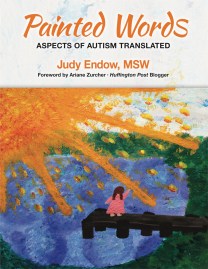
“Working 13 years with students who are diagnosed with severe autism, my colleagues and I have often wanted to visualize and better understand what our students were seeing, feeling and thinking. Judy Endow’s Painted Words takes us on a picturesque journey into the mind of one autistic person through her vivid and breathtaking paintings and sculptures while also explaining in detailed description and poetry what she sees and, via sensory, how she experiences it. Helpful suggestions for working with individuals on the spectrum open a treasure box of insights. Having this ‘backstage pass’ into autism will be priceless for educators, parents and individuals on the autism spectrum.” —Joanna L. Keating-Velasco, educator, and author of A is for Autism, F is for Friend: A Kid’s Book for Making Friends with a Child Who Has Autism.
“Judy Endow combines her art, poetry, and prose to create a thought-provoking book of self-discovery that viscerally captures the essence of a world which only few experience—a world of subtle beauty that can turn too bright, loud, and overwhelming. The practical advice at the end of each chapter has helped me understand and be a better parent to my autistic child. Painted Words is a book to read, reread and share with other parents, educators, physicians, and therapists so they too can learn to appreciate the autistic experience. I’m buying it for all of my friends!” —Debra Hosseini, author of The Art of Autism: Shifting Perceptions.
“Judy gives us a compelling view into her world through words crafted on the page, connected with images that illustrate her experience of being autistic. She encourages the neurotypical world to change their perceptions and assumptions about people with autism, to ask ourselves questions. Painted Words challenges our thinking, leading us to examine beyond what we see on the surface. Your view of autism is bound to shift after experiencing autism through Judy’s words and paintings.” —Maureen Bennie, Director, Autism Awareness Centre, Inc. (www.autismawarenesscentre.com).
“By sharing her paintings and poetry in Painted Words, Judy Endow provides rare insight into a person with autism, including her heightened sensory awareness, her need to establish predictability, her social needs, and much more. This captivating book tempts the reader to learn more about the uniqueness of autism and its neurological impact. Judy shares her experiences, asks thoughtful questions, and challenges the reader, by putting words and visuals to her early childhood. She provides her vision of the world, and her perspective will flood you with emotions and leave you looking through fresh lenses at those with autism. Painted Words is a wonderful gift to us so-called neurotypicals. We may very well feel like we are the ones that are lacking and, thus, not measuring up. Using her own words, I summarize Judy’s contribution with this book by saying, ‘The girl her mastery shows!’” —Danette Schott, M.A., executive editor, special-ism.com.
“Judy Endow has long been one of my finest and clearest teachers when it comes to understanding autism. In Painted Words, Judy takes me into a new, deeper comprehension of her experience of autism using the mediums of poetry, prose and visual expression via her paintings. Her strong activist voice takes no prisoners, requiring me to examine how my own neurotypical arrogance can be a contraindicator in forming relationships with those in my life with autism. This strength is juxtaposed by the clarity of Judy’s paintings, which provides both visual representation and softness, entering my consciousness in a manner completely different than the words that accompany and explain. Judy’s ability to use her own experience to provide ideas and strategies for working with others is a treasure which she shares in each section of the book. Painted Words is a book that will appeal to autistics and neurotypicals alike, as we move forward to bridge the differences in how we experience the world to forge relationships and create better lives for those we love with autism.” —Kate McGinnity, M.S., educational consultant, and co-author of Walk Awhile in My Autism and Lights! Camera! Autism!.
“Judy Endow’s Painted Words is a sensitive and beautiful portal into a life lived with autism. Through evocative paintings and poetry, Judy explores her own experiences and offers invaluable advice to parents, teachers and other professionals who work with people on the autism spectrum. This heartfelt book sparkles and glitters. Highly recommended.” —Jeanette Purkis, author of Finding a Different Kind of Normal: Misadventures with Asperger Syndrome.
“Judy Endow’s Painted Words is an immersive, artful, and educational experience in understanding autism. Judy reveals her autistic neurology or ‘operating system’ by showing her way of perceiving, thinking, and learning. Painted Words is a step up from autism awareness. It is about understanding and accepting diverse minds.” —Jill Jones, filmmaker, currently researching and producing a documentary about autism and sensory perception (www.spectrumthefilm.com).
“Judy has brilliantly demonstrated her skill as a writer and an artist who proudly lives and loves autism. Her candid words and stunning art light up the spectrum as an example of the endless potential of all autistic people.” —Malcolm Mayfield, specialist/consultant, founder of Autism STAR (Autism Spectrum Training, Advocacy and Recruitment), www.autism-star.com.
“Painted Words takes the reader on an unforgettable journey far beyond written text—to a place where visual imagery dances with poetry to provide an intimate understanding of the world of an autistic. Judy Endow’s powerful use of personal art work, poetry, and written text is a must read for every professional working with individuals on the spectrum.” —Ellen E. Eggen, MS LPC ATR-BC, Art Therapist, Director of Planning and Operations, Common Threads Family Resource Center, Madison, Wisconsin.
“What a wonderful book! In combining her talents in both writing and the visual arts, Judy Endow has given us an intimate look into her life with autism that is informative, engaging, beautiful, and thought-provoking. I cannot tell you how much I enjoyed this book.” —Peter Gerhardt, Ed.D., Director of Education, Upper School for the McCarton School, and the Founding Chair of the Scientific Council for the Organization for Autism Research (OAR).
“Judy reveals her unique sensory experience in this generous and compassionate offering. Here, as always, her words provide keys to understanding the autism experience. Yet more remarkably, Painted Words reveals her experience through pristine and seminal art images that open the autism experience in ways that words cannot. The vivid colors and textures of her art invite us into her experience. Her ability to define crucial aspects of the autism experience is matched by precise suggestions to guide neurotypical connection and relationship with persons with autism. I hope Painted Words helps you listen and see with new eyes. Prepare to leave misguided conceptions of autism behind you.” —John B. Thomas, M. Ed., educational consultant, and a principal author of TEACCH Transition Assessment Profile (TTAP).
“Painted Words is an especially valuable book because it weaves together, in a single volume, the prose, poetry, art and sculpting skills of the author with autism demonstrating how they interlink, interact and complement each other. That is an interesting experiential venture in its own right. But the book doesn’t stop there. Additionally, the ‘Considerations When Working With Others’ section at the end of each chapter provides very useful and practical advice distilled from all of the above. These useful hints, tips and pearls are easily understood and applied, put forth in a very reader friendly fashion, for anyone wanting to better understand the differences between autistic and neurotypical thinking and behavior.” —Darold Treffert, M.D., author of Islands of Genius: The Bountiful Mind of the Autistic, Acquired and Sudden Savant, and a consultant on the movie Rain Man (www.savantsyndrome.com).
About the Author
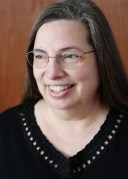
Judy Endow
Judy Endow, MSW, is an author and international speaker on a variety of autism-related topics. She is part of the Wisconsin DPI Statewide Autism Training Team and a board member of both the Autism Society of America, Wisconsin Chapter and the Autism National Committee. In addition, Judy works with the Autistic Global Initiative (AGI), a program of the Autism Research Institute. She maintains a private practice in Madison, Wisconsin, providing consultation for families, school districts and other agencies. Besides having autism herself, she is the parent of three now grown sons, one of whom is on the autism spectrum. Judy’s website is www.judyendow.com.
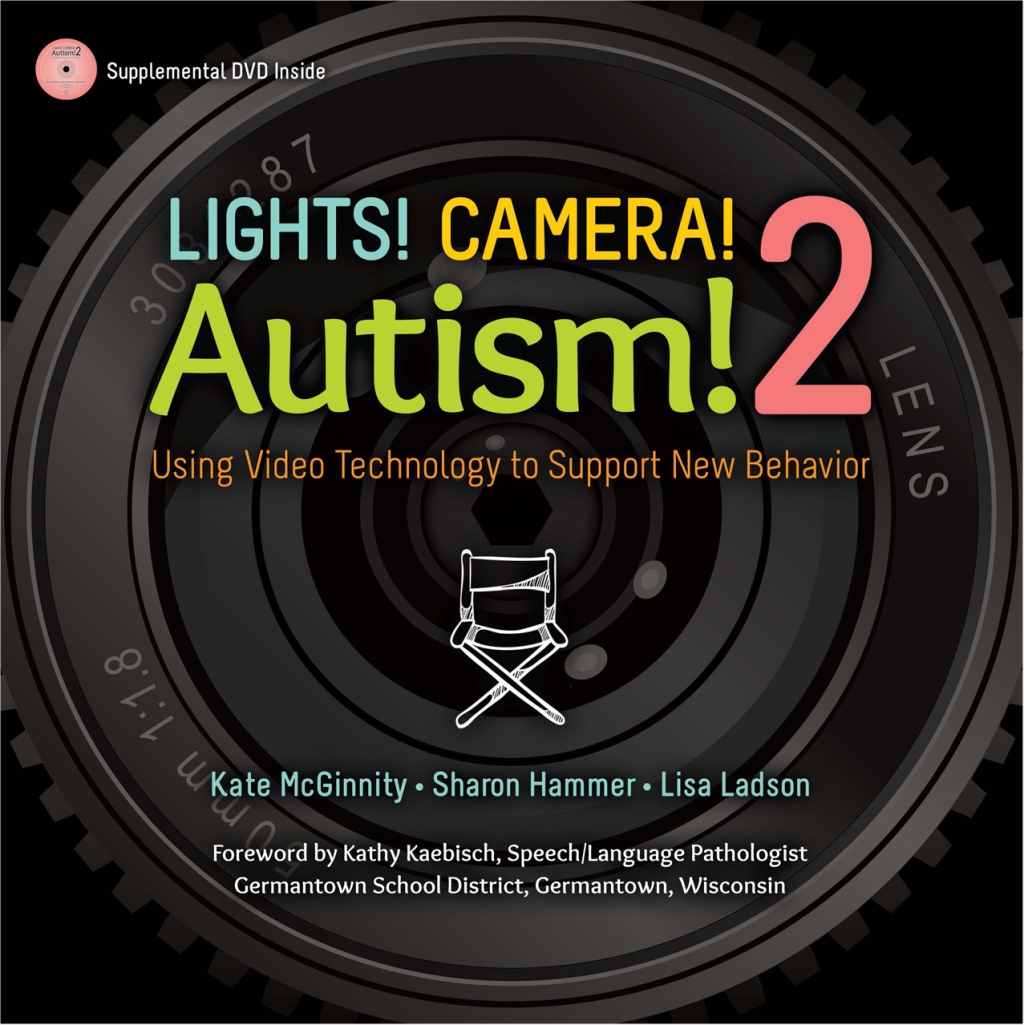
“Lights! Camera! Autism! 2 will help educators and parents alike, and support an environment that is proactive and based on each individual’s strengths and needs. The solutions are proven to be successful. I couldn’t wait to go back to my district and share the book with staff and parents.”—Brian Johnson, Student Services Director, Columbus School District, Columbus, Wisconsin.
“Lights! Camera! Autism! 2 is a gift without measure to parents at any stage of their autism journey. A few minutes spent reading and watching and I was able to create a tool that lifts my son’s anxiety, sorts out some of the confusion he faces, and enables both of us to feel successful. This is a resource I will share with every person who plays a role in my son’s life.”—Rebecca Williams, former elementary school teacher, and proud mom of an incredible, unique, loving, and challenging autistic son.
“There is something powerful that happens when the brain gets to watch the body doing something right. The learning sinks in. New behavior sets up with speed. McGinnity, Hammer and Ladson provide concrete examples for helping people ‘see’ better ways to behave by showing us concretely how to improve our instruction.”—David Pitonyak, Ph.D., consultant for people with challenging behaviors and the needs of their friends, family and caregivers (www.dimagine.com).
“These videos offer an innovative way of training people with special needs to encounter new situations. One of the many challenges people with autism and other disabilities face is how to encounter the ‘unknown’ and generalize social rules across situations. Video is a great platform to help a person understand what a new environment will be like, whether it be a new school, a camping trailer, or a playroom.”—Stephen Hinkle, national speaker and disability rights advocate.
“Lights! Camera! Autism! 2 offers tangible and doable approaches to break out of the way things have always been done. Teachers, parents, and individuals with autism have everything to gain from bringing these tools to life.”—Tamar Jacobsohn, MS Ed, autism program support teacher with over 20 years’ experience in early childhood special education.
About the Authors
Kate McGinnity is an experienced classroom teacher and trainer, and nationally recognized consultant in the field of autism.
Sharon Hammer is a master’s level psychotherapist with over 15 years’ experience working with individuals on the autism spectrum.
Lisa Ladson is an educational and behavioral consultant with extensive knowledge in creating innovative intervention programs for students with complex learning challenges.
“Paula Kluth has done it again! A lively, practical and engaging how-to book on creating inclusion. Her focus is on all of us, teachers, students, staff, principals, district and community members, reminding us that inclusion, as with all social justice, is about joint action and commitment. Tons of practical ideas and examples presented in her inimitable style. Hurrah!”—Anne M. Donnellan, Ph.D., Director of the University of San Diego Autism Institute; Professor Emerita, University of Wisconsin-Madison.
“Paula Kluth’s enthusiasm is contagious and the structure of her new book is revolutionary.”—Barbara Buswell, Executive Director, PEAK Parent Center, Colorado.
“Implementation science at its best. Paula Kluth reminds us of the importance of regularly revisiting our mission to create schools where everyone belongs.”—Mary C. Schuh, Ph.D., National Center on Inclusive Education, Institute on Disability, University of New Hampshire.
“An outstanding guide, packed with strategies and tips. Paula Kluth has created a remarkable resource for schools and communities that want to renew or improve their inclusive practices.”—Nicole Eredics, Inclusion Specialist (www.theinclusiveclass.com).
Dr. Paula Kluth is a consultant, author, and advocate dedicated to supporting inclusive education in preschool, elementary, and high schools. Paula is a former special educator who has served as both a classroom teacher and inclusion facilitator. She is the author or co-author of numerous books on inclusive education including, “You’re Going to Love This Kid!”: Teaching Students with Autism in the Inclusive Classroom, and “A Land We Can Share”: Teaching Literacy to Students with Autism. Visit her website at www.paulakluth.com.
First Time in One Volume: Leary and Donnellan’s influential works on autism and sensory-movement differences
“If we follow the lead offered here we will not only have a model of the discipline we must cultivate, we will also have the support of people with disabilities as full partners in the difficult search for better understanding. Leary and Donnellan carefully note anomalies, irregularities likely to be ignored or explained away in routine practice: irregularities such as the many accommodations people with disabilities and those who care about them have invented beneath the notice of the professionals who ordinarily control their treatment. The authors rigorously deconstruct the myth of mental capacity.”—John O’Brien, author (with Connie Lyle O’Brien) of Members of Each Other: Building community in company with people with developmental disabilities.
“The trend of our best work in behavioral difficulties has been to move from coercion and control to understanding and accommodation. Martha Leary and Anne Donnellan have made a crucial advance with their groundbreaking research.”—Herbert Lovett, author of Learning to Listen: Positive approaches and people with difficult behavior.
About the Authors
Martha R. Leary, MA, CCC-SLP, is a Speech and Language Pathologist who has learned from people with autism and their supporters and their families for over 30 years. She has lectured extensively in the United States, Canada, Ireland, Australia and England. Her highly acclaimed writings with David Hill, Jodi Robledo and Anne Donnellan, present alternative ways of viewing the symptoms of sensory and movement differences which may affect our understanding of people with communication differences and unconventional behaviors. Martha continues to learn from people with unusual support needs. She consults with people and their teams through organizations that focus on personalized positive supports.
Anne M. Donnellan, Ph.D., is a Professor in the School of Leadership and Education Sciences at the University of San Diego as well as Professor Emerita at Wisconsin-Madison. A long-time member of the Professional Advisory Panel of the Autism Society of America, she is also on the Board of the Autism National Committee and active with TASH. She has published some 100 books, articles, chapters and monographs and has lectured throughout the world. She is currently co-host of the Frontiers in Integrative Neuroscience special issue, Autism: The Movement Perspective. Her career spans over 40 years of training, research, and advocacy work on behalf of children and adults with communication and behavior challenges.
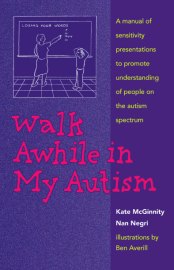
Walk Awhile in My Autism by Kate McGinnity & Nan Negri has been a consistent seller for CBR Press since the book’s publication in 2005. Over 3,500 copies have been sold through workshops and online. We’re pleased to announce that Walk Awhile in My Autism is now available as a Kindle ebook from Amazon.com.
“A must for every parent, every professional and every child who lives with autism. Buy it. Read it. Love it.”—Anne M. Donnellan, Ph.D., Director of the University of San Diego Autism Institute, and Professor Emerita, University of Wisconsin-Madison.
“I especially liked the quotes from people with autism, Planet Autism, and the visual, auditory and tactile exercises to simulate the sensory problems of people with autism. The main thing is all the exercises people can do so teachers, parents, and others can experience how a person with autism senses and feels the world.”—Temple Grandin, Associate Professor of Animal Science at Colorado State University, and author of Emergence: Labeled Autistic, and Thinking in Pictures.
Using video technology to enhance lives. Supplemental DVD included.
“Lights! Camera! Autism! challenged me with its many rich ideas, clear and compelling examples, and positive and ever-encouraging voice. It is not only a user-friendly guide, it is also a call to action. Throughout the book, the authors quietly suggest that we think differently about autism and about support. They also show us how to calm, support, encourage, teach, and challenge students with this one simple tool and they compel us to use it often and widely.”—from the Foreword, by Paula Kluth, Ph.D., author of You’re Going to Love This Kid!: Teaching students with autism in the inclusive classroom.
“This is an amazing book. The authors do what so many in the autism industry fail to do: they nest their suggestions in a solid understanding of the literature on sensory-movement differences that people with autism tell us circumscribe their experience and their performance. From iPads to iPhones, Flip videos to skyping, social networking to TV shows, they guide us through example after example of ways to use technology to truly personalize supports and accommodate the unique needs of individual learners in real life situations.” —Anne M. Donnellan, Ph.D., Director of the University of San Diego Autism Institute; Professor Emerita, University of Wisconsin-Madison.
“It is essential for self-advocates, professionals and family members to have consistent access to learning technology information that is evolving faster than one can keep up with. This person-centered, wonderful book clearly accomplishes just that. I couldn’t put it down and you won’t either. Lights! Camera! Autism! heralds a new realm of achieving learner participation in the classroom and the community.” —Patrick Schwarz, Ph.D., National-Louis University, Chicago, author of From Disability to Possibility: The power of inclusive classrooms, and co-author with Paula Kluth of three books, You’re Welcome, Just Give Him the Whale, andPedro’s Whale.
“A must-have for all who want to work with, rather than work on, people with autism differences, supporting them to be all they wish to be in this world. Lights! Camera! Autism! explains how to use the power of visual technology across environments in an easy to read, pick-up-and-implement format.” —Judy Endow, MSW, author of Making Lemonade: Hints for autism’s helpers, and Paper Words: Discovering and living with my autism.
“Arguably the most extensive, readable, and clearly written book on using video technology for individuals on the autism spectrum.” —Jane Pribek, parent, and Events Coordinator, Autism Society of Wisconsin.
“An invaluable reference tool and guide for anyone wanting to support and empower individuals with autism at home, in school, and in the community.” —Michael D. Shoultz, Ph.D, educational and behavioral consultant with more than 30 years of experience in the field of autism.
God, Seed: Poetry & Art About the Natural World
Rebecca Foust and Lorna Stevens
Tebot Bach 2010
Reviewed by Bob Wake
Lavish is the word that comes to mind when beholding God, Seed: Poetry & Art About the Natural World (Tebot Bach, 2010) by poet Rebecca Foust and artist Lorna Stevens. Well established in their respective mediums, Foust and Stevens’ collaboration in God, Seed is one of those felicitous combustions of text (forty-three poems) and illustration (thirty full-color images) that result in a brilliant hothouse hybrid.
Readers should prepare themselves for sensory overload if not an outright short-circuit when experiencing a two-page spread of, say, Stevens’ lush eye-popping watercolor of a parsimmon opposite Foust’s sensual accompanying poem, “Parsimmons” (“ … rich river pudding, plush and pulp, / soft-slide swallow delight / and sweet, sweet”).
Conversely, later on, we are chilled to the bone by Stevens’ austere black brushwork depicting galloping bison that mimics the timeless mysteries of a prehistoric cave drawing. Foust’s chastising poem is “Last Bison Gone” (“We love what we love / in the scientific way, efficient, empiric, / vicious, too much …). Thus are the contrasting poles of God, Seed established: rapturous pleasure in nature’s bounty on the one hand, while, on the other, rapacious misuse and abuse of all that humanity surveys.
Rebecca Foust’s poetry has always struck at the heart of hard truths. Her first two tough-minded chapbooks (consecutive winners of the Robert Phillips Poetry Chapbook Prize in 2007 and 2008) were reviewed favorably in our online pages. Dark Card, Foust’s debut, shook a righteous fist at doctors and gods alike for the plight of her son, diagnosed with Asperger’s syndrome. Mom’s Canoe, the follow-up, bracingly recaptured the poet’s own childhood growing up in the depressed strip-mining region of western Pennsylvania.
Although ostensibly casting a wider impersonal net in God, Seed, it is a testament to Foust’s raw unflinching truth-telling that a poem like “Frog”—about genetically mutated amphibians in a PCB-poisoned pond—spirals instead toward the son whom we remember from Dark Card:
Still, sleeping,
I dreamt of my son,
his genes expressed
not as autism, but as
four thumbs on two
extra hands
and I want to blame
someone. I want
to drain that pond.
God, Seed respects and encourages full immersion in the world—politically and personally—an attainable if too often lost connection to our surroundings. The poem “Now,” for instance, erases all borders between our bodies and nature’s enraptured seasonal rebirth: “… places in the body’s uncharted waters, new worlds / lying green and deep off winter’s bow // and now, spring. Bone-ache thaw, wind sough / through snow-scoured woods, bud swell …”
And yet, lest we fall prey to the ecstasy of hubris, the final poem in Foust and Stevens’ God, Seed, “Perennial,” gives nature the last word by writing us out of the picture altogether: “When you’re gone, it won’t matter to the musk rose / twining the old trellis over the eaves. Willow / will continue to pour her yellow-green waterfall // next to forsythia, one half-tone better on the scale / of bright …”
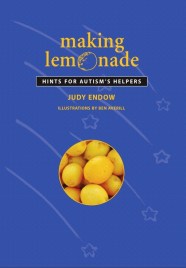
Cambridge Book Review Press author Judy Endow (Making Lemonade: Hints for Autism’s Helpers) was recently profiled in the New York Times. Story includes photos and an audio interview. Congratulations, Judy!
A significant article in the latest issue of Disability Studies Quarterly, “Rethinking Autism: Implications of Sensory and Movement Differences” by Anne Donnellan, David Hill, and Martha Leary, cites two of our Cambridge Book Review Press titles: Walk Awhile in My Autism (2005) by Kate McGinnity & Nan Negri, and Making Lemonade: Hints for Autism’s Helpers (2006) by Judy Endow.



 Coffee Spew