“The G.O.D. Club” is a new short story by Dwight Allen, author of two novels, Judge (2003) and The Typewriter Satyr (2009), and a collection of short stories, The Green Suit, reissued in 2011. Bonus features of this exclusive ebook single from Cambridge Book Review Press include an introduction by Wisconsin State Journal columnist Doug Moe, and an afterword by novelist and poet Dale M. Kushner (The Conditions of Love). Also included is “The Thread of It,” an excerpt from Dwight Allen’s memoir-in-progress.
“The unnamed loss, the unspoken terror in ‘The G.O.D. Club’ is the loss of time itself.”—Dale M. Kushner, author of The Conditions of Love.
Larry Watson at the Wisconsin Book Festival 10/19/11.
Opening night of the 10th annual Wisconsin Book Festival featured a lively reading/Q&A with Milwaukee-based novelist Larry Watson (Montana 1948, American Boy) and Madison novelist and short story writer Dwight Allen (The Green Suit, The Typewriter Satyr) at the Madison Museum of Contemporary Art. Novelist Mary Gordon, who was scheduled to join them, had to cancel due to an airline delay, although it was promised that she’d be at the festival for a reading the following evening. Watson read from his just-released American Boy(Milkweed Editions), a coming-of-age novel set in fictional Willow Falls, Minnesota in 1962. The title might suggest a Young Adult novel, but American Boy isn’t so easily categorized. It’s suffused with the volatile sexual tension and barely suppressed violence that mark Watson’s best work. (I’ll be reviewing the novel in an upcoming issue of Wisconsin People & Ideas.) [Update 1/31/12: my review of American Boy is now posted on the Wisconsin Academy website.]
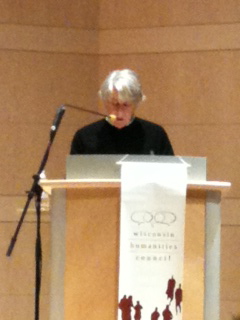
Dwight Allen at the Wisconsin Book Festival 10/19/11
Dwight Allen read the opening pages of his mordantly funny short story “Succor” from The Green Suit, a collection first published in 2000 and just reissued, with an added story, from the University of Wisconsin Press. “Succor” concerns an unlikely friendship that develops between Allen’s recurring character, Peter Sackrider (whose perfect name manages to suggest both a lewd euphemism and the mopey bemusement with which Sackrider views the world), and a disreputable force-of-nature named Larry Hale, who may or may not have stolen a necklace belonging to Sackrider’s wife. Props to Allen for mentioning during the Q&A that he recently read and enjoyed David Foster Wallace’s posthumous novel, The Pale King. He also candidly admitted an inability to get beyond the first three-hundred pages of Wallace’s woolly-mammoth masterpiece, Infinite Jest, a novel which, Allen felt, exemplified “the limitations of brilliance.”
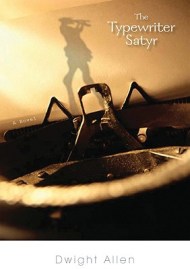
Dwight Allen writes meticulous, witty fiction about dysfunctional underachievers. The dual protagonists of his funny and warm new novel from the University of Wisconsin Press, The Typewriter Satyr, are two rudderless ships colliding in the night. Oliver Poole, middle-aged typewriter repairman, and Annelise Scharfenberg, thirtyish community radio show host, seem at first to share little in common aside from fragile befuddlement. Set in a pastoral make-believe Wisconsin town called Midvale (hilariously mirroring Madison’s blend of corporate pragmatism and pothead eccentricity) during the escalating indignities of George Bush’s second term of office circa 2004, Oliver and Annelise’s love affair is neither inevitable nor remotely convenient for either individual. Oliver is already married with four sons and Annelise is a survivor of childhood sexual abuse. The abuse angle is more than a little daring on Allen’s part, especially given that no less a talent than John Irving was defeated by similarly queasy material at the center of his 2005 novel, Until I Find You. Irving’s approach was fetishistic and muddled with slapstick, which felt grotesque and out of place. Allen, on the other hand, has struck the perfect tone, respectful of his characters and his readers, and bringing depth to the narrative instead of derailing it. The Typewriter Satyr, like Allen’s short story collection, The Green Suit (2000), and his luminous first novel, Judge (2003), is beautifully constructed storytelling that’s built to last.


 Coffee Spew