Book critic Stephanie Bedford in The Capital Times (week of Jan. 4-10) pens some wonderfully trenchant remarks about Rod Clark’s Redshift: Greenstreem (now a CBR Press ebook):
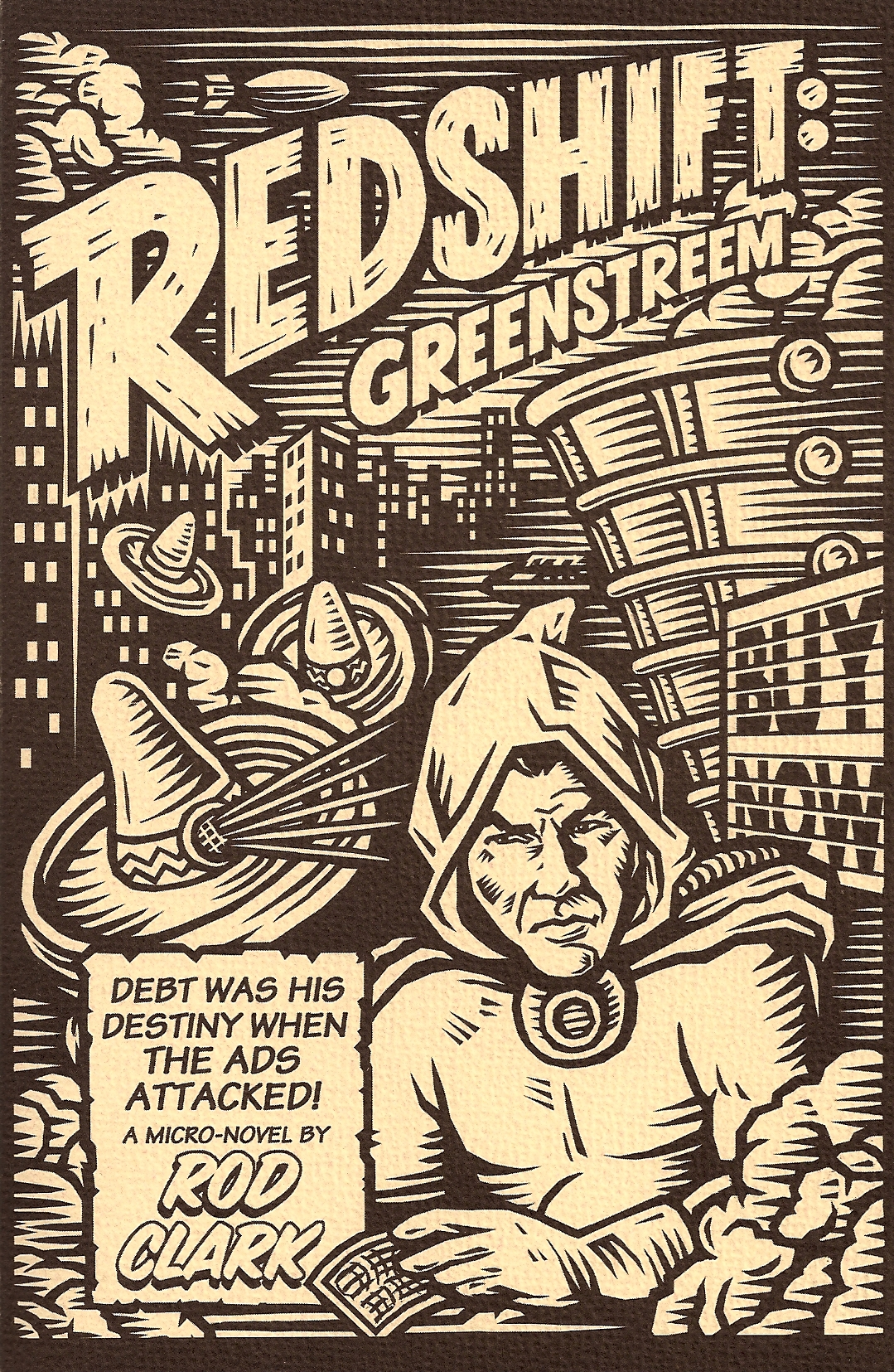
Cambridge’s CBR Press has just reissued the short, punchy and funny sci-fi “micro-novel” Redshift: Greenstreem by Cambridge resident Rod Clark. First published in 2000, it’s an unapologetically geeky piece of futuristic sci-fi set in 2093 Los Angeles, in a world where what we quaintly refer to as “the 99 percent” have been enslaved by debt and inflation. These consumer drones inhabit “Redshift,” an area where their whimsical desires, fanned by a constant stream of advertising, can be transformed against their will into binding agreements to purchase. Redshift presents a satirically exaggerated dystopia, but one that pointedly resembles our own here and now. Wonky appendices hark back to other sci-fi classics like 1984 and A Clockwork Orange, but Redshift is more intent—if only slightly—on tickling your funnybone than giving you nightmares.
We’ve been alerted to some incisive remarks about Rod Clark’s Redshift: Greenstreem (now a CBR Press ebook) from writer and literary translator Brett Alan Sanders. The latest issue (51) of Rosebud includes an excerpt from Sanders’ translation of Passionate Nomads by Argentinian novelist Maria Rosa Lojo. Here’s what else Mr. Sanders found in Rosebud 51:
It also contains Appendix I and Appendix II from Clark’s science fiction “micro-novel” Redshift: Greenstreem, originally published in 2000 and just re-issued by the Cambridge (WI) Book Review Press. (It is available from the publisher and from amazon.com.) The book is being touted as “a minor cult classic,” and having just purchased and read a copy I can see why. It has much to say about the present economic crisis (about which it is highly prescient) and about the need for something like the Occupy Wall Street movement that is currently sweeping the nation. Say what you will about the merits of these occupations, the need for concern that they highlight—over the wildly increasing gap between rich and poor both at home and abroad—seems hard to seriously question. Maybe, by some creative mix of rhetoric and protest, we can still save our children and grandchildren from the ill fate prophesied in Clark’s dystopian narrative.
Rod Clark joined us this morning for coffee and a recording session. Listen as Rod shares a young boy’s perilous shopping adventure from his sci-fi micro-novel Redshift: Greenstreem. First published by CBR Press in 2000, Rod’s dystopian tale of hyperinflation and grocery store products that stalk customers like prey, feels more real and scarier than ever. Redshift: Greenstreem is now available in a 2011 second-printing, and as a Kindle ebook.
Rod Clark 11/17/11
Jem had never been in a “real” store before, and the store knew a rookie customer when it saw one. As he slid his goggles to his forehead to see clearly in the gloom, the glittering tiles lit up beneath his feet, and a thousand soft hooks reached for his eyes. Rainbows of choice wove radiant tentacles about him! How could the severe Saver exchange malls wreathed in black crepe have ever prepared him for this? JUST KEEP MOVING, KEEP MOVING, DON’T LET YOUR EYE REST ANYWHERE, he told himself, walking firmly down the aisle toward the seemingly distant and unreachable counter. But the dreams were stacked so thick and bright on the shelves; it hurt not to reach out and touch them. Bright bottles of soda with their implicit promise of fun-filled romps with laughing girls, menthol cigarettes pitched by tinnily singing penguins holostitched on the cartons. KEEP MOVING! JUST KEEP MOVING!, he thought. But narcotic lollipops in myriad flavors leaned toward him like flowers toward a rare beam of sun. Bottles of cheap gin and mescal featuring skimpily clad sirens of several genders invited him to an afternoon of debauchery, cheap blue packets of cockroach editing software gave confident promise of virtual pest control, and rows of laundry soaps emanated their sweet and sickly perfumes, strangling him softly in a paradise of fluffy towels and sun-drenched sheets.
The lemon yellows and sweet purples of the packagings made him dream of synthetic blossoms—lawns of artificial grass, fanned by a climate-controlled breeze under a fluorescent sun. Meadows of cool, quick, sweet feeling spread in front of him, lands where true joy and real pain were equally impossible—landscapes looking into sunlit kitchens that were somehow everybody’s kitchens, full of always happy faces and endless platefuls of the world’s most delicious waffles. Mmm! Looked pretty tasty—especially the frozen ones with the pink bunny doing somersaults on the box, and perhaps … NO! NO! JUST WALK TO THE COUNTER! LOOK AT NOTHING! TOUCH NOTHING! FEEL NOTHING!
Rosebud 51 is smokin’ hot off the press and ready for readers and coffee tables. Order the issue direct from the Rosebud website. Worth owning alone for the cover art and inside illustrations by Wisconsin watercolorist Geri Schrab. But there’s so much more: 144 pages of fiction, poetry, and art. “Go Figure” drollery from New Yorker cartoonist and Rosebud regular P. S. Mueller (“The town’s electricity is distributed from a large ceramic-looking wire thrusting out of what everyone calls ‘the Founder’s Rock’ in the basement of the old City Hall”). “Afterwords” comic strip from another Rosebud regular and former National Lampoon cartoonist Rick Geary. Editor Rod Clark’s “Voice Over” column with a grassroots homage to mowing the lawn (“Now and then I glance up to see a turkey vulture circling high above me. Does he imagine me to be a wounded animal nearing my final gasp?”). Fiction from Rosebud founder and editor-at-large John Lehman, and from Hugo Award-winning writer Kristine Rusch. And let’s just say: tons more stuff. Including, dear family and friends, my short story “Summer of the Cinetherapist.”
Rosebud readers of issue 51 can also look forward to excerpts from Rod Clark’s scarily prophetic sci-fi micro-novel Redshift: Greenstreem, first published in 2000 by Cambridge Book Review Press and now available in a 2011 second printing and as a Kindle ebook. And here’s a deal that no one should pass up: Anyone subscribing or re-subscribing to Rosebud can get a copy of Redshift: Greenstreem by putting “I WANT MY RG” on the note with your Paypal order at www.rsbd.net or in a letter with your check to: Rosebud, P.O. Box 459, Cambridge, Wisconsin, 53523.
First published in 2000 by Cambridge Book Review Press, Rod Clark’s Redshift: Greenstreem is now available in a 2011 second-printing, and as a Kindle ebook. Not one word has been changed from the book’s first edition. Clark eerily predicted much of our collective fate since the turn of the millennium. Redshift: Greenstreem is visionary science fiction that has come frighteningly true in the decade since it was written. The future is now. Here are the facts.
∞
News Item (4/9/09): Greenspan’s reputation continues to decline: “He’s a historical relic at this point” [1].
Redshift: Greenstreem (p. 47): “Greenspan’s predictions and admonitions were taken seriously by many millions of important people and actually influenced economic history, just as prophecies plucked from the entrails of chickens by the Oracles influenced the destinies of city states in ancient Greece. His power declined, however, in the wake of the economic crises that erupted during the first decade of the new millennium. Shortly thereafter, modern theories of greenflow gained ascendancy, and the power of the Federal Reserve rapidly faded away.”
∞
News Item (7/18/11): The Tea Party National Committee / The Sins of Federal Debt: “This is the horrifying consequence of America’s sinful addiction to federal debt: Young Americans are waking up into adulthood to the heart-stopping realization that they have been sold into debt to such organizations as the Communist Party of China …” [2].
Redshift: Greenstreem (p. 20): “Smiling, sincere, so very, very Christian Gary [Bauer] who had ridden smugly into the White House in the year 2016 on the slogan ‘DEBT IS PUNISHMENT FOR OUR SINS.’ ”
∞
News Item(6/19/11): China’s ghost towns: New satellite pictures show massive skyscraper cities which are STILL completely empty [3].
Redshift: Greenstreem(pp. 29-30): “Upstairs, outstairs, into the endless night, leviathans folded and unfolded on distant moons, carving labyrinths in inanimate rock, unrolling real estate plats on ancient asteroids, inexplicably building airless condominiums by the thousand on the uninhabitable wastes of Uranus and the moons of Jupiter, constructing skyscrapers on Saturn and vast complexes on Venus that had no known purpose, and often did not function at all—only to rip them down, and start again.”
∞
Spencer Walts illustration from “Redshift: Greenstreem.”
News Item (8/30/11): Suitcase Nuclear Reactors to Power Mars Colonies [4].
Redshift: Greenstreem(p. 49): “The first experimental macroset was created by Engineer Jack Dougal McCool in 2042. He called it a ‘factory in a suitcase’ or FIS …”
∞
News Item (8/30/11): Clive Thompson on the Problem with Online Ads: “Consider Facebook: Each year, it redesigns its site to gradually nudge users to make more and more of their material public. This is partly because CEO Mark Zuckerberg seems to think publicness is inherently good—but it’s also a rational response to the demands of the ad market, which needs as many people looking at as many things as possible” [5].
Redshift: Greenstreem(p. 15): “ … [D]reemwaves … bathed the planet since early in the 21st century when the triple ‘M’ (mesmeric microwave merchandizing) consortiums had begun inserting microscopic holo-projectors and speakers in the texture of virtually every manufactured item in the solar system to leverage the power of advertising.”
∞
News Item(1/8/10): Making Fortunes in Milliseconds: “It’s called high frequency trading (HFT), but it’s also described as algorithmic trading or quant trading” [6].
Redshift: Greenstreem (p. 31): “A positive rivulet of solvency could only be generated by anchoring vats of biosentient or AI investment software to the arcane task of constantly buying assets every fraction of a second, letting their value amplitude rise microscopically, and then almost instantly selling them, sometimes microseconds before they dissolved into nothingness—reinvesting the profits in commodities or securities that would be (for a few instants at least) of slightly greater value and duration.”
∞
New Item(3/10/11): An Introduction to Hyperinflation: “Imagine taking a road trip. At the start of the day, a can of soda at a convenience store costs exactly $1. By nightfall, that same can of soda costs $3. This sounds impossible, right? … Money can become essentially worthless …” [7].
Redshift: Greenstreem(p. 20): “Glancing down at the bill in his hand through gray-tinted goggles, he saw with dismay that digital monetary decay was already in rapid progress. The inflationary readout on what had been a hundred-dollar bill only a few minutes ago was now down to ninety-six bucks and dropping.”
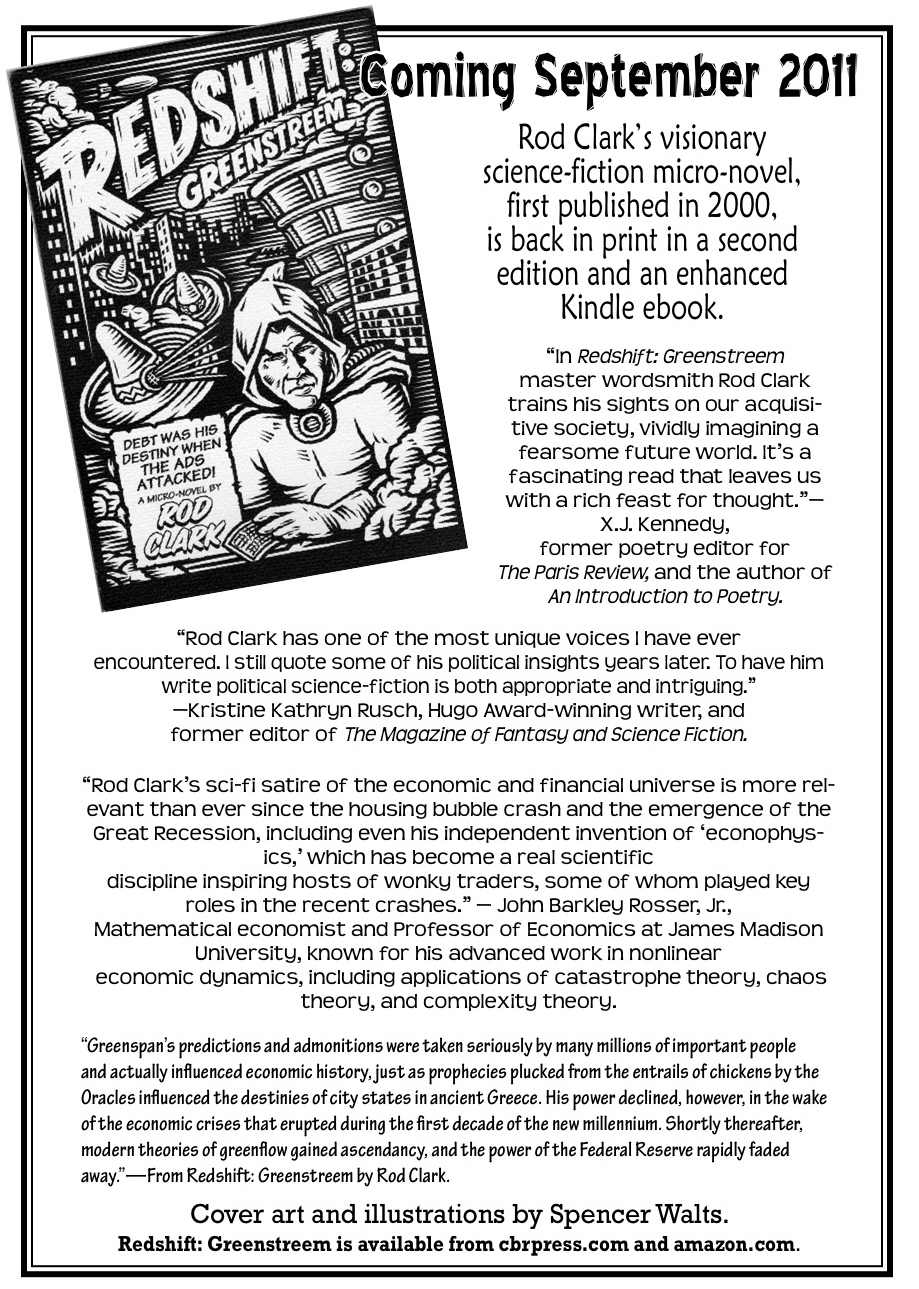
Rod Clark’s Redshift: Greenstreem with illustrations by Spencer Walts is now available in a Kindle edition for $2.99 and includes two bonus stories! The 2011 paperback second-printing is also available for $8.00 from PayPal and Amazon.



 Coffee Spew