Once Upon a Time in Hollywood: A Novel Quentin Tarantino Harper Perennial 2021
Reviewed by Bob Wake
Dwight Garner’s cautiously laudatory New York Timesreview of filmmaker Quentin Tarantino’s epic 400-page novelization of Once Upon a Time in Hollywood gets it right: “If it were written better, it’d be written worse.” Tarantino’s novel is pulp fiction best appreciated as a companion text, or better yet, a skeleton key to the movie. Lots of riotous untold backstory of how Hollywood stuntman Cliff Booth (played by Brad Pitt in the movie) comes by his casual proficiency with ultraviolence. There’s a deeper dive into Manson Family dynamics, perhaps not as nuanced as Emma Cline’s The Girls, but no less chilling. The novel even has its own surprise ending that cleverly subverts the movie’s surprise ending. There are seedy detours into Hollywood lore, including a poignant depiction of alcoholic actor Aldo Ray’s decline. Most enjoyable is the book’s torrent of geeky motor-mouthing film criticism, similar in tone to the engaging program notes that the director has been penning in recent years since purchasing the New Beverly Cinema in Los Angeles.
Eli Roth was unforgettable playing “The Bear Jew” in Inglourious Basterds, Quentin Tarantino’s audacious wish-fulfilling WWII epic that posited the successful assassination of Adolf Hitler. I just caught up with this: Roth’s father, who is a Harvard professor and psychoanalyst, wrote a thoughtful, surprisingly moving essay on the pride he felt watching his son onscreen “machine-gun the Fuhrer’s face to a bloody pulp.”
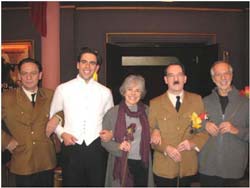
Photo and caption from patheos.com: “On the set of Inglourious Basterds (from left), Sylvester Groth, who played Josef Goebbels, Eli Roth in his character Donny Donawitz, Cora Roth, Martin Wuttke, who played Hitler, and Sheldon Roth.”
Versatile British film director Peter Yates gave Steve McQueen one of his defining roles as a laconic steely-nerved San Francisco cop in Bullitt (1968). Yates did something similar for an aging Robert Mitchum in The Friends of Eddie Coyle (1973), a film finally getting a long-overdue and much-anticipated DVD release. Rather than a signature role for an emerging superstar, the part of hardluck hood and Boston mob gunrunner Eddie Coyle is low-key and unassuming, ideally suited to Mitchum’s disaffected persona. Disaffection was Mitchum’s stock-in-trade, reflecting a kind of no-bullshit post-WWII cynicism and emotional guardedness. In his fifties when Eddie Coyle was made, Mitchum’s sagging jowls seem finally to have caught up with the smartass defeatism behind his jaded line readings. He appears in only a quarter of the film, but it’s a great performance that haunts the story even when he’s off screen. Call it a disappearing act. Mitchum disappears in the role and the role disappears in the movie, dimming in the end to darkness like a burnt-out taillight on a ’68 Ford Galaxie.
George V. Higgins’s 1970 novel—a stunning debut for the author, a former journalist and attorney who died in 1999 at 59—has only improved with age, a must-read for fans of the movie. Find a copy of the 2000 paperback reissue with Elmore Leonard’s introduction, in which he states flat-out that The Friends of Eddie Coyle is “the best crime novel ever written.” It’s also first-rate literary fiction. (One of the chapters originally appeared in the North American Review.) Higgins didn’t much care for being pigeonholed as a genre writer, as he discusses in his still relevant and useful 1990 writer’s manual, On Writing:
Regardless of whether you relish the prospect, every reader who encounters your prose, whether amateur (your friends and family) or professional (heartless editors if you’re unlucky, brilliantly insightful editors if you are blessed), with the first sentence will automatically commence the process of categorizing it, subjectively determining—often if not usually quite erroneously—where it belongs in the stream of current writing (I learned this the hard way: my first published book was categorized as a “hard-boiled detective story”—it was not—and most of the others since have been critically rated by reference to the same ill-chosen scale, thus neatly deflecting the general reader—the reader I have in mind—while deceitfully luring the crime-story addict. This leaves many in the first group cruelly deprived of acquaintance with my genius, many in the second group feeling themselves meanly bilked, and me with much smaller royalty checks than I would prefer to receive).
Higgins relied heavily on dialogue, seemingly naturalistic yet stylized wiseguy lingo, in a manner that would influence not only Elmore Leonard, but also David Mamet and Quentin Tarantino (who borrowed the name “Jackie Brown” from a character in Eddie Coyle).


 Coffee Spew