St. Martin’s Press edition (1962). Design: Tom O’Brien.
Pictured here is the cover to the 1962 St. Martin’s Press edition of Fisherman’s Beach by Wisconsin writer George Vukelich (1927-1995). Vukelich reprinted the novel in 1990 under his own North Country Press imprint, with a new cover, but using what appear to have been either the original printer’s plates of the inside pages or, more likely, newly shot photo-offset reproductions from the earlier edition. Cambridge Book Review Press is currently preparing an ebook edition of Fisherman’s Beach for release in spring 2012. The ebook will include a new introduction (by a Madison notable and Vukelich friend who we’re keeping a surprise for a while longer). Also included will be photos of Two Rivers, Wisconsin, where the novel is set, by fine arts photographer Thomas J. King. There’ll be additional supplemental material in the ebook, as well, such as a biographical sketch of George Vukelich by James P. Roberts, and a study guide that should make Fisherman’s Beach perfect for reading groups and classrooms.
Here’s the inside jacket copy from the 1962 edition:
Old Man LeMere was dying upstairs. He was a tough old gull, but nobody lives forever. Downstairs, Roger, his second son, was waiting to inherit the fisherman’s beach. He could not afford to wait long. The lamprey eels from the ocean were destroying the trout of Lake Michigan, and the fishermen were powerless to stop them. Also he was afraid of Germaine.
Germaine was the eldest son. He had left the family and the Church. He was a major, stationed in Europe, who had come home for the first time in many years when he heard of his father’s illness. The Old Man wanted Germaine to take over the beach. Roger—ambitious, brutal, suspicious—knew it and would not believe that Germaine wanted no part of the inheritance. Nor would Roger believe that Germaine had not come home to reclaim Ginny Dussault, Germaine’s high school sweetheart who, despairing of Gemaine’s return, had allowed Roger to become her lover.
From these elements George Vukelich has woven a first novel of astonishing power. He is a poet and his descriptions of the changing seasons on the lake shore of his native Wisconsin are woven with a lyricism too seldom found in contemporary writing. He is also a keen student of humanity—its frailties and its strengths. Fisherman’s Beach gives an unforgettable picture of a family of strong characters, closely united yet at war among themselves.
And here’s the back cover author’s photo and bio:
Author photo of George Vukelich from 1962. No photographer credited.
Mr. Vukelich is best known in Wisconsin as “Papa Hambone,” a disc jockey with the top rated night-time program in the Madison area. He writes “I’ve become a split personality to further a writing career. ‘Papa Hambone’ buys the groceries, meets the mortgage payments and maintains the menage; George Vukelich simply tries to write the best first novel of which he is capable.” George Vukelich also spent a year as a creative writing instructor at the University of Wisconsin, and another as a merchant seaman. His poetry and short stories have been published in many magazines, including The Atlantic Monthly and Botteghe Oscure.
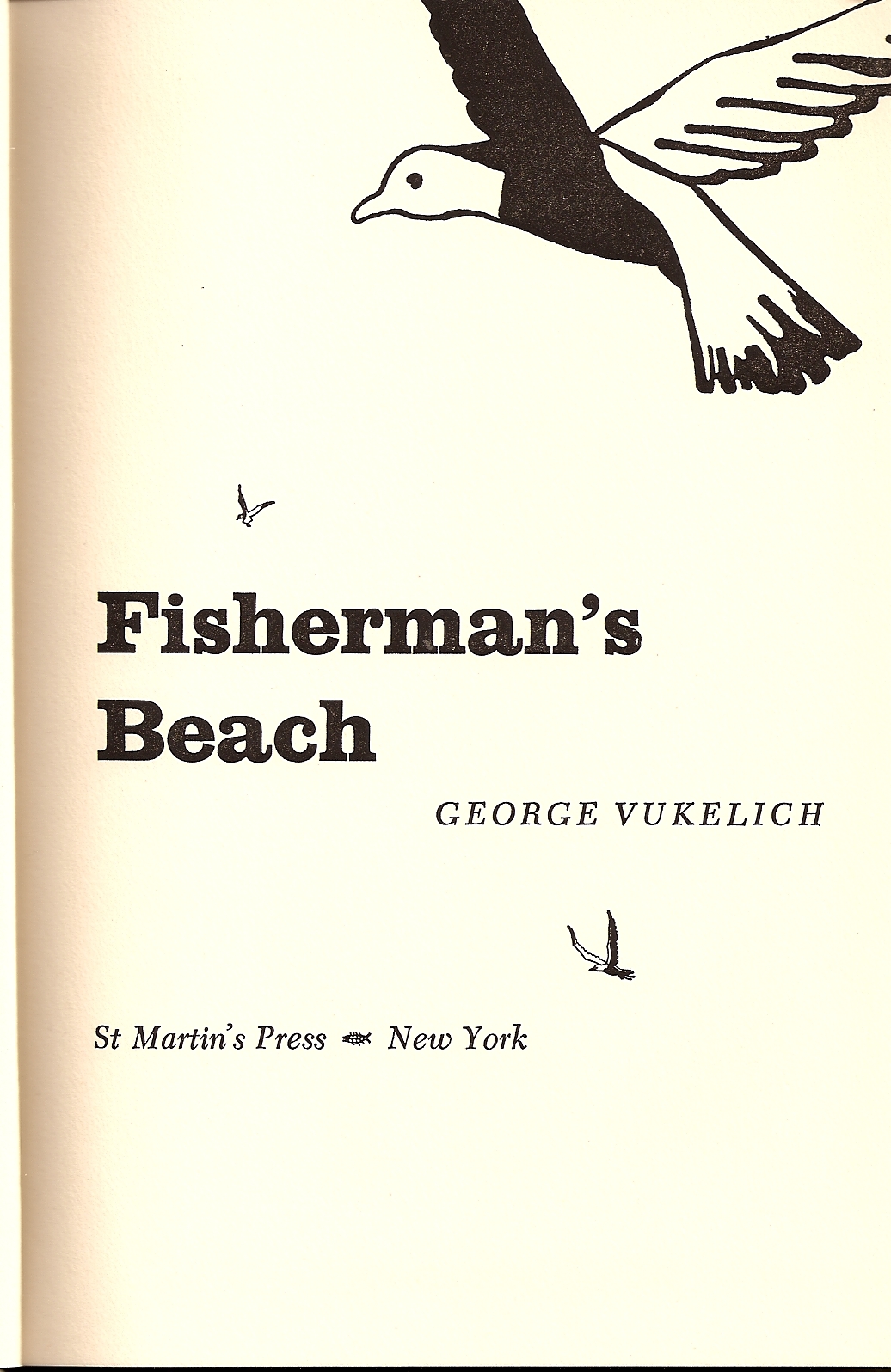
Title page: North Country Press 1990.Title Page: St. Martin Press 1962.
Cover to the 1990 reprint edition published by Vukelich’s North Country Press.
Cambridge Book Review Press is delighted to announce that digital rights have been secured to publish a Kindle ebook edition of Fisherman’s Beach, the masterful novel by the late Wisconsin author and long-time Madison newspaper columnist and radio-host George Vukelich (1927-1995). Originally published in 1962 by St. Martin’s Press, Fisherman’s Beach is a remarkably assured debut novel charting the postwar struggles of a Catholic fishing clan in Two Rivers, Wisconsin. The family is headed by a dying patriarch, Old Man LeMere. Often at odds with his Irish wife, his five sons, not to mention his doctor and his priest, LeMere represents a tradition and moral force that seem to be breaking down around him. Writer August Derleth, with whom Vukelich studied following a stint in the Merchant Marine during the Second World War, said that Fisherman’s Beach is “one of the best family novels of our time—not the family novel that moves from one generation to another … but the novel that is the portrait of the family seen at a time of crisis.” Vukelich’s sturdy naturalism has kept the novel’s style timeless and fresh. And in its depiction of a family business battling state politicians over fishing rights, Fisherman’s Beach touches on an all-too-contemporary Wisconsin theme: political power and its abuse.
Watch for Fisherman’s Beach in ebook format coming in spring 2012 from Cambridge Book Review Press.
[Update 10/9/11: Read Doug Moe’s Wisconsin State Journal column about CBR Press and the origins of the Fisherman’s Beach ebook project.]
[Update 4/10/12: Fisherman’s Beachebook now available!]
Talk about a catch of the day. How about netting 175 remaindered copies of George Vukelich’s masterful 1962 Wisconsin novel, Fisherman’s Beach, selling for ninety-eight cents each on the bargain table at the UW Bookstore at Hilldale in Madison. Originally published by St. Martin’s Press, the novel was reprinted in 1990 under Vukelich’s own North Country Press imprint, which is the edition UW Bookstore is selling.
It seems likely that Vukelich, who died in 1995 at 67, had access to St. Martin’s original printer’s plates. There’s a striking use of pen and ink seagull silhouettes on the cover, title page and chapter headings, as well as a small fish icon beside each page number. It’s the kind of elegant layout and textual design that was common enough in 1962 when publishers had in-house graphic designers, but seems like a classical lost art form today.
The story of a struggling Catholic fishing clan—Old Man LeMere, his wife, and five sons—on the shores of Lake Michigan, Fisherman’s Beach manages vivid characters across generations and is written in an assured naturalistic style that hasn’t aged and probably never will:
They spent half an hour getting the tug ready for the run out to the fish grounds. Out of the shanty gear shack came the empty fish boxes they hoped to fill by noon. Raphael and Gabriel lugged these aboard while Roger gassed up the tug and Germaine carried out the foul-weather gear. They moved quickly, quietly, anxious to have the joework over with and be underway. Once they cleared the dock, they could relax and smoke during the seven-mile run back up the coast to the nets. Now there were hundreds of pounds of ice to be put aboard and steel oil drums into which they could fling the trout guts when they cleaned them on the way back. The offal would be sold to the area farmers. It wasn’t much but every little penny helped now.
The plot is set in motion when the oldest son, 35-year-old Germaine, returns home to Wisconsin from living abroad after the Second World War. Unbeknownst to his family, Germaine is a widower with a 5-year-old daughter. Old sibling rivalries resurface. A former girlfriend—currently dating Germaine’s brother Roger—enters the picture. The family business is threatened by politicians in Madison considering legislative limitations on commercial fishing.
Nestled within the larger narrative of Fisherman’s Beach is a beautifully evoked coming of age tale of ten-year-old Reuben LeMere. It’s a chilling moment when Reuben receives a 22-calibre rifle for his eleventh birthday, and, tiring of target practice with tin cans, begins “to want to kill something.” In the grip of bloodlust, he recklessly fires at seagulls overhead.
Then he jerked the trigger and the rifle moved a little and the wind carried away the noise of the shot so it sounded almost flat. The gull he had aimed at was still flying and starting to sweep away and he knew he had missed. He pulled back the bolt and the empty smoking shell spun out, end over end: he could smell the smell of burnt powder. The shot didn’t seem to scare the gulls away although most of them had risen now and were twisting over the rocks like pieces of paper caught in an air current. He had loaded up and was aiming again when he heard the shout. He lowered the rifle. It was a big dark man in a blue shirt leaning out of a window in the lighthouse and hollering at him. The wind was blowing away most of what the man was saying but Reuben could hear two words very clearly. “Goddamn you!” the man was yelling. “Goddamn you!”
Fisherman’s Beach is George Vukelich’s only novel. He had a long career as a journalist and essayist and radio host in Madison. He published two strong collections of his essays, North Country Notebook, Vol. I (1987) and Vol. II (1992). There’s a useful biographical sketch of Vukelich in James Roberts’ 2002 book, Famous Wisconsin Authors (online at Google Books).





 Coffee Spew