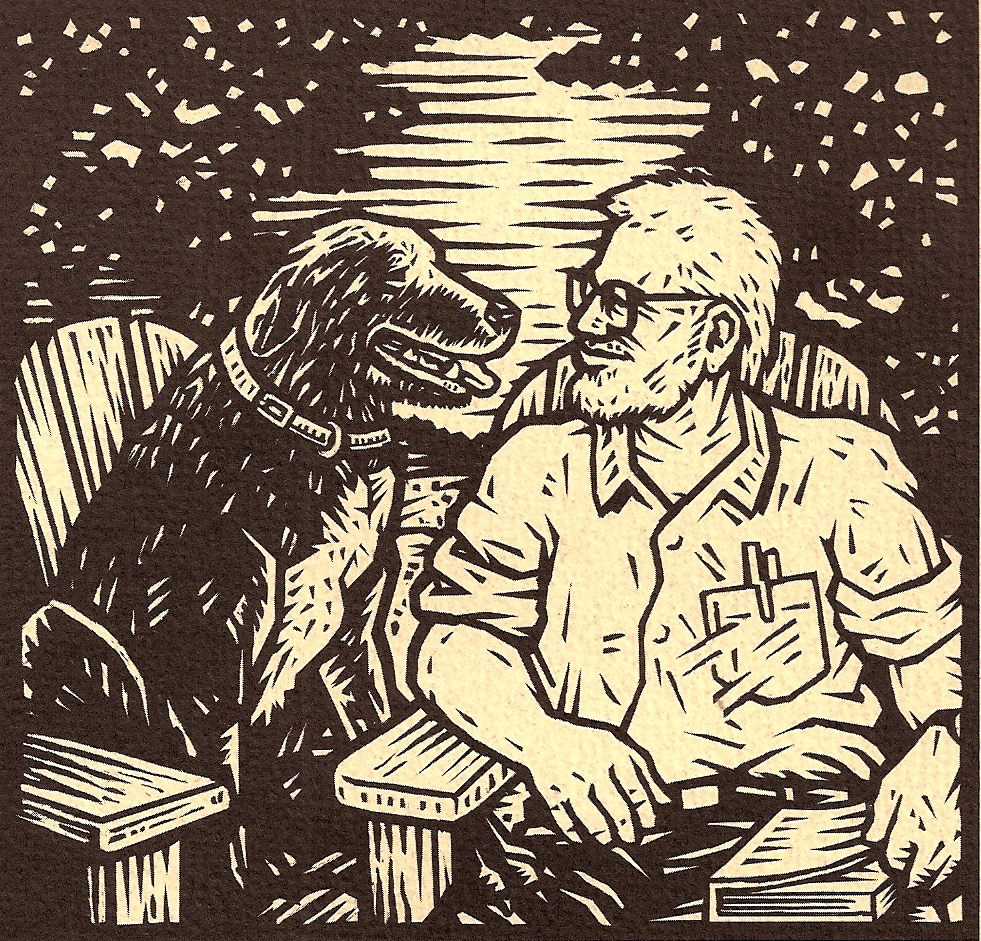
Sketch of poet John Lehman by artist Spencer Walts, from the back cover of Shrine of the Tooth Fairy.
We’re celebrating the release of the ebook edition of John Lehman’s poetry collection, Shrine of the Tooth Fairy, first published by Cambridge Book Review Press in 1998 with illustrations and cover art by Spencer Walts. John stopped by for coffee this morning and we recorded him reading from the collection. Here’s “Clark Street Rag”:
Clark Street Rag / John Lehman
On a night that shadows make tents
of backrooms a streetcar strums
past the cemetery
on the corner of Clark and Wilson
as Harold the Upholsterer
eyes a 1911 D penny,
the air in his shop suffocating
as a worn cushion—
dusty, warm, smelling of mold.
“I lost this,” he says and points
to a left ear chewed past the lobe,
“in a fight to a guy
who vomited so hard he died …
with the help of a pen knife.”
Floorboards creak in the vacant
apartment above.
Harold runs his thumb along the
counter’s glass edge.
He is a Pharaoh with a jeweler’s lamp
and the moon’s rays trapped
in his tomb.
“Four dollars.”
It twists from his mouth, a sound
like dry leather,
to the boy with an envelope
clutched in his hand.
And my heart plays banjo
to a city of small deals!
Spencer Walts illustration from Shrine of the Tooth Fairy.
John Lehman stopped by this morning for coffee and audio. We’re celebrating the release of the Kindle ebook edition of John’s poetry collection, Shrine of the Tooth Fairy, first published by Cambridge Book Review Press in 1998. The ebook includes Spencer Walts’s wonderful illustrations. Here’s John earlier today reading “Del’s Supper Club”:
Del’s Supper Club / John Lehman
They used to sit on car hoods
along the beach
or turn radio knobs and cigarettes
and watch the coil
of sun go out
and wait
for distant rumblings,
for the smell of lightning
from across the lake.
Now they applaud
tumbles
of liar’s dice
in a leather cup—
white shirt, short sleeved men,
who might sell appliances or tires
their wrist hairs coil
so smoothly
over chainlinked bands.
Laughter barks
from gesturing hands.
They caress a party glass
with a pin-up in a dress
that disappears
behind ice and gin
as the incandescent sign
through an open window’s screen
blurs
into a lipstick blot,
red taffeta,
eye glass frames of plastic bone.
They drift to midnights long ago
when bodies slid from clothes
and in the river glided over rocks,
their fingers slipping into moss,
while pines reeked, overripe
as rotting cantaloupe.
They hesitate,
alone,
at urinals,
with feet raised on rails at bars,
and in parking lots
at the door handles of their cars,
listening
to a green strand of neon
snap.
Spencer Walts illustration from Shrine of the Tooth Fairy.
Happy Holidays from Cambridge Book Review Press. We’ve dropped the price on Shrine of the Tooth Fairy, John Lehman’s wide-ranging collection of poetry, first published in 1998 with illustrations by Spencer Walts. For a limited time, the $8.00 paperback will be available for $2.99. John’s stopping by the CBR studio this week to record some Tooth Fairy audio that we’ll be posting soon. Plus, a Kindle edition is on the way!
~
Survey of Teachers’ Sexual Fantasies / John Lehman
Phys Ed
When we moved away
from our old house
I left a magazine
of naked women
with pillowy breasts
hidden in the attic.
We stopped at a motel
with an indoor pool
that smelled like warm semen.
My parents stayed
in their room,
drank bourbon.
I dove again and again
through clouds.
Home Ec
Once she had a boy
in her classroom.
He sat slouched in the corner.
“His eyes glowed,” she said,
“like that back left burner
I just turned off.”
She thought his bare arm
looked like baking sponge-cake.
She touched it.
It was greased metal.
Assistant Principal
It tastes so good
don’t ever try it
even once.
English
The fish’s belly—
slippery smooth,
whiter than the neck
under a girl’s long hair—
is kissed
purple, red, yellow,
and blue
by the lamprey’s bite.
Metal Shop
I love a good truck.
Art
I was married to a man
who once was my student.
He, not I, could have been
another Auguste Rodin.
I loved the way he listened
to my words when I talked,
and when he did
I listened to them too.
Mathematics
I’m going to drive
to Ann Arbor for a convention.
I like to go kind of slow
in my ranchwagon,
watch those women go by
alone in their cars.
I like the ones
with short black hair,
eyes bulging behind wire glasses.
Not cool blondes,
but new housewives
with buckteeth
who won’t look back.
Sometimes I’m late.
I forget, go too slow.
History
My young man died in Vietnam
pouring the foundation for
a village school by himself.
Shot. From bushes. His rifle
wrapped in plastic to keep it
clean, against a tree.
At nights—his lieutenant
was kind enough to write—
he had been digging a well
by hand with a shovel.
The officer wondered if
it weren’t a sort of grave.
But I know. Stripped, sweating,
breathing hard in the dark,
he is burrowing home to me.
Janitor
Lock your doors and windows.
We don’t want trouble here,
if you know what I mean.
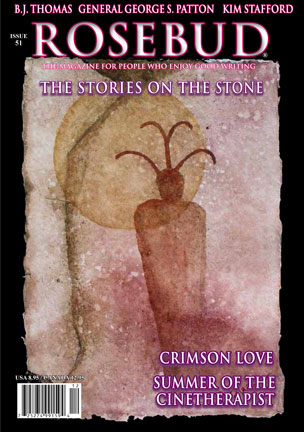
Rosebud 51 is smokin’ hot off the press and ready for readers and coffee tables. Order the issue direct from the Rosebud website. Worth owning alone for the cover art and inside illustrations by Wisconsin watercolorist Geri Schrab. But there’s so much more: 144 pages of fiction, poetry, and art. “Go Figure” drollery from New Yorker cartoonist and Rosebud regular P. S. Mueller (“The town’s electricity is distributed from a large ceramic-looking wire thrusting out of what everyone calls ‘the Founder’s Rock’ in the basement of the old City Hall”). “Afterwords” comic strip from another Rosebud regular and former National Lampoon cartoonist Rick Geary. Editor Rod Clark’s “Voice Over” column with a grassroots homage to mowing the lawn (“Now and then I glance up to see a turkey vulture circling high above me. Does he imagine me to be a wounded animal nearing my final gasp?”). Fiction from Rosebud founder and editor-at-large John Lehman, and from Hugo Award-winning writer Kristine Rusch. And let’s just say: tons more stuff. Including, dear family and friends, my short story “Summer of the Cinetherapist.”
Rosebud readers of issue 51 can also look forward to excerpts from Rod Clark’s scarily prophetic sci-fi micro-novel Redshift: Greenstreem, first published in 2000 by Cambridge Book Review Press and now available in a 2011 second printing and as a Kindle ebook. And here’s a deal that no one should pass up: Anyone subscribing or re-subscribing to Rosebud can get a copy of Redshift: Greenstreem by putting “I WANT MY RG” on the note with your Paypal order at www.rsbd.net or in a letter with your check to: Rosebud, P.O. Box 459, Cambridge, Wisconsin, 53523.
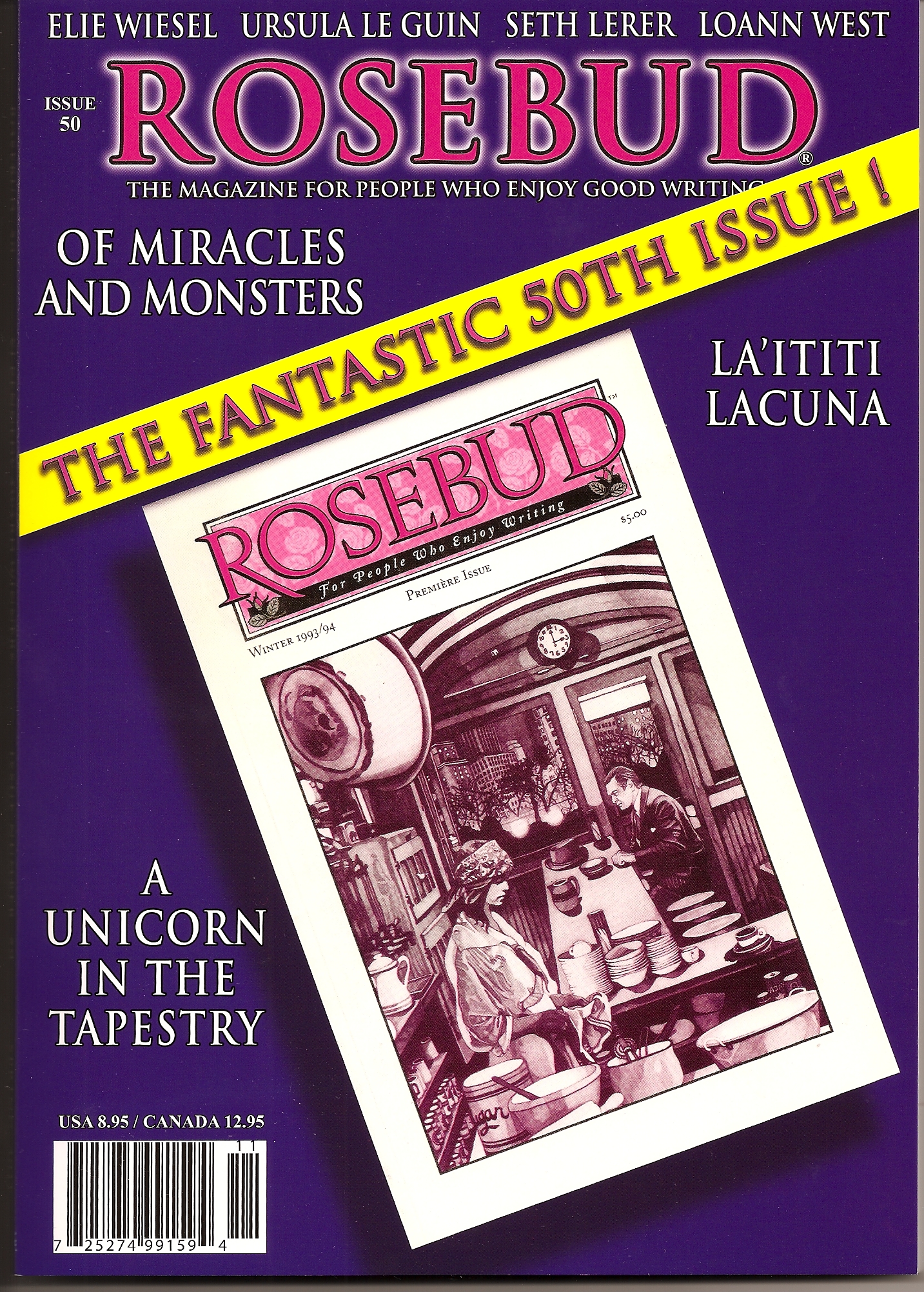
Rod Clark stopped by this morning with the much anticipated fiftieth issue of Rosebudmagazine. Congratulations are in order. Certainly to Mr. Clark and his tireless editorial helmsmanship. To graphic designer Parnell Nelson. To associate publisher John Smelcer. To founder and editor emeritus John Lehman. And to the general excellence—past and present—of the magazine’s contributors and its masthead personalities who have kept Rosebud running and the quality unwavering since the inaugural winter 1993/94 issue. The 50th brings back the artist showcased in the first issue: the wildly original and often disturbing Wisconsin illustrator Dierdre Luzwick. There’s a wealth of new fiction, essays, and poetry. Known names like Ray Bradbury, Elie Wiesel, and Ursula Le Guin combine with new voices. Wonderful, too, to see contemporary Wisconsin poetry represented by work from Sarah Busse, Michael Kriesel, and Wendy Vardaman.
Wisconsin poet John Lehman recast my overtaxed vacationeer’s Facebook post as a Lehman “justified poem.” I’m deeply honored. (With apologies to the Steve Miller Band.)
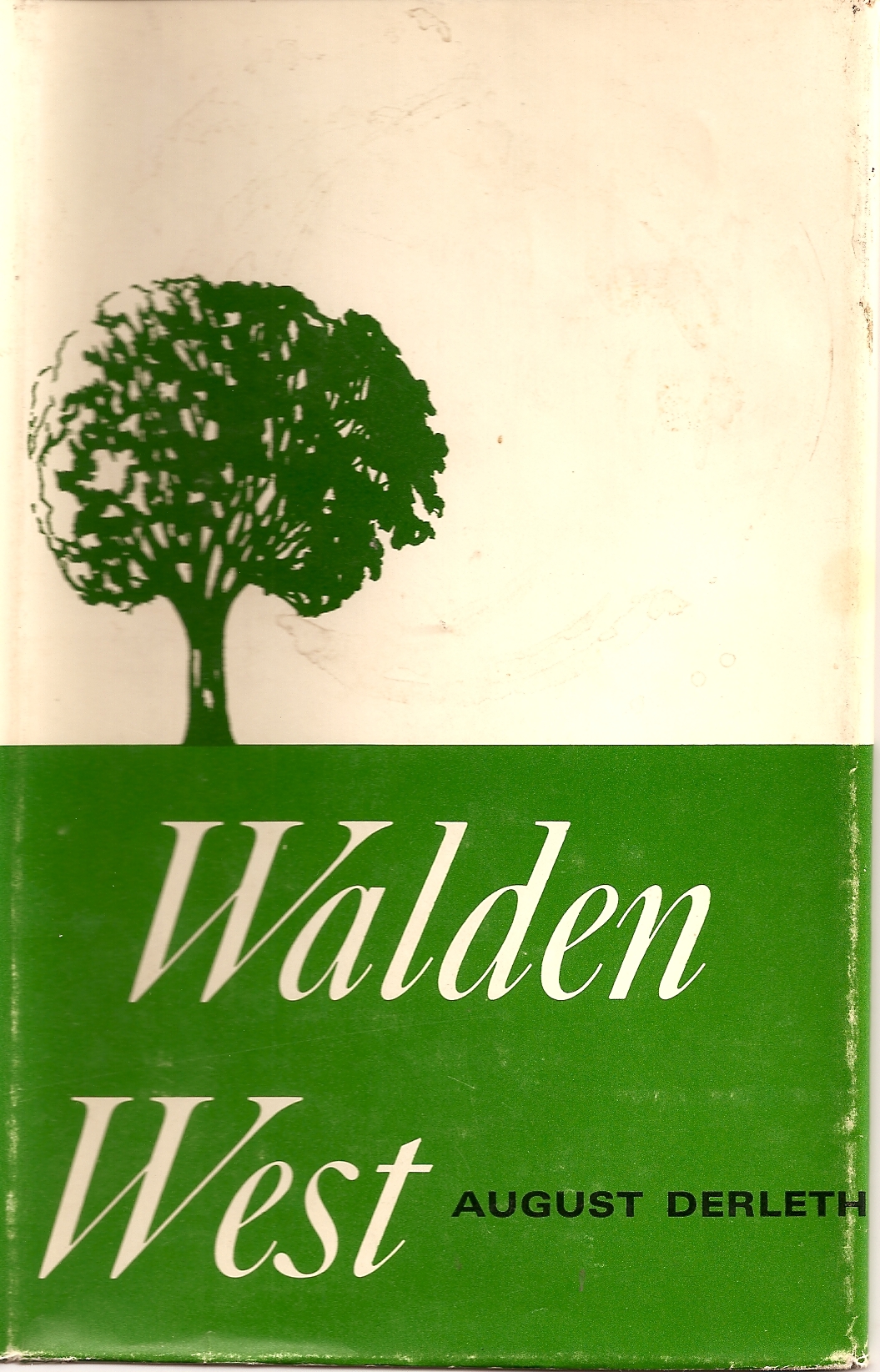
The current issue of Wisconsin People & Ideas (Winter 2011) includes my essay on August Derleth’s 1961 Walden West. The book is a portrait of the people and landscape of Sac Prairie, a lightly fictionalized composite of Derleth’s Sauk City hometown and the adjacent village of Prairie du Sac. It’s an evocative literary work that’s never really gotten its due. Here’s a brief passage from my piece:
In Walden West Derleth captures a small-town populace increasingly alienated from a natural world to which their rhythms are still connected. It is a book written by a stubborn, unapologetic regionalist, who, in 1961, seemed out of step with the forward-looking optimism and youthful vigor of John F. Kennedy’s New Frontier. While not outright ignored, Walden West was critically panned upon publication. “These sketches have little distinction, no particular chronology or unifying drama,” sniffed a critic for Kirkus Reviews.
My thanks to the magazine’s editor, Jason Smith, and literary editor, John Lehman. An earlier version of this essay won the Council for Wisconsin Writers Rediscovering Wisconsin Writers Award in 2004.
Today’s mail brought copies of the Elkhorn, Wisconsin Popcorn Press anthology, The Hungry Dead, edited by Popcorn’s founder, Lester Smith. The delightfully disgusting cover was designed by Smith’s daughter, Katheryn. The collection is cool from several perspectives (aside from the fact that my poem “The Last Supper” is included). First, Lester solicited submissions during October via social networking platforms like Twitter and Facebook, as well as a sharp website, and then announced the chosen selections on Halloween with a mockup of the book ready for printing. Planning, executing, and printing a book this quickly is a crazy challenge, but the proof is in the blood pudding, as they say. The Hungry Dead is a classy production: sixty-five works of poetry and fiction from eighteen authors, including several well-versed Wisconsinites familiar to us such as John Lehman, Sarah Busse, Michael Kriesel, and Dead editor Lester Smith. The Hungry Dead is available from Popcorn Press and Amazon (you can peek at the contents with Amazon’s Look Inside the Book feature).
A terrific Saturday afternoon of good food and literary talk with small press publishers at Edenfred arts residency in Madison. The event was sponsored by Verse Wisconsin, a newly launched poetry magazine edited by Wendy Vardaman and Sarah Busse. The magazine is a reboot and redesign of Linda Aschbrenner’s much-admired Free Verse, which flourished for over ten years until Linda decided to pass the torch last year.
Wendy Vardaman and Sarah Busse were kind enough to spend a few minutes talking with Coffee Spew at Edenfred about their co-editorship of Verse Wisconsin:
Thanks is due Edenfred executive director David Wells for preparing a startlingly upscale gourmet lunch. See below for photos of the attendees:
Left to right: Jerry and Paula Anderson (Echoes), B.J. Best (Arbor Vitae), Sarah Busse (Verse Wisconsin), Rod Clark (Rosebud), John Lehman (The Village Poet).
Left to right: Linda Lenzke (Our Lives), Jeri McCormick (Fireweed Press), Ralph Murre (Little Eagle Press), Charles Nevsimal (Centennial Press), Erik Richardson (Signs and Wonders).










 Coffee Spew