In the Land of Men Adrienne Miller HarperCollins 2020
Reviewed by Bob Wake
An instant classic. Adrienne Miller was the fiction editor at Esquire magazine in the late-90s when she was still in her twenties. Crossed paths with Mailer, Updike, Bret Easton Ellis, Dave Eggers, and, the real subject of her book, David Foster Wallace, whom she edited (some of his best short stories appeared in Esquire, including “Adult World (I),” “Adult World (II),” and “Incarnations of Burned Children”), and with whom she shared a romance, off and on, for several years. It’s something of a lurid tell-all (one review is titled “Infinite Jerk”), but offers lots more about the era, its literature, its sexism, and the rise and fall of glossy magazine publishing at a time when the Internet was just taking hold. Miller chose not to talk with D.T. Max for his biography of Wallace, so the material presented here is largely uncharted and eye-opening. Her respect for Wallace as a writer is worshipful. The mind games she endured during their wildly complicated relationship are jaw-dropping. The richest, fullest portrait of David Foster Wallace that has so far appeared in print. Highly recommended.
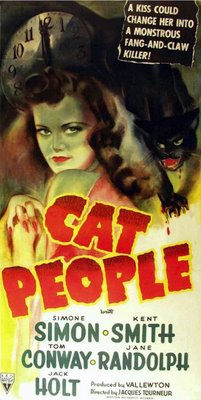
The original Cat People (1942), directed by Jacques Tourneur, is both an acknowledged classic of suggestive horror and one of the most famous Hollywood B-movies of all time. First in a series of low-budget RKO fright films produced by Val Lewton, Cat People became a surprise hit that saved the studio from near-bankruptcy following the failure of two iconic films that in their day were costly flops—Citizen Kane (1941) and The Magnificent Ambersons (1942)—directed by the mercurial boy-genius, Orson Welles. Lewton, while unpretentious by Wellesian standards, was no less hungry to make movies.
Cannily, Lewton found a creative path within the system by working fast and cheap. (And finding an economical use for abandoned sets like the ornate staircase from The Magnificent Ambersons that shows up in Cat People.) He’d been a deadline-driven journalist and pulp novelist. And before being offered his own production unit at RKO studios, Lewton worked his way up at MGM as an ambitious story editor and researcher. Cat People’s disquieting atmosphere of Old World otherness combined with New World dislocation can be traced in part to the European backgrounds of Lewton, born in 1904 in what is now Ukraine, and Tourneur, born the same year in France. The film evokes a haunted American melting pot of primitive mythologies and new-fangled superstitions (i.e., psychoanalysis) ill-equipped for securing one’s safety or survival in a modern impersonal cityscape. It should come as no surprise that after working with Val Lewton, director Jacques Tourneur (along with Cat People cinematographer Nicholas Musuraca) went on to make the influential film noir, Out of the Past (1947), which helped define the genre as doom-laden and populated with psychologically crippled outsiders and social misfits.
Cat People’s Irena Dubrovna (played by French actress Simone Simon) is an aspiring fashion designer of Serbian heritage living in New York City. Introspective and melancholic, she believes herself descended from a devil-worshipping were-leopard who survived an Eastern European witch-hunting pogrom in the 16th century. Irena finds herself drawn to the caged leopard in the Central Park Zoo. Her impromptu marriage to a marine engineer (Kent Smith) remains unconsummated because Irena fears that her own unleashed passion will destroy her husband just like, it’s implied, her mother may have killed Irena’s father in a sexual frenzy when Irena was conceived.
Val Lewton wrote a short story, “The Bagheeta,” published some 12 years earlier in Weird Tales magazine, about medieval villagers hunting a black leopard believed to be a were-beast capable of transforming itself into a beautiful woman of taunting, deadly sensuality. Which is to say, a kind of origin myth for Cat People’s folkloric equating of arousal with bestiality and bloodlust. The screenplay is credited to DeWitt Bodeen, although Lewton contributed heavily to its thematic construction and rewriting. Biographer Edmund G. Bansak, in his book Fearing the Dark: The Val Lewton Career, points to passages in “The Bagheeta,” such as the following, that clearly presage Cat People’s distinctive conjuring of fear and eroticized anxiety through the unseen:
Again he rode through the wood. Again he peered right and left for some sign of the beast, fearful always of seeing golden eyes glow at him from the pitch blackness of the night. Every rustle of the wind, every mouse that scampered on its way, flooded his heart with fear, and filled his eyes with the lithe, black bulk of the Bagheeta, stalking toward him on noiseless paws. With all his heart he wished that the beast would materialize, stand before him, allow him opportunities to slash and thrust and ward. Anything, even deep wounds, would be better than this dreadful uncertainty, this darkness haunted by the dark form of the were-beast.
Simone Simon in Cat People (1942).
Simone Simon’s complex portrayal of shapeshifter Irena Dubrovna is sympathetic in a manner not unlike that of Lon Chaney, Jr.’s bewildered lycanthropist Larry Talbot in The Wolf Man (1940), which had been a recent entry in the long line of lavish Universal studio horror hits that RKO wanted Val Lewton to replicate at a fraction of the cost. No time-consuming elaborate monster make-up for Simone Simon. Instead, characters are stalked by … something. Branches rustle. Shadows loom. Sinister growls echo from the locker room of an indoor swimming pool. Paw prints in the park appear to segue into high-heel shoe indentations.
Concerns that Lewton may have gone too far in substituting shadows and sound effects for in-your-face literal scares caused studio bosses to insist that a leopard be shown during the climactic mauling death of the psychotherapist (Tom Conway) who sexually assaults Irena in his office. Nevertheless, the film’s most frightening jump-in-your-seat moment—still effective 70 years later—is the oft-copied sudden lurching into the film frame of a city bus with its air-brakes hissing.
II. Cat People (1982)
The cult status of Paul Schrader’s 1982 remake of Cat People rests largely on a couple of tangential aspects of the production. First, the David Bowie/Giorgio Moroder theme song, “Cat People (Putting Out Fire),” endures as a great Bowie track and gained further pop culture permanence with Quentin Tarantino’s wildly effective use of the song in a climactic sequence of Inglourious Basterds (2009).
Second, director Paul Schrader’s cocaine-fueled obsession with the film’s star, Nastassja Kinski, as recounted in Peter Biskind’s guilty-pleasure history of 1970s Hollywood, Easy Riders, Raging Bulls: How the Sex-Drugs-and-Rock ’n’ Roll Generation Saved Hollywood, rivals the stories of Alfred Hitchcock’s creepy abuse of Tippi Hedren on the set of The Birds (1963). Schrader shot more nudity of Kinski than the actress was comfortable with. He then spitefully added much of it to the film in retaliation for Kinski quitting their turbulant relationship during production. After finishing the movie, she fled to Paris with Schrader in pursuit. Kinski reportedly told him: “Paul, I always fuck my directors. And with you it was difficult.”
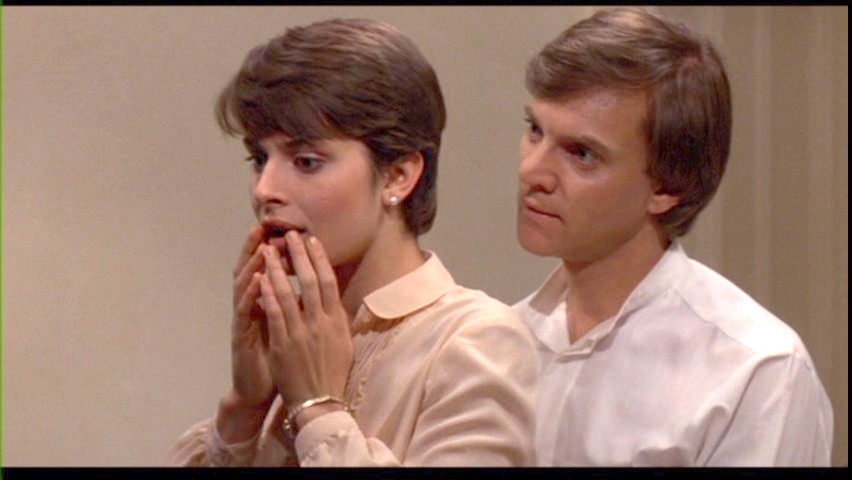
The 1982 Cat People relocates the story to contemporary New Orleans, where Kinski’s character Irena Gallier arrives at the film’s opening to be reunited with her brother—a shapeshifting minister played with menacing brio by Malcolm McDowell—whom she hasn’t seen since childhood. Unfortunately, before we meet Kinski and McDowell, we’re treated to a turgid 6-minute prologue of cat people “mythology.” The film never really finds an effective juxtapositional tone between its gruesome modern-day tale of sexual violence and the primal symbolism of the prologue (and a later scene set in the same blood-red dreamscape). A not dissimilar film from the same era, Ken Russell’s Altered States (1980), found a way to integrate this kind of Jung-on-acid material so that the border between waking reality and the unconscious seemed radically porous.
There are compensatory pleasures to be found in Schrader’s Cat People, to be sure, beginning with its high-toned production design and sensational cast. In addition to Kinski and McDowell, there’s John Heard’s shy zoologist whose obsession with Irena brings out his inner fetishist; Annette O’Toole as Heard’s spurned love interest; Ruby Dee as McDowell’s Creole housekeeper; and Ed Begley, Jr. as the affable zoo-employee sidekick whose arm is graphically torn off in a memorable blood-spurting shock moment.
Nastassja Kinski & Malcolm McDowell in Cat People (1982).
Paul Schrader’s films have suffered somewhat unfairly in their critical reception over the years because his reputation as the brilliant screenwriter of two classic Martin Scorsese films—Taxi Driver (1976) and Raging Bull (1980)—has raised unfulfilled and probably unreasonable expectations for his own directorial efforts. Cat People was not a box office success. This resulted in Schrader being pushed out of studio-financed work and toward the rocky shoals of independent filmmaking. (He has grabbed a lot of attention and raised some eyebrows for his latest project, The Canyons, a Kickstarter-funded mock-exploitation film due out next year, with a script by Bret Easton Ellis and starring Lindsay Lohan and porn star James Deen.)
Further complicating any clear-eyed appraisals of Schrader’s work is his vaunted renown as a trenchant film critic in his own right, in particular as the author of Transcendental Style in Film: Ozu, Bresson, Dreyer, a remarkable examination of the “Holy” in the filmmaking styles of the three European directors addressed in the book title. The study grew out of a thesis written at UCLA Film School, where Schrader received an MA after studying theology at Calvin College. He’d fallen under the spell and personal mentorship of famed New Yorker critic Pauline Kael. Because Schrader’s intellectual background precedes him, film scholars have sometimes been misled in their desire to find deeper layers of philosophical intent to his movies. (To which one wishes to add: Good luck deconstructing The Canyons.)
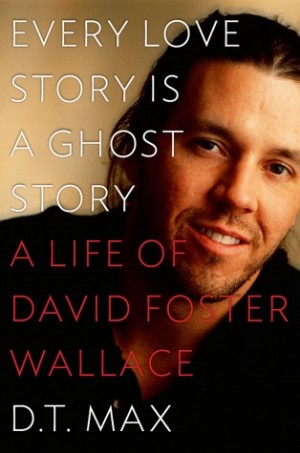
Every Love Story is a Ghost Story
D.T. Max
Viking 2012
Reviewed by Bob Wake
D.T. Max’s solid biography of American writer David Foster Wallace (1962-2008), Every Love Story is a Ghost Story, portrays with emotional force Wallace’s successful struggle to stay sober for the better part of his adult life. From roughly 1989 up until his 2008 suicide (resulting from a recurrence of severe depression that plagued him on and off since his Midwestern adolescence), we learn that he worked a rigorous recovery program, attending regular support group meetings (even when on the road in unfamiliar cities), and befriending and helping fellow recovering addicts. The importance of sobriety to his life and work cannot be overstated. His career-making 1996 maximalist novel, Infinite Jest, can legitimately be considered The Great American AA Novel.
Wallace honored recovery group tenets by not divulging his personal involvement in one organization over another (and the biography never directly links him with any specific twelve-step program by name). Max quotes from a Newsweek interview in which Wallace was asked about Infinite Jest’s verisimilitude and insight regarding Alcoholics Anonymous and halfway-house living conditions. The author replied at the time:
I went with friends to an open AA meeting, and got addicted to them. It was completely riveting. I was never a member—I was a voyeur. When I ended up really liking it was when I let people there know this and they didn’t care.
Michael Pietsch, his editor at Little, Brown, recognized early on that the recovery material was the heart of Infinite Jest, what Pietsch called a “huge roiling story about addiction and recovery, their culture and language and characters, the hidden world that’s revealed when people come in and tell their stories.”
Less impressive to the editor was the novel’s “ornately bizarre-to-goofy superstructure” of dystopian Canadian terrorist cells and the hunt for a lethal video cartridge that induced addictive stupor and even death in those who watched it. The manuscript was cut and reshaped, a process during which Wallace devised his soon-to-be-iconic solution of off-loading some of the novel’s pile-up of political and cinematic arcana and narrative tangents into 100 pages of small-print endnotes, 388 in total.
Max situates the development of Wallace’s nascent writing style (a mixture of Thomas Pynchon’s digressive erudition with the experimental playfulness of Donald Barthelme) within the polarized scene of mid-1980s American literary fiction. When he enrolled in the University of Arizona MFA writing program in 1985, the “dirty realism” of minimalists like Raymond Carver, Jayne Anne Phillips and Richard Ford was in vogue. So was the bestselling “brat pack” fiction (defined by Max as “minimalism with attitude”) of Jay McInerney, Tama Janowitz and Bret Easton Ellis. Wallace found himself butting heads with writing professors who championed above all else “the well-made realist short story.” The dynamic with his teachers shifted, however, with the 1987 publication of his antic 500-page first novel, The Broom of the System. The book had been written as his undergraduate thesis at Amherst College before enrolling at Arizona. (Remarkably, he wrote two Amherst theses for a dual-degree. The second was in philosophy, published posthumously in 2010 as Fate, Time, and Language: An Essay on Free Will.)
Wallace would later disavow much of what he considered the metafictional games of his pre-Infinite Jest fiction. Some critics, like A.O. Scott in a perceptive 2000 NYRBpiece titled “The Panic of Influence,” believed the writer was kidding himself. As Max summarizes it, Scott “emphasized Wallace’s anxious relationship with postmodernism and also his expectation he could have things both ways, pursuing the questionable tactic of writing cleverly to assert the superiority of sincerity in a world wedded to cleverness.”
The growing ranks of Infinite Jest fans felt otherwise, of course. More than a few flocked to sign up for classes taught by Wallace in the English department at Illinois State University, where he was employed when the 1,079-page novel was published to near-instantaneous notoriety:
Students had begun applying to the graduate program specifically to study with him. He was becoming a beacon for a kind of writing, not the postmodernism of the rest of the department and not the realism of Iowa and everywhere else, but a third approach, uncomfortable but sincere realism for a world that was no longer real. Making the head throb heartlike had the potential to become a literary movement. Different names were bruited for it, from the New Sincerity to Post-postmodernism. Occasionally one heard Grunge Fiction.
Every Love Story is a Ghost Story steers clear of hagiography by maintaining a thoroughly researched journalistic tone. The substance abuse, repeated suicide attempts and institutionalizations filling the first half of the biography make for harrowing reading, especially given that the scope and magnitude of some of this information is new.
Certainly the heretofore unreported womanizing documented in the book, with Wallace cavalierly sleeping with female students in the manner of Philip Roth’s Professor Kepesh in The Dying Animal, is far from flattering. His borderline stalking of married poet and future influential memoirist Mary Karr (The Liars’ Club), whom he met during the early stages of his halfway-house recovery in the Boston area, is disturbing and dark. If nothing else, we perhaps now have a little more context for judging novelist and friend Jonathan Franzen’s cryptic allusion (in a 2011 New Yorkeressay) to Wallace’s brutish 1999 short story collection, Brief Interviews with Hideous Men:
I will pass over the question of diagnosis (it’s possible he was not simply depressive) and the question of how such a beautiful human being had come by such vividly intimate knowledge of the thoughts of hideous men.
The biography grew out of a well-received profile that Max wrote for The New Yorker in 2009. Wallace, it seems, was a compulsive letter writer, most notably to Franzen and the novelist Don DeLillo (a formative literary influence and someone from whom Wallace appears to have sought a good deal of working-writer advice, sometimes in dire desperation). Never a fan of the Internet—“He was wise enough,” writes Max, “to see a snare in it for an addict like himself”—he only began using email after 2000. Generous quotations from his correspondence with Franzen and DeLillo, his life-long agent Bonnie Nadell, and Little, Brown editor Michael Pietsch (whose posthumous assemblage of the author’s unfinished novel, The Pale King, was widely admired) add immeasurably to the portrait of Wallace and his writing process.


 Coffee Spew