The Unexploded Ordnance Bin
Rebecca Foust
Swan Scythe Press 2019
Reviewed by Bob Wake
Rebecca Foust’s The Unexploded Ordnance Bin is a ferocious work of poetry. The chapbook’s title and ominous cover design (by artist Lorna Stevens) connote urgency and dread. Its thirty poems, touching on a variety of charged topics and poetic forms, all share Foust’s fierce intelligence, sharpened wit, and an abiding reverence for the natural world and our place in it. The title poem begins like a Hitchcock movie about a family excursion that turns darkly comic with menace:
our son found the hollow shell
snub-nosed & finned
& looking like an Acme cartoon bomb
where we raked for clams
he wanted to keep it
& we wanted to let him
An author’s note chillingly informs us that U.S. coastal regions “harbor millions of pounds of dumped munitions” from military training exercises. The family in the poem visits the local police station to dispose of the shell. The mother is left discomforted. A chain-reaction of metaphors follows. She is haunted by her son’s autism and wonders “what it would look like / the bin for safe disposal of genes / that can ruin children.” These lines pack the kind of gut-punch that Rebecca Foust’s work never shies away from. She has addressed her son’s autism in poems over the years, at times with grace and understanding, and at other times with cosmic fury.
A triptych of poems, “spec house foundation cut into ridge,” “The Deer,” and “Vehicular” depict the effects of environmental and habitat destruction. Readers might be familiar with the experience of being behind the wheel of a car and striking a deer on a highway or rural road. “The Deer” slows down the moment of impact like a forensic examination of the Zapruder film:
It came mid-sentence, the blow so nearly not a blow, the light
shattered and flung into the fog, scattered shards
blooming chrysanthemum then dissolving away,
a Roman candle illuming the night
In the poem titled “after the dream act is revoked,” the refrain of “what can i do” begins a process of assessing our privilege and our community (“the people / I know are mostly decent / if catatonic with abundance & consumption & god / & their screens”). The prognosis is grim: “when will we admit the pogrom is here.” Some of the strongest work in The Unexploded Ordnance Bin focuses on the human cost of our immigration policies. “Requiem Mass for the Yuma Fourteen” memorializes the fourteen Mexicans who died of exposure in 2001 while trying to cross the Arizona desert into the United States. The poem is a villanelle, a classic form distinguished by its incantatory repetition of phrases. The rigor of the form combines with Foust’s unadorned language to create a biblical evocation of grief. The opening three stanzas:
Beyond the border they could smell the rain. It smelled like freedom. Freedom and home. The desert composes its requiem.
The oldest was sixty, his grandson thirteen.
One wore new jeans, one carried a comb. Beyond the border they could smell the rain.
They got lost, then they lost their water. The sun
was a furnace blast. Dust. Thirst. Delirium, the desert composing its requiem.
As Foust showed in her 2015 book-length sonnet sequence, Paradise Drive, she is skillful at linking poems thematically. The third, and final, section of The Unexploded Ordnance Bin returns to family with a series of deeply personal poems on gender and identity charting her now-adult daughter’s transgender journey. “Shall I mourn one, seeing the other?” she asks in “Moon.”
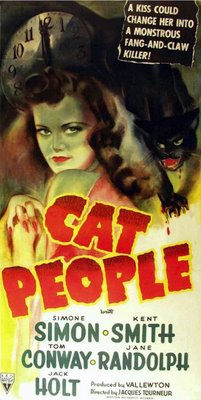
The original Cat People (1942), directed by Jacques Tourneur, is both an acknowledged classic of suggestive horror and one of the most famous Hollywood B-movies of all time. First in a series of low-budget RKO fright films produced by Val Lewton, Cat People became a surprise hit that saved the studio from near-bankruptcy following the failure of two iconic films that in their day were costly flops—Citizen Kane (1941) and The Magnificent Ambersons (1942)—directed by the mercurial boy-genius, Orson Welles. Lewton, while unpretentious by Wellesian standards, was no less hungry to make movies.
Cannily, Lewton found a creative path within the system by working fast and cheap. (And finding an economical use for abandoned sets like the ornate staircase from The Magnificent Ambersons that shows up in Cat People.) He’d been a deadline-driven journalist and pulp novelist. And before being offered his own production unit at RKO studios, Lewton worked his way up at MGM as an ambitious story editor and researcher. Cat People’s disquieting atmosphere of Old World otherness combined with New World dislocation can be traced in part to the European backgrounds of Lewton, born in 1904 in what is now Ukraine, and Tourneur, born the same year in France. The film evokes a haunted American melting pot of primitive mythologies and new-fangled superstitions (i.e., psychoanalysis) ill-equipped for securing one’s safety or survival in a modern impersonal cityscape. It should come as no surprise that after working with Val Lewton, director Jacques Tourneur (along with Cat People cinematographer Nicholas Musuraca) went on to make the influential film noir, Out of the Past (1947), which helped define the genre as doom-laden and populated with psychologically crippled outsiders and social misfits.
Cat People’s Irena Dubrovna (played by French actress Simone Simon) is an aspiring fashion designer of Serbian heritage living in New York City. Introspective and melancholic, she believes herself descended from a devil-worshipping were-leopard who survived an Eastern European witch-hunting pogrom in the 16th century. Irena finds herself drawn to the caged leopard in the Central Park Zoo. Her impromptu marriage to a marine engineer (Kent Smith) remains unconsummated because Irena fears that her own unleashed passion will destroy her husband just like, it’s implied, her mother may have killed Irena’s father in a sexual frenzy when Irena was conceived.
Val Lewton wrote a short story, “The Bagheeta,” published some 12 years earlier in Weird Tales magazine, about medieval villagers hunting a black leopard believed to be a were-beast capable of transforming itself into a beautiful woman of taunting, deadly sensuality. Which is to say, a kind of origin myth for Cat People’s folkloric equating of arousal with bestiality and bloodlust. The screenplay is credited to DeWitt Bodeen, although Lewton contributed heavily to its thematic construction and rewriting. Biographer Edmund G. Bansak, in his book Fearing the Dark: The Val Lewton Career, points to passages in “The Bagheeta,” such as the following, that clearly presage Cat People’s distinctive conjuring of fear and eroticized anxiety through the unseen:
Again he rode through the wood. Again he peered right and left for some sign of the beast, fearful always of seeing golden eyes glow at him from the pitch blackness of the night. Every rustle of the wind, every mouse that scampered on its way, flooded his heart with fear, and filled his eyes with the lithe, black bulk of the Bagheeta, stalking toward him on noiseless paws. With all his heart he wished that the beast would materialize, stand before him, allow him opportunities to slash and thrust and ward. Anything, even deep wounds, would be better than this dreadful uncertainty, this darkness haunted by the dark form of the were-beast.
Simone Simon in Cat People (1942).
Simone Simon’s complex portrayal of shapeshifter Irena Dubrovna is sympathetic in a manner not unlike that of Lon Chaney, Jr.’s bewildered lycanthropist Larry Talbot in The Wolf Man (1940), which had been a recent entry in the long line of lavish Universal studio horror hits that RKO wanted Val Lewton to replicate at a fraction of the cost. No time-consuming elaborate monster make-up for Simone Simon. Instead, characters are stalked by … something. Branches rustle. Shadows loom. Sinister growls echo from the locker room of an indoor swimming pool. Paw prints in the park appear to segue into high-heel shoe indentations.
Concerns that Lewton may have gone too far in substituting shadows and sound effects for in-your-face literal scares caused studio bosses to insist that a leopard be shown during the climactic mauling death of the psychotherapist (Tom Conway) who sexually assaults Irena in his office. Nevertheless, the film’s most frightening jump-in-your-seat moment—still effective 70 years later—is the oft-copied sudden lurching into the film frame of a city bus with its air-brakes hissing.
II. Cat People (1982)
The cult status of Paul Schrader’s 1982 remake of Cat People rests largely on a couple of tangential aspects of the production. First, the David Bowie/Giorgio Moroder theme song, “Cat People (Putting Out Fire),” endures as a great Bowie track and gained further pop culture permanence with Quentin Tarantino’s wildly effective use of the song in a climactic sequence of Inglourious Basterds (2009).
Second, director Paul Schrader’s cocaine-fueled obsession with the film’s star, Nastassja Kinski, as recounted in Peter Biskind’s guilty-pleasure history of 1970s Hollywood, Easy Riders, Raging Bulls: How the Sex-Drugs-and-Rock ’n’ Roll Generation Saved Hollywood, rivals the stories of Alfred Hitchcock’s creepy abuse of Tippi Hedren on the set of The Birds (1963). Schrader shot more nudity of Kinski than the actress was comfortable with. He then spitefully added much of it to the film in retaliation for Kinski quitting their turbulant relationship during production. After finishing the movie, she fled to Paris with Schrader in pursuit. Kinski reportedly told him: “Paul, I always fuck my directors. And with you it was difficult.”
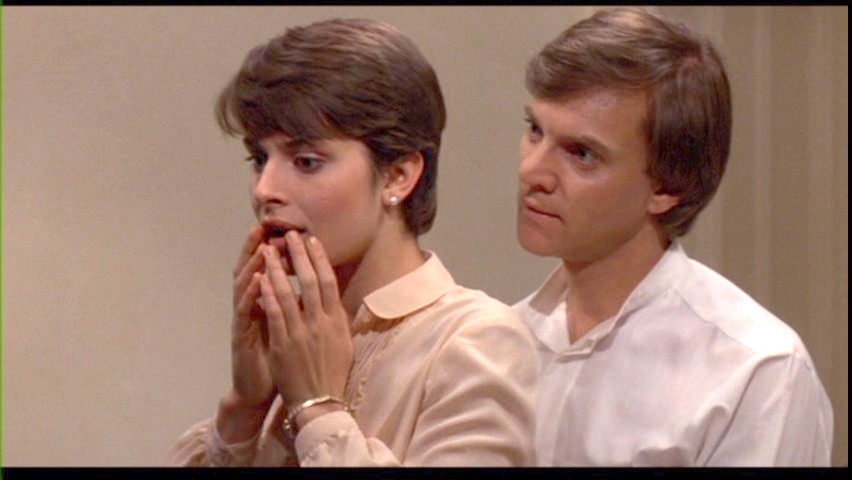
The 1982 Cat People relocates the story to contemporary New Orleans, where Kinski’s character Irena Gallier arrives at the film’s opening to be reunited with her brother—a shapeshifting minister played with menacing brio by Malcolm McDowell—whom she hasn’t seen since childhood. Unfortunately, before we meet Kinski and McDowell, we’re treated to a turgid 6-minute prologue of cat people “mythology.” The film never really finds an effective juxtapositional tone between its gruesome modern-day tale of sexual violence and the primal symbolism of the prologue (and a later scene set in the same blood-red dreamscape). A not dissimilar film from the same era, Ken Russell’s Altered States (1980), found a way to integrate this kind of Jung-on-acid material so that the border between waking reality and the unconscious seemed radically porous.
There are compensatory pleasures to be found in Schrader’s Cat People, to be sure, beginning with its high-toned production design and sensational cast. In addition to Kinski and McDowell, there’s John Heard’s shy zoologist whose obsession with Irena brings out his inner fetishist; Annette O’Toole as Heard’s spurned love interest; Ruby Dee as McDowell’s Creole housekeeper; and Ed Begley, Jr. as the affable zoo-employee sidekick whose arm is graphically torn off in a memorable blood-spurting shock moment.
Nastassja Kinski & Malcolm McDowell in Cat People (1982).
Paul Schrader’s films have suffered somewhat unfairly in their critical reception over the years because his reputation as the brilliant screenwriter of two classic Martin Scorsese films—Taxi Driver (1976) and Raging Bull (1980)—has raised unfulfilled and probably unreasonable expectations for his own directorial efforts. Cat People was not a box office success. This resulted in Schrader being pushed out of studio-financed work and toward the rocky shoals of independent filmmaking. (He has grabbed a lot of attention and raised some eyebrows for his latest project, The Canyons, a Kickstarter-funded mock-exploitation film due out next year, with a script by Bret Easton Ellis and starring Lindsay Lohan and porn star James Deen.)
Further complicating any clear-eyed appraisals of Schrader’s work is his vaunted renown as a trenchant film critic in his own right, in particular as the author of Transcendental Style in Film: Ozu, Bresson, Dreyer, a remarkable examination of the “Holy” in the filmmaking styles of the three European directors addressed in the book title. The study grew out of a thesis written at UCLA Film School, where Schrader received an MA after studying theology at Calvin College. He’d fallen under the spell and personal mentorship of famed New Yorker critic Pauline Kael. Because Schrader’s intellectual background precedes him, film scholars have sometimes been misled in their desire to find deeper layers of philosophical intent to his movies. (To which one wishes to add: Good luck deconstructing The Canyons.)


 Coffee Spew