A Theory of Lipstick
Karla Huston
Main Street Rag Publishing Co. 2013
Reviewed by Bob Wake
“I only write poems about sex,” begins Karla Huston’s poem “My Husband Thinks.” The poet proceeds to catalog the more quotidian concerns she insists have graced her work over the years, from “the dentist’s office” and “rotting potatoes” to “paperboys peeing in the snow” and “even the guy who stole my parking place.” But damned if “My Husband Thinks” doesn’t suddenly spring to pulse-pounding life with the lines, “Today I wrote about how the pubic hair I shaved / for you has started to twirl and bend again, / how the skin itches, the way a healing // wound does …”
Huston has never shied away from the maddening predicament of desire, its commingling of love and spite, sacrifice and lust. She can be a brutal satirist of the tyrannical male gaze. The poem “Mona Lisa Imagines” is a stream-of-consciousness monologue of mounting irritation by the artist’s iconic model while Leonardo—“farting when you bend for a rag, / or scratching your balls”—demands prim stillness from his subject: “At least the twelve apostles could / gnaw meat off bones while they lingered / or leaned into a bit of gossip / or fingered silver coins. Today // you want my hands folded just this way.”
Karla Huston. Photo: Steve Huston.
A Theory of Lipstick, Huston’s first full-length collection (after more than a decade’s worth of six well-received chapbooks), is comprised of fifty-four poems. While not always about sex, they are never less than insightful about our shared messy humanness and the ecstasies of the natural world. The title poem, which originally appeared in Verse Wisconsin and was awarded a 2012 Pushcart Prize, is another of the poet’s masterful catalogs that blends the sensible and the sensual, this time into a rhapsody of Day-Glo images: “made from fruit pigment and raspberry cream, / a lux of shimmer-shine, lipstick glimmer, duo / in satin-lined pouch, Clara Bow glow: city brilliant / and country chick—sparkling, sensual, silks / and sangria stains, those radiant tints and beeswax liberty— // oh, kiss me now, oh, double agents of beauty …”
Especially memorable are Huston’s portraits of small-town inhabitants whose lives have the vivid contours of Chekhov or Welty characters. They include “The Dog Catcher’s Wife” (“She’s concerned / that even the nets, nooses or tranquilizer / darts won’t save him from the angry ones”) and “Vanishing Woman” (“But now / even bad sex would be better / than none, grinding blindly into / the night, mapping the smoky / landscape with her flesh”), as well as rueful group snapshots like “Girls Tanning”:
Stretched on benches the first warm day in May
so sure of their beauty with their firm arms
and thighs, their high-riding breasts, so content
knowing that they own the world
as the wind steals their hair and eyes, bright
with the strain of staring into the sun,
posing, white teeth flashing as they lick
cherry gloss from their lips. […]
Accessible and inviting even at its most acerbic, Karla Huston’s A Theory of Lipstick is no unproven hypothesis, it’s a fully vetted and means-tested map of the American heart and heartland.
Photo: B & B Rare Books, Ltd. A 1941 First Edition of The Last Tycoon. Value: $4,000.
Inspired on several fronts (seeing Baz Luhrmann’s film adaptation of The Great Gatsby; rewatching the 1974 Gatsby; revisiting Elia Kazan’s 1976 film of The Last Tycoon), I just finished reading again after many years F. Scott Fitzgerald’s posthumous The Last Tycoon, edited by Edmund Wilson and published in 1941. The Last Tycoon is the title by which I still prefer to think of the novel. There’s an updated 1993 reconstruction by Fitzgerald scholar Matthew J. Bruccoli which uses what Bruccoli believed was Fitzgerald’s choice for the novel’s title, The Love of the Last Tycoon: A Western. Fitzgerald originally floated some curious titles for The Great Gatsby, too. How does Trimalchio grab you? By whatever title, The Last Tycoon is a great novel, even in its incomplete form. (A worthy contemporary comparison: David Foster Wallace’s unfinished but much-admired novel The Pale King, edited by Michael Pietsch and published in 2011.)
Thirty-five-year-old Hollywood producer Monroe Stahr’s obsession with an Englishwoman’s resemblance to his late actress wife might at first seem superficially similar to Gatsby. Fitzgerald in his letters and notes about The Last Tycoon, many of which were famously appended to Wilson’s reconstructed text, writes:
If one book could ever be “like” another, I should say it is more “like” The Great Gatsby than any other of my books. But I hope it will be entirely different—I hope it will be something new, arouse new emotions, perhaps even a new way of looking at certain phenomena.
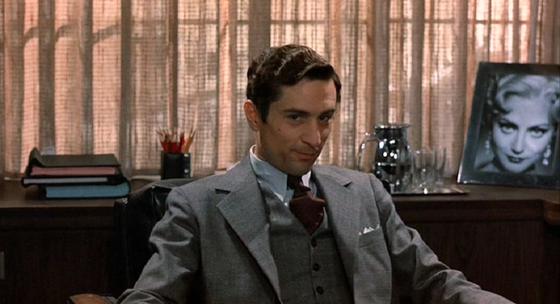
Robert De Niro as Monroe Stahr in The Last Tycoon (1976).
Stahr’s self-awareness evolves over the course of the narrative and differs significantly from Gatsby’s static and deluded nostalgia. This perhaps reflects Fitzgerald’s own battle with despair and loss in the years following Gatsby’s publication. (See Edmund Wilson’s posthumously edited collection of Fitzgerald’s autobiographical essays, The Crack-Up.) The Great Depression coincided with Fitzgerald’s falling fortunes: money woes, ill-health, his wife Zelda’s confinement to a mental hospital, and his career slide into near-obscurity. After living extravagantly as one of the country’s highest paid and most famous writers of the 1920s, he was an out-of-print and largely neglected author by the time he was writing his final novel. The romantic obsession at the core of The Last Tycoon is less about nostalgia than Stahr’s struggle to micromanage a psychological corner of his life while everything else seems to be spiraling beyond his control. As the novel progresses, it becomes clear that the Hollywood that Stahr once dominated as an autocratic whiz-kid producer is becoming decentralized. “At that time the studios feared mob rule,” runs one passage. Stahr’s preparation for a meeting with a communist union organizer has a political edge that signaled the author’s broadening skills as a satirist and social observer:
Afterwards Stahr told me that he prepared for the meeting by running off the Russian Revolutionary films that he had in his film library at home. He also ran off Doctor Caligari and Salvador Dali’s Le Chien Andalou, possibly suspecting that they had a bearing on the matter. He had been startled by the Russian films back in the twenties, and on Wylie White’s suggestion he had the script department get him up a two-page “treatment” of the Communist Manifesto.
Monroe Stahr is wonderfully alive in his sometimes cruel complexity (heightened by the novel’s occasionally spiteful narrator, a rival producer’s daughter secretly in love with Stahr). His confidence is shaken and something new and untested is awakened in him. “I want to show that Stahr left certain harm behind him just as he left good behind him,” Fitzgerald writes in another of the supplemental notes. Stahr isn’t adverse to change, but he wants change on his own terms, unshackled from the studio’s cash-driven bottom line. “For two years we’ve played it safe,” Stahr says at one point to a gathering of suspicious studio heads and money men. “It’s time we made a picture that’ll lose some money.” No dewy-eyed idealist, he adds: “Write it off as good will—this’ll bring in new customers.”
The Last Tycoon was also a reawakening of Fitzgerald’s preternatural talent for writing about romantic infatuation in a manner that manages to embrace clichés while at the same time reinvigorating them:
“I don’t want to lose you now,” he said. “I don’t know what you think of me or whether you think of me at all. As you’ve probably guessed, my heart’s in the grave—” He hesitated, wondering if this was quite true. “—but you’re the most attractive woman I’ve met since I don’t know when. I can’t stop looking at you. I don’t know now exactly the color of your eyes, but they make me sorry for everyone in the world—”
Robert De Niro and Jack Nicholson in The Last Tycoon (1976).
Elia Kazan’s 1976 film of The Last Tycoon never quite catches fire, but it’s a fascinating attempt nonetheless, in its Harold Pinter script (remarkably faithful to the more polished sections of the novel), and many of the performances, especially Robert De Niro’s elusive and darkly internalized portrayal of Monroe Stahr. A notorious flop when released, the movie ended Elia Kazan’s directing career. Kazan devotes seventeen painful pages to the making of the film in his 1988 autobiography, A Life. He was dealing with his mother’s failing health and, finally, her death, during production. Moreover, there were clashes with producer Sam Spiegel. The film deserves reevaluation. It’s never revived or talked about anymore. There’s a strong and richly amusing climactic scene with Jack Nicholson as Brimmer, the novel’s communist union organizer, playing a spirited match of Ping-Pong with De Niro’s Stahr. It’s taken nearly verbatim from the novel and it’s a highlight of the movie. Kazan’s film would make for a great double feature with Last Call, a surprisingly eloquent 2002 Showtime movie based on Francis Kroll Ring’s memoir about working for Fitzgerald during his final days in Hollywood writing The Last Tycoon.
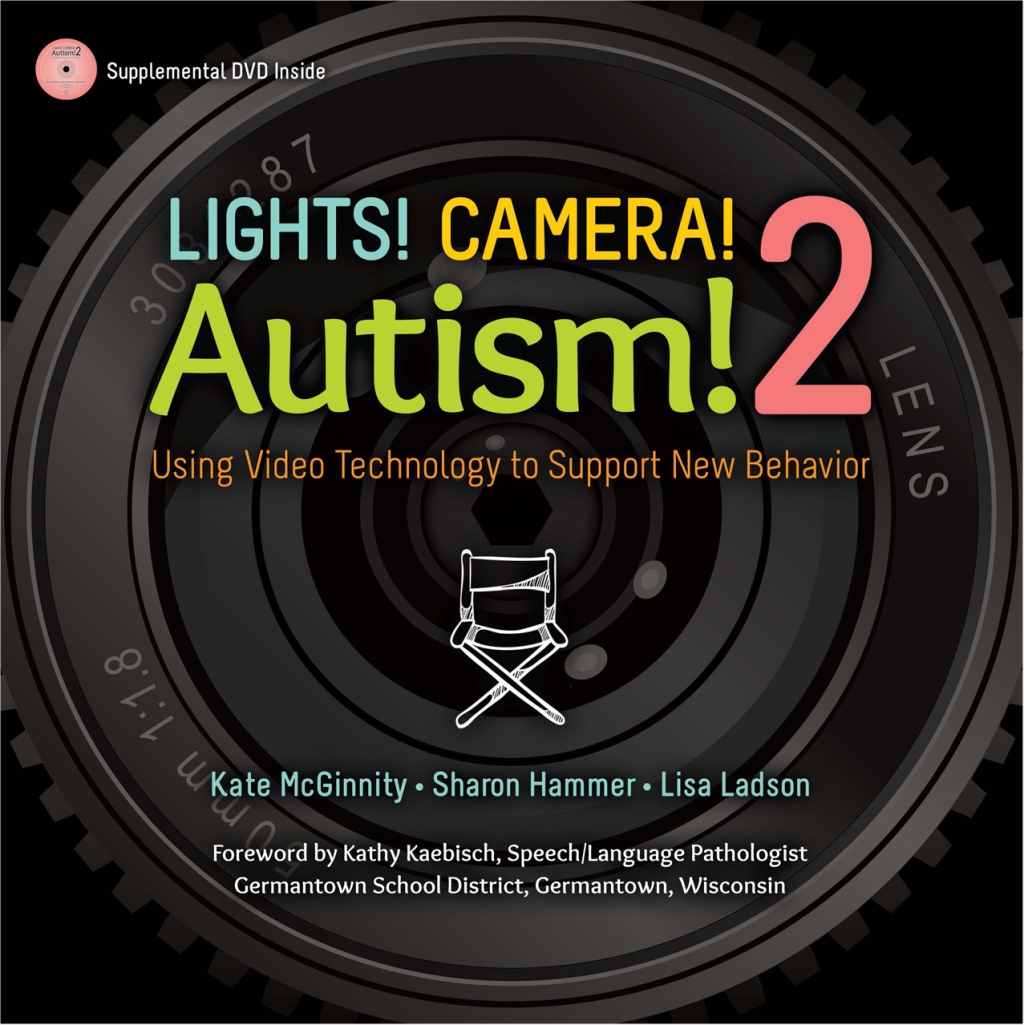
“Lights! Camera! Autism! 2 will help educators and parents alike, and support an environment that is proactive and based on each individual’s strengths and needs. The solutions are proven to be successful. I couldn’t wait to go back to my district and share the book with staff and parents.”—Brian Johnson, Student Services Director, Columbus School District, Columbus, Wisconsin.
“Lights! Camera! Autism! 2 is a gift without measure to parents at any stage of their autism journey. A few minutes spent reading and watching and I was able to create a tool that lifts my son’s anxiety, sorts out some of the confusion he faces, and enables both of us to feel successful. This is a resource I will share with every person who plays a role in my son’s life.”—Rebecca Williams, former elementary school teacher, and proud mom of an incredible, unique, loving, and challenging autistic son.
“There is something powerful that happens when the brain gets to watch the body doing something right. The learning sinks in. New behavior sets up with speed. McGinnity, Hammer and Ladson provide concrete examples for helping people ‘see’ better ways to behave by showing us concretely how to improve our instruction.”—David Pitonyak, Ph.D., consultant for people with challenging behaviors and the needs of their friends, family and caregivers (www.dimagine.com).
“These videos offer an innovative way of training people with special needs to encounter new situations. One of the many challenges people with autism and other disabilities face is how to encounter the ‘unknown’ and generalize social rules across situations. Video is a great platform to help a person understand what a new environment will be like, whether it be a new school, a camping trailer, or a playroom.”—Stephen Hinkle, national speaker and disability rights advocate.
“Lights! Camera! Autism! 2 offers tangible and doable approaches to break out of the way things have always been done. Teachers, parents, and individuals with autism have everything to gain from bringing these tools to life.”—Tamar Jacobsohn, MS Ed, autism program support teacher with over 20 years’ experience in early childhood special education.
About the Authors
Kate McGinnity is an experienced classroom teacher and trainer, and nationally recognized consultant in the field of autism.
Sharon Hammer is a master’s level psychotherapist with over 15 years’ experience working with individuals on the autism spectrum.
Lisa Ladson is an educational and behavioral consultant with extensive knowledge in creating innovative intervention programs for students with complex learning challenges.
According to the L.A. Times literary blog Jacket Copy, George Saunders chose to leave “Fox 8” out of his recently published collection Tenth of December because he felt it was “asking one stretch too many from the reader.” I get that. In fact, I much prefer reading the occasional Saunders story in The New Yorker rather than compiled in short story collections. His stories, artfully spun and eccentrically self-contained, can seem overly precious and “worked up” when set side by side. That said, he’s written more than his share of masterful short stories. “Fox 8,” which began life as a failed children’s book, is as memorable as anything Saunders has written, which is to say it will stay with you because of qualities it shares with timeless, even mythic storytelling.
George Saunders. Photo: Chloe Aftel.
The story is narrated by a visionary fox struggling to convince his starving den comrades that their only chance for survival is to strike out in quest of food at the newly constructed shopping mall that has displaced their habitat. “Fox 8” is actually an epistolary fable, written as a beseeching letter to the humans whose language Fox 8 has learned, if not precisely mastered, as a kind of earthy Chaucerian Middle English: “Stay in your awesum howses, play your music lowd, however you make it play so lowd, yap your Yuman jokes, sending forth your crood laffter into the nite.” Also worth noting about this very cool 99-cent ebook are the wonderful illustrations by graphic designer Chelsea Cardinal (the sharp cover design is hers as well).
Proposals for the Recovery of the Apparently Drowned
Michael Sheehan Colony Collapse Press 2012
Reviewed by Bob Wake
The four short stories that comprise Michael Sheehan’s Proposals for the Recovery of the Apparently Drowned are ambitious and often darkly amusing fictions that adroitly mesh genre-busting experimental writing and rock-solid literary instincts. While each story succeeds well enough on its own ingeniously devised terms, the title story is perhaps the strongest in the collection. Stripped of the hypertextual footnotes and pop culture references that function as metafictional ballast in the other stories collected here, “Proposals for the Recovery of the Apparently Drowned” is instead a tightly composed narrative about the mounting internalized horror of a woman plunged into a coma-like state of “conscious paralysis” after stumbling and falling outside of a New York dance club. Passages of dryly delivered historical documentation on “suspended animation” are woven directly into the text and add to the story’s powerful effect. Sheehan never pushes the existential metaphor of an unmoored and despairing Beckettian consciousness, allowing us to intimately share the protagonist’s dislocation:
Deep inside herself, willing her body limp and empty and motionless and withdrawing every bit of her true self inside, away, acutely aware of everything around her and through this awareness focused more and more on nothing but staying still, hidden.
Michael Sheehan. Photo: Colony Collapse Press.
The final story, “September,” is the longest in the collection and its hilarious over-the-top self-indulgence is clearly intended as an homage to the influential writer for whom the story is dedicated: David Foster Wallace (1962-2008). Sheehan cleverly glosses aspects of Wallace’s Infinite Jest (the novel’s apocalyptic tennis court game of Eschaton—which also inspired the Decemberists’ video for their “Calamity Song”—becomes an epic round of Civilization in Sheehan’s story). More than mere parody, Sheehan’s “September” finds its own rhythms and drug-fueled conspiratorial compulsions, and the story’s final section (dated September 12, 2008, the date of Wallace’s death) is heartbreakingly beautiful as writing and as eulogy.
The Tiger’s Wedding
James Dante
Martin Sisters Publishing 2013
Reviewed by Bob Wake
“Moments of conventional bliss had a way of eluding me,” declares Jake St. Gregory, a young American accountant from dreamland, U.S.A.—Burbank, California—working as an English teacher in Seoul, South Korea. Jake, the 30-year-old protagonist and narrator of James Dante’s wry and wise debut novel, The Tiger’s Wedding, will thoroughly test the multicultural limits of convention and bliss by the finish of his tale.
There’s a tangled romance at the heart of The Tiger’s Wedding, with Jake falling in love with a married Korean woman, an aspiring musician with two young children. Dante finds enough page-turning complications and believable twists to both keep the plot percolating efficiently and to largely sidestep cliches. He grounds his story in solid characterization and skillful depictions of cultural and familial conflicts.
James Dante. Photo: Martin Sisters Publishing.
It’s no surprise to learn from his author’s bio that Dante, a Northern Californian by way of New York, spent time teaching in South Korea. The novel is lovingly awash in quotidian details of cuisine and landscape, as well as nightlife high and low. The story avoids lapsing into travelogue while at the same time taking Western readers to locations we’d be curious to see ourselves. Whether or not The Tiger’s Wedding was completed before the viral K-pop YouTube sensation of “Gangnam Style,” Dante’s description of the song’s locale provides an interesting gloss on its Day-Glo milieu:
We rode the subway into Gangnam, a chic section of Seoul. Even below ground, imitation Renaissance statues squirted water into flood-lit pools. Walking from the subway stop to street level involved passing boutiques … I had heard the stories about young Gangnam males who caroused in the nightclubs and eateries, terrorizing the staff and lighting cigarettes with money.
More ominous is Jake’s darkly funny visit to the Korean Demilitarized Zone with a photojournalist (a sardonic American from Columbus, Ohio whose character functions at times as Jake’s bad conscience):
On the other side of the border stood a 500-foot flagpole, which supported a 600-pound North Korean flag. Even with the steady wind, the flag hung limp from its own weight. Amplified rhetoric echoed from the enemy side. Through powerful loudspeakers, North Korea continuously reminded the Southern troops that the North had created a Workers’ Paradise. Big deal. In the South they drove Hyundais and listened to rap.
Dante’s strongest creation is the character of Jae-Min, the 33-year-old working mother and abused wife whom Jake befriends and whose life becomes increasingly enmeshed with his own. Jae-Min’s complexity keeps the story off-balance in a compelling manner: she can’t comfortably resolve the multiple conflicts complicating her life. Dante is at his best in showing us her resilience and allowing us, along with Jake, to second-guess—often with shameful inaccuracy—Jae-Min’s behavior.
Labor protests and a growing anti-Americanism in Seoul heighten the climactic sections of the novel. (“Lines of riot police, resembling a thousand Darth Vaders, pushed back with even greater force, knocking people to the ground.”) There’s much to recommend here, from the novel’s careful attention to detail and the shifting allegiances of its characters, to its cultural and political backdrop. The strong excerpts from The Tiger’s Wedding that ran in Rosebud Magazine have more than fulfilled their promise.
If I Could Tell You
Lee Jing-Jing
Marshall Cavendish Editions 2013
Reviewed by Bob Wake
From neglected children and lost young adults, to the developmentally disabled and the forgotten elderly, If I Could Tell You is narrated by a wide range of multigenerational and multicultural voices. The setting for Lee Jing-Jing’s graceful debut novel is both exotic and excruciating: A condemned public-housing apartment building in Singapore. Most of its residents have been relocated. The skeleton crew of remaining occupants comprise “the old, the poor, people who have had trouble finding a new home.” The novel’s opening pages include a jumper from the upper floors lying dead on the pavement below.
The jumper’s death haunts the neighborhood if not the television news. “I guess it was much too ordinary,” muses a middle-aged unemployed electronics engineer, dismayed by the absence of media coverage. His thoughts return again and again to the tragedy. Soon his dreams are enveloped in apocalyptic imagery:
Then I was on the ground, below the block of flats, looking up while the building leaned to the right, tossing my wife and daughter out of the naked window. The building crashed to the ground like a felled tree, but slowly, silently, as if the weight of it was nothing more than a browned leaf, a scrap of paper. All the while, I just stood and watched and did nothing, my hands hanging by my sides, my feet heavy as rocks. The dream stayed with me the rest of the day. I could hardly look at my wife and daughter during breakfast.
Lee Jing-Jing. Photo: Marshall Cavendish Editions.
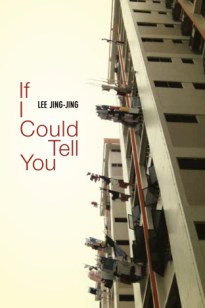
Lee Jing-Jing, currently living in Germany, has spoken in a newspaper interview about her public-housing upbringing in Singapore (the book’s cover photo, taken by the author, depicts a now-demolished block of apartments where her aunt once lived). While If I Could Tell You immerses us in poverty and broken lives, nothing here is sensationalized or made mawkish. The unwavering matter-of-factness of the storytelling yields enormous narrative and dramatic power as the novel unfolds.
Language barriers add to the isolation of some characters, such as an eighty-year-old Cantonese-speaking Chinese woman known in the neighborhood as “Cardboard Auntie” because she collects cardboard box scraps and sells them from a cart on the streets. Cardboard Auntie’s impoverished external life masks a roiling internal world of brutal memories (“Tch, I’ve seen worse. When the Japanese were here. Much worse”) and borderline delusional conversations with her deceased husband, whom she addresses as the Old One (“Old One, what do you want for lunch? Fan wat ze jook? Rice or porridge?”).
If I Could Tell You is not without a kind of mordant Hitchcockian humor: the jumper’s falling body is witnessed by multiple characters, often out of the corner of the eye, allowing the author to replay the gruesome event from a variety of subliminal perspectives (“something fell through the air, close enough that they felt and heard the whoosh as it went past them”). It’s a rare debut novel that’s written with such assured mastery of style and tone. The final pages give voice to a character whose despair is so complete that it would be unendurable for most of us. By focusing on the rich inner lives of its societal outcasts, If I Could Tell You tells us plenty: Lee Jing-Jing has written as fine a work of literary fiction as you’re likely to read this year.
“Paula Kluth has done it again! A lively, practical and engaging how-to book on creating inclusion. Her focus is on all of us, teachers, students, staff, principals, district and community members, reminding us that inclusion, as with all social justice, is about joint action and commitment. Tons of practical ideas and examples presented in her inimitable style. Hurrah!”—Anne M. Donnellan, Ph.D., Director of the University of San Diego Autism Institute; Professor Emerita, University of Wisconsin-Madison.
“Paula Kluth’s enthusiasm is contagious and the structure of her new book is revolutionary.”—Barbara Buswell, Executive Director, PEAK Parent Center, Colorado.
“Implementation science at its best. Paula Kluth reminds us of the importance of regularly revisiting our mission to create schools where everyone belongs.”—Mary C. Schuh, Ph.D., National Center on Inclusive Education, Institute on Disability, University of New Hampshire.
“An outstanding guide, packed with strategies and tips. Paula Kluth has created a remarkable resource for schools and communities that want to renew or improve their inclusive practices.”—Nicole Eredics, Inclusion Specialist (www.theinclusiveclass.com).
Dr. Paula Kluth is a consultant, author, and advocate dedicated to supporting inclusive education in preschool, elementary, and high schools. Paula is a former special educator who has served as both a classroom teacher and inclusion facilitator. She is the author or co-author of numerous books on inclusive education including, “You’re Going to Love This Kid!”: Teaching Students with Autism in the Inclusive Classroom, and “A Land We Can Share”: Teaching Literacy to Students with Autism. Visit her website at www.paulakluth.com.
Begin with the beckoning title of Wisconsin poet Sarah Busse’s Somewhere Piano. Within its pages, we find the eponymous poem doubling down and rechristened as “Somewhere Piano, Again.” It’s a poem about getting things right, not just on piano or paper, but in our heads:
These are the rehearsal rooms of the brain,
strangely echoed, some, and others
strangely dead. Wander once more
the narrow, ill-lit halls.
There’s no poetic triumphalism here. “Somewhere Piano, Again” suggests a painfully stalled dark night of the soul, a writer’s prayer for illumination:
Rehearsing and rehearsing
on the instrument of haunt, reversing again,
and overheard through walls, muffled,
a someone else, anonymous, not quite
in tune, remembered ever, trying
and trying (how much we want)
to get that passage right.
Busse is a rare species of writer: a secular poet of the sacred. She has found a language to illustrate the all-too-brief moments of revelation that sneak into our days, the instances of what theologian Jean-Luc Marion has called “saturated phenomena,” when we’re astonished by unbidden hints of connectedness. Busse’s poem “Flicker,” for instance, begins:
This morning a flock of flickers—flash of red,
flash of yellow at my feet—rose and flew
past the blue turkey-foot, the prairie dropseed.
The grasses nodded their purple heads, bronzed,
lazy in their affirmation … until the wind blew.
Although the moment evaporates in a September breeze, the poet’s own “feathered heart,” in the second stanza, has been altered by the experience: a quickened recognition of “how the honey locust / shivers down its gold and gilds my driveway …” By the third and final stanza, following the trail from prairie to driveway, the poet arrives home with a renewed reverence that continues to draw its airborne imagery from the bird flock seen that morning: “My children toss leaves up to see them / leap and fall and leap again, laugh and beg for more.”
Busse’s poems have the curious feature—not uncommon in religious poetry from Donne to Dickinson—of never quite being about what they presume to be about. Her work directs our gaze or our contemplation to something beyond the poem’s focus. She’ll grant you a stable ground outside your kitchen window, but then she’ll pull you seductively toward something chaotic and profound, undefined but ecstatically present at any given moment if we choose to engage it, take it on. Here, embedded within a poem framed around her eight-year-old son’s whimsical improvisations on the family piano (“To Robert Cabaste Wind on His Birthday”), a kind of cosmic disturbance invades the morning:
He is playing imagined music for
imagined listeners of imagined radio, the lit
windows of morning kitchens dot the hills
of the Driftless. The music launches,
and a coffee cup suspends, dishes
go unwashed, an argument hangs midair.
Eyes go vacant at the curious passages …
In the final stanza, mirroring her son’s improvised melodies, the poet/mother is inspired to improvise her own morning prayer or hymn, a suburban matins:
Blessings on the marriages of the morning,
blessings on the scrambled kids about to board buses,
the dogwalkers and garbage trucks and gardeners
who will let the music drift over and off
and get on with their variegated days …
Sarah Busse
Busse in the last few years has gained recognition as a tireless proselytizer for poetry, especially in her roles shared with fellow Wisconsin poet Wendy Vardaman, as co-editor of Verse Wisconsin and Cowfeather Press. Verse Wisconsin found its voice—or, to be accurate, voices plural, as in “multitude”—when in the thick of the winter 2011 labor protests in Madison, the magazine’s Facebook page became a living anthology of poets old, new and spontaneously birthed, reacting in real time to a historic political crisis. In January, 2012, Mayor Paul Soglin appointed Sarah Busse and Wendy Vardaman to a four-year term as Madison’s Poets Laureate.
While two chapbooks preceded it—Quiver (Red Dragonfly Press 2009) and Given These Magics (Finishing Line Press 2010)—this is Busse’s first full-length collection. The real success of Somewhere Piano’s diverse and rich selection of 47 poems can be measured by the fact that Busse’s chilling 2012 Pushcart Prize-winning poem, “Silhouettes,” an account of a home-invasion and sexual assault, is but one example of the high level of artistry on display throughout Somewhere Piano.











 Coffee Spew