Coffee Spew

  • About
  • Cambridge Book Review
  • Cambridge Book Review Press
  • Selected Reviews

  • Noir or Noir Not?

    This is a golden age for film noir on DVD. One of the latest and long-awaited treats is Road House (1948). Looks terrific, especially Jefty’s, the neon-lit roadhouse/bowling alley where much of the action takes place, an elaborate dreamscape of a studio set. The digitally sharp black and white is certainly superior to the VHS copy I taped off of AMC years ago (a broadcast dated July 2, 1993). There are purists, such as Dave Kehr, who don’t feel Road House qualifies as film noir. (See David Denby’s definition quoted in an earlier Coffee Spew post: “violent, saturnine, dark-city crime narratives driven by strongly motivated characters.”) He’s probably right. Road House is more of a love-triangle melodrama with precious little psychological probing of its stock characters.

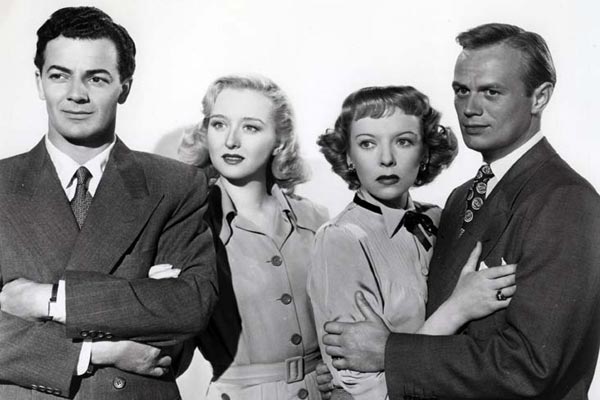
    Cornel Wilde, Celeste Holm, Ida Lupino, and Richard Widmark in a publicity pose for “Road House”

    And yet there are noirish touches throughout. Certainly Ida Lupino’s character, hardluck lounge singer Lily Stevens with her lit cigarette notching burn marks on the pianotop, would be at home in any of the nightclubs found in classic noirs like Gilda (1946), They Live by Night (1948), or In a Lonely Place (1950). Then there’s Richard Widmark. His performance as Jefty Robbins—whose improbable third-act freakout seems designed to reprise the giggling psychopath that the actor played to great acclaim the previous year in Kiss of Death—gives Road House its strongest dose of noir cred. But, yeah, this flick is pushing its luck. I found it less satisfying than I remembered.

    Do I recommend it? Heck yes! Ida Lupino at 34 is ravishing. Sure, her singing is pretty bad—as Celeste Holm accurately mentions at one point in the movie—but its her own voice, she refused to be dubbed, and it fits the character to a tee. Be sure to watch Road House a second time with the commentary track by Eddie Muller and Kim Morgan. Really gets fun about halfway through when Muller starts pouring drinks.

    September 25, 2008
    Film Noir, Ida Lupino, Richard Widmark

  • Creature Features

    Sunshine, but temperatures below zero. Work canceled. School closed. Wife’s out of town, so it was a father/son day for me and our eleven-year-old. We drove into the city and caught a couple of monster flicks.

    Cloverfield is getting a lot of attention as the ultimate in shakycam chic, a sort of rollercoaster hybrid of The Blair Witch Project crossed with The Bourne Ultimatum. Which is plenty cool, if you’re attracted to motion sickness. Thank God for Dippin’ Dots ice cream, which calmed our stomachs like Milk of Magnesia. I’ll refrain from describing the precise nature of the disaster that befalls Manhattan. The 9/11 imagery is impossible to ignore, with scenes of collapsing skyscrapers and roaring clouds of smoke chasing pedestrians down city streets. There is nothing low-tech about Cloverfield’s state-of-the-art CGI special effects. What most impressed me was a small but ingenious stylistic flourish: the camcorder through which we’re witnessing the story is recording over an older tape of a romantic excursion to Coney Island by two of the characters. Throughout the movie, a few seconds of Coney Island footage occasionally bleed through like flashbacks.

    The second flick was I Am Legend in IMAX. Big-ass screen, no question. More scenes of a demolished Manhattan. More Dippin’ Dots. Will Smith, possibly the last man alive, has survived a plague that’s wiped out most of humankind. Those who haven’t died have devolved into menacing nocturnal zombies. It’s a serviceable sci-fi premise. In fact, this is the fourth adaptation of the same Richard Matheson novel, preceded by The World, the Flesh, and the Devil (1959), The Last Man on Earth (1964), and The Omega Man (1971). Will Smith carries the film. His range and intensity give the story more depth than it probably deserves. (I Am Legend, like Cloverfield, uses heart-tugging flashbacks—scenes of Will’s former life with his wife and daughter—but the cutaways are handled in a more conventional fashion.)

    January 30, 2008

  • Otto Focus

    Simmons & Mitchum in "Angel Face"
    Simmons & Mitchum in Angel Face (1953).

    As regards classic 1940s and 50s film noir, David Denby said it best in his recent New Yorker profile of director Otto Preminger:

    So many pictures now are bloated with unnecessary spectacle and backstory that the economy and decisiveness of the noirs—violent, saturnine, dark-city crime narratives driven by strongly motivated characters—seems more miraculous than ever.

    Preminger’s best-known noir is Laura (1944), but cognoscenti and coffee spewers alike prefer Angel Face (1953), starring Jean Simmons as femme fatale and Robert Mitchum as unsuspecting chump. Should you watch Angel Face on DVD, don’t miss the commentary by Eddie Muller.

    January 23, 2008

  • Orientation Week

    In the meantime, visit us at Cambridge Book Review.

    January 21, 2008

Previous Page

Blog at WordPress.com.


Loading Comments...
 

    • Subscribe Subscribed
      • Coffee Spew
      • Join 55 other subscribers
      • Already have a WordPress.com account? Log in now.
      • Coffee Spew
      • Subscribe Subscribed
      • Sign up
      • Log in
      • Report this content
      • View site in Reader
      • Manage subscriptions
      • Collapse this bar