Rebecca Foust has won the Robert Phillips Poetry Chapbook Prize two years running. Last summer in CBR:15 we reviewed her 2007 award winning debut, Dark Card, a forceful collection of linked poems about her son with Asperger’s syndrome. Foust’s 2008 winning chapbook, Mom’s Canoe, is just out from Texas Review Press. Once again sequenced around a thematic thread—Foust’s upbringing in the Allegheny Mountains of Pennsylvania—these are terrific poems, flinty and tough like the quarries and strip mines she writes about and, like her work in Dark Card, devoid of sentimentality and easy emotions. Nothing is left unscarred. “Gills burned, drowned in air …” she writes in “How the Fish Feels.” In “Things Burn Down,” the same air that chokes the unlucky hooked fish is killing us too: “Thick smoke from the papermill / all day and night, understand? No one asked // in those days if that shit could kill you …”
Hardship and loneliness become stark forces of nature in poems like “Allegheny County Winter Day” (“Everyone’s going / or gone. Sunset bleeds / through bare boughs; / snow hollows go blue”) and “The Mountains Come Close When It Rains” (“And say it’s ten below zero, skies gray so long you / forget what blue looks like, and you can’t find a job”). The twenty-four poems in Mom’s Canoe evoke a world rich in novelistic detail. A traffic light is made memorable in “November”: “The traffic / light is wanton, / an exotic / painted parrot / or harlot— // Emerald. / Burnt gold. / Then / throat-catching / scarlet.” And this glorious cascade of childhood images of her mother’s canoe in the collection’s title poem: “Frail origami, vessel of air, / wide shallow saucer suspended where / shallows met shadows near the old dam.”
An email from Tim Ware informs us that he’s launched an Infinite Jest wiki. Fans new and old of David Foster Wallace’s novel will find it a tremendous resource. Thanks, Tim, for including an external link to my warhorse website, Reviews, Articles, & Miscellany, a compendium of early Infinite Jest material circa 1996-99. Archaic in every way (before a brief touch-up this afternoon, I literally hadn’t updated it in the last ten years), it still contains some useful items unobtainable elsewhere.
The Spring 2009 issue of Cambridge Book Review is now online. It includes four poems from Madison writer Sarah Busse and a review of Eric Baus’s Tuned Droves.
Recorded exclusively for Coffee Spew, here’s Wisconsin poet John Lehman reading from his work. First, from Acting Lessons (Parallel Press, 2008), a film noir reverie:
Things More Distant Than They Appear / John Lehman
Let’s say that you had just two choices. The first, to leave
Rick’s Club, walk the six blocks down to your girl’s place
and apologize. The second, to stay and finish your drink.
The entranceway—stark, mail on the floor, broken buzzer
and unlocked door—with a little Scotch, takes on a movie
musical glow. A set where you tap dance up the staircase
into the arms of someone who is young and silken-robed.
In fact, the place is shabby. One, two, three stories of fried
onion smell. Then, of course her apartment door is locked
and at this time of night, why would she answer anybody’s
knock? So, it would be back to Rick’s anyway, right? No,
not quite, because you see the door is inexplicably ajar,
though all is dark inside. Now there are two more choices:
to call out “hello”—the only sensible thing to do—or push
the door open and, very quietly step within, the idea being
that you’ll make your way to her room, kneel beside her
bed and whisper your affection in her delicate ear as she
dreamily awakes. In you go, for this is the night of fools,
feeling furniture with your toes stealthily as a cat. Each
step takes days, each day is a week. Your lifetime passes
as you breathe through the doorway to her bed which is
—What did you expect?—empty. All you know for sure,
is that you’re tired and drunk and sad. You want to tumble
on top of that bed for a minute’s rest. You do, and dream
that you are back at Rick’s, and this time she comes in.
She puts her fingers to your lips; there’s no need for you to
speak. “My place or yours,” she smiles and since you already
smell the lavender candles of her room and feel the softness
of her pillows on your cheek, there are no choices, anymore.
But you’re not in her dreams, like she’s in yours. You don’t
need to leave Rick’s to discover that. So you sit and listen
to Chet Baker’s trumpet on the jukebox, to remember and forget.
*
Next, from Dogs Dream of Running (Salmon Run Press, 2001), an affectionate encounter with the late, great author:
John Updike Spills the Beans Riding through New Jersey / John Lehman
It was about this same time of year. We
were driving through a rural New Jersey
night, the wife of a Princeton Italian pro-
fessor, Tom Kennedy and me. She had
organized a day for us to conduct writing
workshops and now after the culminating
event, a lecture by the legendary John
Updike, we were headed to a reception
at the house of a dean. “Wasn’t Updike
something?” we all asked, remembering
the eloquence of his extemporaneous
words as they blended seamlessly with
excerpts which he read, like some vast
swelling on a literary sea, to raise us, not
to truth or beauty, but to a profound, new
level of sleep. Tom admitted to nodding
off several times and I to once awakening
with a start. Even our hostess could not
deny, “with the warmth, the lights, the ‘oh
so busy’ day …” But now how deliciously
refreshed we were, ready over cocktails
and hors d’oeuvres to impress each other,
all over again, with cleverness and wit.
Later, in the Cadillac en route to the motel,
we three were joined by the man himself.
He proved humble in a way the successful
are humble, dismissing their genius, though
mindful the rest of us be sure to disagree.
A lanky man slightly bending an enormous
head, he said, “I couldn’t help but notice
there was one person who … fell asleep.”
Was that the engine or his rising voice that
roared? He continued, “All I could think of
was how I might rouse this poor soul in the
third row from her stuporous dreams.” At this
pronoun Tom and I exhaled, and our driver
let us know, from where she was sitting in the wings she didn’t see anything. “Well,”
he sighed, “that reminds me of when T.S.
Eliot came to Yale. We had waited hours
in line to hear him speak. Student seats
were high in the balcony and amidst the
rising radiator heat …” And here the courtly
Updike chortled to himself, like a spent
wave tickling the sand on a distant beach.
“Can you imagine,” he said, “I fell asleep.”
Dublin-born Anne Enright’s 2007 Man Booker Prize-winning novel The Gathering is a stylistic tour de force. Indeed, the quality that most places it within the Irish literary tradition is its besotted piss-elegant obsession with language. Language as balm and bulwark against anxiety and death. Language as weapon, as conveyor of lies and painful truths. Language as bullshit, poisoned by alcohol and Catholic guilt. When a providential tyke loudly shouts “Shut uhhhp!” at a funeral in the novel’s final pages, it’s like a plea for sanity and silence, a halt to the maddening inadequacy of our words to connect honestly with our experience of the world.
Enright’s prose is craggy and lyrical, epigrammatic and at times very, very funny:
The British, I decide, only bury people when they are so dead, you need another word for it. The British wait so long for a funeral that people gather not so much to mourn, as to complain that the corpse is still hanging around. There is a queue, they say on the phone (the British love a queue). They do not gather until the emotion is gone.
The first-person narrative voice belongs to 39-year-old Veronica Hegarty, who often seems drunk or desperate to be drunk or on the way to getting drunk (driving alone in her Saab in the dead of night), restaging over and over in her mind the familial trajectory that may have contributed to her brother Liam’s recent suicide by drowning (Virginia Woolf-style, weighted down with rocks in his pockets).
No Irish tale worth its salt is complete without a long climactic depiction of a funeral wake replete with ghostly psychosexual hauntings. On this score, The Gathering doesn’t disappoint. Veronica’s chilly marriage and two young daughters seem far more remote than her clannish childhood and memory’s awful persistence: growing up among eleven siblings, assorted oddball relatives and sinister hangers-on. And they don’t come any more sinister than the late Lambert Nugent, landlord and louse. It’s a name that conjures gas-lit streetlamps and twirly mustachioed villainy. Placed within the novel’s complex modern sensibilitiy, he’s also pathetic and all-too-humanly evil. The Gathering is a motley, monstrously dysfunctional portrait, constructed incrementally through layered flashbacks and emotionally-charged vignettes and asides. (“Although my father used to hit his children all the time, more or less, it was never personal.”)
It’s giving nothing away to say that sexual abuse plays a role in the story (and is hinted at in the novel’s opening sentence): the terrible secret of what happened in their grandmother’s house when Veronica was eight and Liam was nine. Enright, to her credit, doesn’t drag this out too long. The mystery is resolved for us midway through the novel (not without an element of ambiguity, but with nowhere near the kind of coy “doubt” overplayed by John Patrick Shanley in his comparatively crude Catholic parable) while still allowing for a twist at the end, worth the wait, and satisfying in its own way as a credible suggestion of a future that won’t merely recapitulate the miseries of the past. Enright’s hothouse writing, verging on the wildly melodramatic at times, is tempered by gallows humor and the deftness of her dialogue. Literary fiction of the highest calibre.
The last John Updike novel I read was 2006’s Terrorist. Creaky at times in its plotting, there was also something admirable and fresh in his striving to step inside and bring to life the consciousness of an eighteen-year-old American Muslim drawn toward committing a terrorist act. Less interesting were the novel’s other characters, particularly the high school guidance counselor, Jack Levy, who seemed too much a retread of those aging middle-class malcontents that Updike perfected long ago and about whom he apparently had nothing new to say. In other words, while I enjoyed the sheen of his trademark polished prose, it wasn’t a novel I recommended to friends or cared to review.
What I’ve read of his over the years, I most admired The Centaur (1963). It’s one of the richest literary evocations of adolescence. A standout scene has the youthful autobiographical protagonist hesitantly pulling off his shirt and revealing to a girlfriend the stigma of psoriasis on his arms and chest. Updike’s essay “At War with My Skin,” from his 1989 memoir Self-Consciousness, describes in unflinching, painful detail his lifelong struggle with psoriasis. While he sometimes seemed like a writer who hid behind his voluptuous style, at his best and sharpest he could harness his preternatural fluency in the service of hard emotional truth.
Not long ago I pencil-marked a soaring passage in an otherwise pedestrian short story, “Lunch Hour,” from Updike’s collection Licks of Love (2000). It’s about a high school reunion of oldsters. The prose comes alive in describing an autumn joyride in a Studebaker coupe through the Pennsylvania countryside circa 1948:
Little cemeteries of tilted sandstones, mysterious thick groves of planted evergreens, rickety farm stands that would have appeared deserted but for their fresh yellow squashes and orange pumpkins and the bonneted old woman keeping an eye on things from the porch; collapsing stone springhouses, the overgrown ruins of old iron forges, creeks making brown foam with their chuckling small waterfalls; fields of corn, of rye, of tobacco, of cattle, of peach and apple trees in blossom or bent low with fruit—all of this poured around the noontime travelers, who were oblivious to most everything but one another and the sensation of speed.
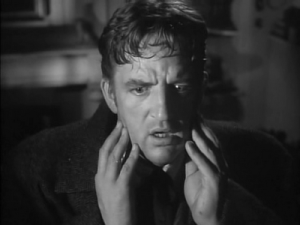
Wisconsin winters are a leveling force. Ground zero. Then there’s thirteen degrees below ground zero. Like today. The choice is clear: you can watch yourself go nuts, or, better still, you can watch a superb new DVD about a schizophrenic composer and let the guy in the movie go nuts. Hangover Square (1945) was the last film to star Laird Cregar, one of Hollywood’s great forgotten talents. He died, age 28 (or 31; his date of birth has been given variously as 1913 or 1916), while the movie was in postproduction. Weighing some 300 pounds in earlier roles, Cregar put himself on a crash diet (i.e., amphetamines) that resulted not only in his losing 80 pounds for Hangover Square but also brought on a stomach disorder, hospitalization, and finally a heart attack. Typecast once too often as an overweight psychopath, he yearned to unleash his inner matinee idol. Whether or not the sexually conflicted Cregar might have transformed himself into a proto-Montgomery Clift is anyone’s guess, but there’s no disputing the fact that few actors before or since have played an overweight psychopath with such soulful, wrenching menace and pathos. Film noir fans know him as the disturbed Inspector Ed Cornell in I Wake Up Screaming (1941). Horror buffs know his Jack the Ripper in The Lodger (1944). But nothing compares with Hangover Square. Cregar is George Harvey Bone, a frustrated composer of serious music (whose dissonant “Concerto Macabre” for piano and orchestra was written for the movie by Hitchcock’s great film composer Bernard Herrmann). The story is set in fog-shrouded turn of the century London, a backlot cost-cutting decision that allowed for using the sets left over from The Lodger.
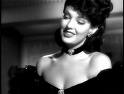
Linda Darnell
The psychotic sad sack Mr. Bone falls under the spell of a femme fatale music hall singer played by Linda Darnell. He also suffers blackouts that send him on murderous rampages, killing cats and antique dealers and anyone else who ticks him off. Hangover Square boasts at least two bravura sequences: Bone’s hauling a corpse up a ladder to the top of a massive Guy Fawkes Night bonfire, and the climactic performance of the Concerto Macabre with Bone madly pounding away at the piano with the concert hall engulfed in flames. It’s a potent metaphor for the artist’s imagination and the thin line between creativity and self-destruction. An inferno guaranteed to keep you toasty on the coldest of winter nights.
Our good friend, the poet and coffee spewer extraordinaire John Lehman, has a new chapbook of poetry, Acting Lessons, just out from the University of Wisconsin’s Parallel Press. It’s a rarefied honor for any writer to be included among the Parallel Press poets, a mark both of distinction and validation. Mr. Lehman has arrived, as they say. You can visit John online and sample his cinematic flare at Spanky and John Go to the Movies.
Bernhard Schlink’s slim, eloquent 1995 novel The Reader never quite came to life for me on the page, for reasons I couldn’t initially pinpoint. Yet, it is an experience that stays with one and, in retrospect, grows richer. A delayed reaction, if you will. Because the novel is so brief, it can feel attenuated and dramatically skimpy. I also wanted to blame the vagaries of reading a German novel in translation. Certainly, in the abstract, the plot is compelling. A fifteen-year-old schoolboy has a torrid summer’s affair with a thirtysomething woman in 1950s postwar Germany. The woman, Hanna Schmitz, lives in a coldwater flat and works as a streetcar conductor. She takes an interest in the boy’s schoolwork, especially his literature studies, and before long their lovemaking sessions never fail to include his passionately reading aloud to her from great novels and plays. The writing in this first third of The Reader is evocative and sensual. At summer’s end Hanna abruptly leaves town. The schoolboy, Michael, moves on with his life, eventually attending law school. The story at this point begins to feel less dramatic than schematic, an outline rather than a full-bodied narrative. Worse, I felt, a chilliness overtakes Michael’s narrative voice. As part of a university seminar, he and his classmates attend a Nazi war crimes trial in which several women are charged as former concentration camp guards. Michael discovers that Hanna is among them. The most horrific charge involves the guards having locked the doors of a burning church trapping several hundred women prisoners inside.
Hanna Schmitz is an ingeniously conceived character. Our sympathies, like Michael’s, remain deeply ambivalent. Midway through the novel, during the trial, we learn that Hanna is illiterate. The adult Michael resumes reading to Hanna via tape cassettes sent to her prison cell. She turns her cell into a classroom and teaches herself to read and write. We, as readers, are asked to consider to what extent an individual can be forgiven or redeemed. No convenient answers are provided. Schlink also raises larger questions of national and generational guilt.
My wrong-headed verdict upon finishing reading the novel: A book too slight and narrow in tone for the enormous historical atrocities it wants to illuminate. But the more I thought about it the more I realized that Michael grapples with similar questions as he narrates the novel, mentioning by name epic cathartic works of Holocaust literature like Sophie’s Choice and Schindler’s List (works which, he suggests, “supplement” and “embellish” our imaginations). We come to see that Michael’s emotions are shut down. He describes this dissociative state of mind perfectly in the novel (only later did I recognize that he was describing his own psychology and The Reader itself, the text itself):
All survivor literature talks about this numbness, in which life’s functions are reduced to a minimum, behavior becomes completely selfish and indifferent to others, and gassing and burning are everyday occurrences. In the rare accounts by perpetrators, too, the gas chambers and ovens become ordinary scenery, the perpetrators reduced to their few functions and exhibiting a mental paralysis and indifference, a dullness that makes them seem drugged or drunk. The defendants seemed to me to be trapped still, and forever, in this drugged state, in a sense petrified in it … Even then, when I was preoccupied by this general numbness, and by the fact that it had taken hold not only of the perpetrators and victims, but of all of us, judges and lay members of the court, prosecutors and recorders, who had to deal with these events now; when I likened perpetrators, victims, the dead, the living, survivors, and their descendants to each other, I didn’t feel good about it and I still don’t. [The Reader, p. 103.]
The movie version of The Reader works reasonably well. David Hare’s screenplay is faithful to the novel. Kate Winslat portrays Hanna’s complexity with subtlety and precision. She’s less persuasive as the older version of Hanna, however, mimicking a kind of stereotyped oldster’s stooped shuffle. While Ralph Fiennes is technically perfect as the adult Michael—detached, emotionally blinkered—the actor has played so many similarly reserved characters that The Reader is typecasting of the blandest sort. Even as an ironic counterweight to the actor’s earlier brilliant turn as the sadistic Nazi Amon Goeth in Shindler’s List, his performance here never really seems to connect. (Fiennes still has the juice: witness his zany over-the-top mob boss in In Bruges, released concurrently this year with The Reader. Fiennes gives a wonderfully dark and funny performance that personifies the sardonic heart of darkness at the of core of In Bruges bleak sick-joke universe.) Also note re: The Reader: Bruno Ganz as Michael’s law professor and Lena Olin as a camp survivor give strong, focused performances.






 Coffee Spew