Coffee Spew

  • About
  • Cambridge Book Review
  • Cambridge Book Review Press
  • Selected Reviews

  • Verse Wisconsin

    Here’s the press release about Verse Wisconsin, now accepting submissions (some of co-editor Sarah Busse’s own poetry appears in CBR:16):

    NEW ONLINE RESOURCE FOR WISCONSIN POETS

    The new poetry magazine, Verse Wisconsin, has gone online as of September 1, 2009. Featuring information for poets across the state and beyond, the website ushers in the next phase of Verse Wisconsin’s project, and offers a place for poets across the state to post their local events and learn of others.

    Co-editors Wendy Vardaman and Sarah Busse welcome everyone on board. “We know our links page isn’t nearly complete. Far from it! But we also wanted poets to feel free to share information with each other, rather than for us to pose as the experts,” explains Busse.

    The magazine will publish poetry and prose about poetry and is currently accepting submissions. “We’re hoping to reach a broad cross-section of poets in the state, and beyond,” says Busse. “Our predecessor, Linda Aschbrenner, published a variety of styles and voices in Free Verse. In moving the magazine to Madison, and updating it, we’re hoping to continue her tradition and expand upon it.”

    The editors are accepting poetry submissions from poets now, with the intention of publishing a first issue, online and in print, in January 2010. The online and print versions will offer different, but complementary, material.

    Learn more at www.versewisconsin.org.

    ###

    Published from 1998-2009 as Free Verse, Verse Wisconsin publishes poetry and serves the community of poets in Wisconsin and beyond.  In fulfilling our mission we:
    • showcase the excellence and diversity of poetry rooted in or related to Wisconsin
    • connect Wisconsin’s poets to each other and to the larger literary world
    • foster critical conversations about poetry
    • build and invigorate the audience for poetry

    September 16, 2009
    Poetry, Sarah Busse, Verse Wisconsin, Wendy Vardaman, Wisconsin poetry

  • A Gate at the Stairs / Book Cover Design

    The book jacket for Lorrie Moore’s A Gate at the Stairs is as striking and original as the novel itself. With design credited to Barbara de Wilde, it’s printed on textured cover stock (coated on the reverse side), front lettering debossed, the sunken white letters smoothed of texture. Sturdily bound, it’s a beautiful book to hold and read. (Take that, eReaders.) The stark photo by artist Kamil Vojnar portrays a detached metal staircase sitting in an empty field. The stairs end in midair, and the uppermost steps seem to be reflecting an incendiary sunset or sunrise. Here’s Moore, from her interview in Wisconsin People & Ideas (Summer, 2009), describing how she learned about Vojnar’s work and then apparently had to convince Knopf that the staircase photo would make for a great cover:

    I found myself enchanted by the cover of Sebastian Barry’s 2008 novel, The Secret Scripture. When I saw the photo credit on it, I looked up the photographer online, and, lo and behold, there was a website with an eerie, surreal photo of some stairs in a field. It seemed just about perfect. To me this was clearly destiny, God’s will, kismet, etc. But my publisher did not see it that way. They had other ideas, which I was open to, until I saw them, and then I cried out in pain and woe. And things proceeded from there.

    The cover to Sebastian Barry’s The Secret Scripture:

    secret

    Given the 9/11 backdrop to A Gate at the Stairs, the cover’s abstract similarity to one of the most iconic pictures of the World Trade Center rubble is downright spooky. No doubt this subliminal connection is intended, but whether or not the staircase photo was originally shot to evoke the WTC image is an interesting question. Note the near identical angle of the skeletal stairs on the Moore cover and the bent building fragment on the left side of the frame in the WTC photo:

    GateWTC8

    September 15, 2009
    A Gate at the Stairs, Barbara de Wilde, Kamil Vojnar, Lorrie Moore, Sebastian Barry, The Secret Scripture

  • A Gate at the Stairs

    A Gate at the Stairs
    Lorrie Moore
    Knopf Doubleday 2009

    Reviewed by Bob Wake
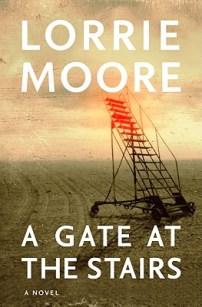
    Gate A Gate at the Stairs is a brilliant comic novel about inconsolable grief and loss. (I lost a whole day reading it. Labor Day utterly consumed, family obliterated, along with exercise and square meals.) It’s by far the longest and most ambitious of Lorrie Moore’s three novels to date, risking wide-eyed engagement with thorny issues like racism, war (gender and military), terrorism, and, perhaps the thorniest issue of all: childrearing. Remarkably, she hasn’t altered her patented hyper-comedic sensibility one iota while enlarging her vision.

    The brainy 20-year-old narrator, Tassie Kiltjen, a farm-raised Midwestern innocent, heads off to college—thirty minutes from home—and finds herself slipping into a global village quagmire. She becomes a nanny for an adopted biracial two-year-old girl. And she begins dating a young man, a Brazilian student, who, like the family Tassie works for, harbors disturbing secrets. Believe me, some of this material is strong stuff. Horrible. Moore, in the tradition of our very best modern writers, from Flannery O’Connor to David Foster Wallace, uses comedy as a means to accentuate dislocation, anxiety and folly. Her wit and wits in overdrive, Tassie has to awkwardly navigate explicitly post-9/11 social realities. (The story takes place in the year following the September 11th attacks.) Back home, her brother weighs enlisting in the armed forces.

    Moore cannily invokes 9/11 as a double-edged metaphor for innocence betrayed. “Despair,” states a character in the novel, “is mistaking a small world for a large one and a large one for a small.” Which is also the unresolved dilemma fueling much of contemporary fiction. The inadequacy of the self. The crushing assault of the ineffable. There’s something going on in Moore’s novel that feels timely and fresh and bracingly edgy. A Gate at the Stairs is uncompromisingly full-strength Lorrie Moore—laden with grotesque puns and jokey patter while remaining thematically complex and fiercely literary—which is to say it’s a great novel on Lorrie Moore’s own idiosyncratic terms. (Reviews have been mixed, to say the least. Malcolm Jones, in Newsweek, sniffs, “You finish the book wondering if it was worth the trouble”; Stephanie Zacharek, over at Salon, scolds the novel for being “exhausting” and “emotionally unsatisfying”; the most evenhanded appraisals I’ve seen so far are the two New York Times reviews, one from Jonathan Lethem, the other from Michiko Kakutani.)

    September 14, 2009

  • Signed Derleth

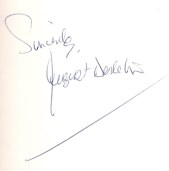
    derlethsignOur son, Augie, loves rummage sales and flea markets, so we stopped yesterday at Cambridge’s Amundson Center to check out a Vintage Harvest estate sale. Among the retro kitchenware, furniture, and household knicknacks, was a table of miscellaneous hardback books, mostly postwar popular novels from the 1950s and 60s, selling for $2 each. Didn’t take long to spot three volumes by Wisconsin’s premiere writer (and Augie’s namesake), August Derleth (1909-1971), lifelong resident and chronicler of Sauk City. One of the books, Return to Walden West (1970), was inscribed by the author. (The other two were a 1945 Stanton and Lee edition of Evening in Spring and a 1945 Scribners edition of The Shield of the Valiant, easily Derleth’s two finest literary novels, exquisite portraits of growing up in a midwestern small town.) Needless to say, this was six bucks well spent.

    returnwaldenAuthor of over a hundred books in multiple genres (mystery, horror, history, biography, poetry), August Derleth was, at his best, one of the country’s great nature writers. Walden West (1961) and Return to Walden West, considered central works in his enormous output, combine Thoreauvian nature observations with piercing (and sometimes shockingly intimate) portraits of the townspeople he grew up with. Here’s a taste of Return to Walden West:

    Now and then, in the course of my walks in the hills or marshes, there were brief periods when awareness of unity with all nature burgeoned—a sense of utter harmony with all things: leaf, stone, soil, blade, water, air—of kinship with insect, bird, all wild creatures—a pouring forth of secret springs deep within, filling me with an almost unbearable bliss. Every sense seemed heightened—I heard the distant hermit thrush as were it at my right hand—the fragrance of maple leaves was never so pervasive—I felt the wind as an intimate caress—I saw deep into the heavens in an experience that was both sensual and spiritual.

    September 6, 2009
    An Evening in Spring, August Derleth, Return to Walden West, The Shield of the Valiant, Walden West, Wisconsin writing

  • The Writer’s Cave

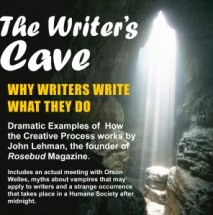
    cave-cd-single-coverJohn Lehman’s The Writer’s Cave: Why Writers Write What They Do has seen several incarnations over the last few years. First as a two-part essay in Rosebud issues 39 & 40. Then as a two-person theatrical piece presented last year in Madison’s Frederic March Play Circle as part of the Wisconsin Book Festival. This summer Lehman went into a recording studio and produced an audio version of The Writer’s Cave, now available on CD. It’s Lehman’s own voice sharing his homebrew memoir and writer’s handbook, with fascinating forays into film criticism (touching on Orson Welles and Ingmar Bergman) and literary biography (about the great Wisconsin poet Lorine Niedecker).

    Here’s an audio sample from The Writer’s Cave:

    https://coffeespew.org/wp-content/uploads/2009/09/writerscave.mp3
    September 4, 2009
    Ingmar Bergman, John Lehman, Lorine Niedecker, Orson Welles, Rosebud, The Writer’s Cave

  • Rosebud:45

    rosebud45The Summer/Fall 2009 issue of Rosebud should be arriving in bookstores. Also available for purchase online. The featured artist is watercolorist Chris Hartsfield. Dig that crazy, vibrant cover illustration. More of Hartsfield’s work can be found on the back cover and scattered throughout the issue. And you’ll find my short story “Liquidity” on pages 118-127.

    August 22, 2009
    Chris Hartsfield, Rosebud

  • Pynchon Speaks …

    It’s confirmed. The voiceover on the video trailer for Thomas Pynchon’s latest novel, the noirish Inherent Vice, is the reclusive author himself. Reading in character as Doc Sportello, the novel’s private-eye protagonist, he has the same laid-back doper’s cadence as Jeff Bridges’ “the Dude” from The Big Lebowski. Pynchon is still cool at seventy-two. Reviews of Inherent Vice have been mixed. (“Feels more like a Classic Comics version of a Pynchon novel than like the thing itself,” says Kakutani in the New York Times.) Nevertheless, Will Blythe’s thoughtful online review at The Second Pass has me wanting to pick up the novel sooner rather than later. (Blythe’s verdict: “Inherent Vice, an act of minor Pynchon, is still major enough.”)

    August 20, 2009
    Inherent Vice, Jeff Bridges, The Big Lebowski, The Dude, The Second Pass, Thomas Pynchon, Will Blythe

  • District 9

    If you enjoyed Neill Blomkamp’s fiendishly clever sci-fi hit District 9 as much as Augie and me, you’ll want to take a look at the director’s 2005 short film, Alive in Joberg, which is essentially a six-minute nanobot blueprint for District 9. The engaging actor Sharlto Copley—who stars in District 9 as Wikus van der Merwe—also appears in Alive in Joberg (about three and a half minutes in).

    August 18, 2009
    Alive in Joberg, District 9, Neill Blomkamp, Sharlto Copley, Wikus van der Merwe

  • The Comedy of Errors

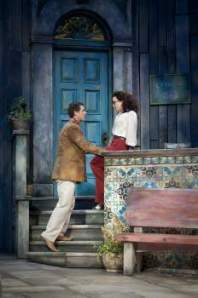
    Marcus Truschinkski and Susan Shunk
    Marcus Truschinski & Susan Shunk in The Comedy of Errors

    Debate has raged in the Coffee Spew household the last two summers over the decision by American Players Theatre to forego their classical approach to Shakespearean set and costume design. We’ve agreed that last year’s updating of A Midsummer Night’s Dream was Felliniesque, but not as a compliment. The set was a construction site complete with porta-potty and the “rude mechanicals” as working-class laborers in hardhats. There were starlets in sunglasses and paparazzi on cell phones. We’re feeling more warmth toward this year’s Casablanca-inflected The Comedy of Errors, with its playful foreign-intrigue backlot designed by Kevin Depinet. (We attended last night’s clear, if humid outdoor performance.) The dizzying identical-twins mix-up lends itself to fast-paced and intricately choreographed screwball comedy and slapstick farce, hallmarks of Hollywood in the 30s and 40s, as well as American Players Theatre at its audience-pleasing best. (Laurel and Hardy—among many—used a version of Shakespeare’s plot for their 1936 film, Our Relations, in which they played both sets of identical twins via trick photography.)

    Perhaps the biggest success of the night was the imaginative work of costume designer Devon Painter. Actresses Carey Cannon and Susan Shunk—strong in their roles as Adriana and Luciana, respectively—were dressed like glamorous holograms of Ingrid Bergman and Katharine Hepburn. Cleverist modernization touch would have to go to the “lock-out” scene (Act III, Scene I). The gate to Antipholus of Ephesus’s (Andy Truschinski) home became in director William Brown’s staging a locked townhouse door with an electric buzzer and speakerphone. Dromio of Syracuse (Steve Haggard) was offstage (inside the house), while his onstage twin, Dromio of Ephesus (Darragh Kennan), responded to his brother’s increasingly hostile insults issuing from the tinnily amplified speaker. Haggard and Kennan wrung maximum laughs from line readings and agile physical comedy throughout the night. Equally memorable was composer Andrew Hansen’s rousing soundtrack-like music score. (The Comedy of Errors runs through October 4th.)

    August 15, 2009
    American Players Theater, Spring Green, The Comedy of Errors

  • The Decemberists in Madison

    DecemberistsThe Decemberists came to Madison last Wednesday and rocked the plushly appointed concert hall. The Overture Center for the Arts ain’t no Mudd Club or CBGB, but it’s ideal for live performances of concept albums like Brian Wilson’s Smile or The Decemberists’ new rock opera, The Hazards of Love, brainchild of frontman Colin Meloy. Katjusa Cisar’s generally positive 77 Square review of the show is for the most part on target, even her amusing—if snarky—nutshell appraisal of the album’s story line:

    The story—well, nevermind the story. A mash-up of renaissance fair, Rush and The Titanic, sprung from the mind of Meloy, it’s all very mystic: a druid-nymph love affair torn by a jealous queen and snarled by deals-gone-bad and marriage-by-drowning. Someday, it’ll make juicy fodder for an ambitious graduate student studying the link between Nordic folk tales and prog rock.

    The Hazards of Love is compelling musically and dramatically (after locating a synopsis, here or here, which is something the CD booklet could really use). I do take issue with Cisar’s characterization of Meloy’s performance as “weirdly stiff” and “emotionally flat.” He seemed ironic and cerebral to me. Weirdly stiff and emotionally flat in a good way. No question that guest vocalist Shara Worden brought classic rock sizzle to her Not Nice to Fool Mother Nature role as the forest Queen. But “upstaging” Meloy, as Cisar claims? I’d say instead that their contrasting styles define the composition’s strength, its off-kilter clash of hot and cool, intellect and bombast. Colin Meloy’s penchant during the evening for alternating sips from a long-stemmed glass of red wine and a cheap plastic bottle of water pretty much says it all.

    Worth noting for fans: Meloy appears to be blogging now, quoting from Infinite Jest and recounting childhood disagreements with his sister about Depeche Mode lyrics. His sister is Maile Meloy, who has a well-received new book of short stories out, Both Ways is the Only Way I Want It.

    [Editor’s update: I’d be remiss if I didn’t give the last word on the Decemberists’ show to Augie, who’s penned his own enthusiastic review.]

    August 9, 2009
    77 Square, Both Ways is the Only Way I Want It, Colin Meloy, Katjusa Cisar, Maile Meloy, The Decemberists, The Hazards of Love

Previous Page Next Page

Blog at WordPress.com.


Loading Comments...
 

    • Subscribe Subscribed
      • Coffee Spew
      • Join 55 other subscribers
      • Already have a WordPress.com account? Log in now.
      • Coffee Spew
      • Subscribe Subscribed
      • Sign up
      • Log in
      • Report this content
      • View site in Reader
      • Manage subscriptions
      • Collapse this bar