Coffee Spew

  • About
  • Cambridge Book Review
  • Cambridge Book Review Press
  • Selected Reviews

  • Pushover

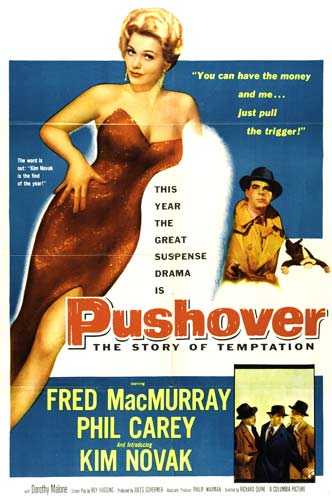
    It’s tempting to make more of Pushover (1954) than this tawdry film noir about a cop (Fred MacMurray) gone bad deserves. After all, many of the very best noirs were wretchedly low-budget affairs. Edgar G. Ulmer’s Detour (1945) is the nadir’s apex, a weird and compelling masterpiece of aesthetic impoverishment. Other examples are plentiful, from Anthony Mann’s Raw Deal (1948) to Joseph H. Lewis’s The Big Combo (1955). The climax of The Big Combo, for example, is shrouded in fog to hide an absence of sets. Mann and Lewis were aided immeasurably by the astonishing chiaroscuro camera work of John Alton. Pushover isn’t stylistically in this league. Lester White’s cinematography overall has the flattened look of 1950s television cop shows. On the other hand, there’s an effective and evocative use of rain-slick city (and backlot) streets.

    It’s equally tempting to make more of the fact that the role of mobster’s moll Lona McLane is played by 21-year-old Kim Novak in her film debut. The character, unfortunately, is underwritten with murky motivations. She’s eager to ditch her bank robbing boyfriend, but we’re never convinced that she could inhabit such a world to begin with, much less lure MacMurray into double-crossing the boyfriend and grabbing his loot. A reluctant femme fatale, in other words, curiously upstaged by the more recognizably “good” woman in the film played with confidence and sensuality by Dorothy Malone. Novak hadn’t yet figured out how to make her passivity alluring and mysterious and maddeningly erotic to the collective male psyche. Hitchcock’s Vertigo was four years in the future, as was Bell, Book and Candle (directed by Pushover’s Richard Quine).

    Pushover is Fred MacMurray’s film. He’s great at portraying a kind of Ron Burgundy denial in the face of disaster, especially when ill-conceived plans begin to crumble and the flop-sweat flows. There’s clearly an intended referential link between his role here as corrupt cop Paul Sheridan and his role a decade earlier as corrupt insurance salesman Walter Neff in Billy Wilder’s classic 1944 film noir, Double Indemnity. In both films we get to watch MacMurray’s rapid slide from disaffected schlub to calculating schlub to murderous schlub, desperately overreaching every step of the way. Double Indemnity was no cheap B-film, however. It was a well-financed top of the bill studio hit with an A-list cast that included Barbara Stanwyck and Edward G. Robinson, both of whom have a field day stealing scenes from Fred MacMurray. But to today’s noir-accustomed eyes it’s easy to see that MacMurray carries the film by refusing to stray from the genre’s narrow hardboiled constraints. MacMurray is Neff. And, in Pushover, ten years older and beginning to crack under the middle-aged weight of quiet desperation, MacMurray is Sheridan.

    Sure, Robert Mitchum got played for a sucker by plenty of dames—notably Faith Domergue in Where Danger Lives (1950) and Jean Simmons in Angel Face (1952)—but somehow Mitchum always retained his masculinity and dignity. Not so MacMurray. It’s almost as if Neff and Sheridan were being punished for presuming to assert themselves at all. We want to avert our eyes from MacMurray’s unseemly demise at the conclusion to Pushover. Not out of sympathy, but rather disdain for his contemptible failure. Television and Disney movies would soon make Fred MacMurray comfortable and wealthy portraying unassertive fathers and harmless eccentrics, characters unencumbered by the kinds of petty aspirations and awkward passions that kept Walter Neff and Paul Sheridan—and America’s legions of losers—awake at night.

    August 5, 2010
    Anthony Mann, Barbara Stanwyck, Bell Book and Candle, Detour, Dorothy Malone, Double Indemnity, Edgar G. Ulmer, Edward G. Robinson, Fred MacMurray, Hitchcock, Joseph H. Lewis, Kim Novak, Raw Deal, Richard Quine, The Big Combo, Vertigo

  • Houdini Pie

    Houdini Pie
    Paul Michel
    Bennett and Hastings 2010

    Reviewed by Bob Wake

    Seems as if everyone recently in the vicinity of our living room coffee table and its disorganized sprawl of books, magazines, CDs and stained coffee cups, spotted my review copy of Houdini Pie and, with a smile, said the name aloud. The title of Paul Michel’s engaging debut novel set in Southern California during the Great Depression evokes tall-tale whimsy, something wide-eyed and nostalgic, perhaps even slightly disreputable. Larry Cyr’s distinctive cover design seals the deal with its infinite sky-blue background and lone sepia-toned Dead End Kid pitching a baseball. Only it’s not a baseball. It’s a pickaxe flung heavenward.

    Houdini Pie is at heart the coming-of-age story of 24-year-old Hal Gates, semipro ballplayer and bootlegger’s son. Hal growing up, like any dutiful son, is drawn again and again into his father’s shady enterprises (“waiting for the umpteenth time for the coast to be clear”). The novel follows Hal’s grudging involvement in a crackpot search for Hopi Indian treasure rumored to be buried in tunnels beneath the streets of Los Angeles. Maybe, just maybe, it’s not a hoax. After all, there’s a real-life Hopi Indian chief with a map and a femme fatale for a daughter. There’s a geologist with a Flash Gordon gizmo for locating gold. There’s a psychic. And let’s not forget the psychic’s daughter.

    Sounds zany like a screwball comedy from the selfsame era. And it is. (Some of the novel’s craziest material is purportedly true, according to Michel in a fascinating Author’s Note.) But what really distinguishes Houdini Pie is that Paul Michel doesn’t write zany. His prose is lean and unfussy, artful in period detail and the construction of believable characters. His third-person narration expertly deploys alternating points of view, which allows us to get up close and personal with an unusually large cast of characters. Here, for instance, is Edith, the psychic, taking in her first baseball game along with her daughter, Isabelle, who’s developed an enthusiasm for the sport (and for the Sheiks’ young pitcher, Hal Gates):

    The ballpark was small by ballpark standards; fewer than four thousand seats, but to Edith it seemed enormous. The playing field was a vast carpet of grass so green it seemed painted. The ball players, in gray or white flannel uniforms, stalked its perimeter. Some swung bats at imaginary pitches; others played catch, a few made quick, sprinting forays onto the field, a dozen steps forward then back, retrieved on invisible leashes. Isabelle’s excitement was infectious as she pointed things out—the drink and peanut hawkers beginning their descents into the stands; the grounds crew laying down the white chalk lines, the black-suited umpires clustered behind home plate like a coven of witches.

    Michel is a veteran short story writer with dozens of literary magazine credits over the last fifteen years. For a first novel, Houdini Pie is structurally ambitious and plotted with a clever eye for withholding information and building suspense. A bootlegging episode gone disastrously wrong early in the novel, for example, becomes clear a hundred pages later. There are incidents in which characters appear in disguise unbeknownst to us until climactic revelations. All in all, Houdini Pie is a triumph of independent small press publishing (kudos to Seattle’s Bennett and Hastings). What’s needed now—while we await another novel from the author—is a collection of Michel’s short stories.

    July 29, 2010
    Bennett and Hastings Publishing, Houdini Pie, Larry Cyr, Paul Michel

  • My Son Killed Adolf Hitler

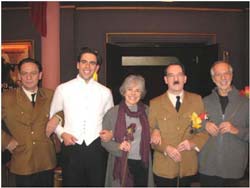
    Eli Roth was unforgettable playing “The Bear Jew” in Inglourious Basterds, Quentin Tarantino’s audacious wish-fulfilling WWII epic that posited the successful assassination of Adolf Hitler. I just caught up with this: Roth’s father, who is a Harvard professor and psychoanalyst, wrote a thoughtful, surprisingly moving essay on the pride he felt watching his son onscreen “machine-gun the Fuhrer’s face to a bloody pulp.”

    Photo and caption from patheos.com: “On the set of Inglourious Basterds (from left), Sylvester Groth, who played Josef Goebbels, Eli Roth in his character Donny Donawitz, Cora Roth, Martin Wuttke, who played Hitler, and Sheldon Roth.”
    July 29, 2010
    Adolf Hitler, Eli Roth, Inglourious Basterds, Quentin Tarantino, Sheldon Roth

  • In Envy Country

    In Envy Country
    Joan Frank
    University of Notre Dame Press 2010

    Reviewed by Bob Wake

    There’s not a false note in Joan Frank’s short story collection, In Envy Country, winner of the 2010 Richard Sullivan Prize in Short Fiction from the University of Notre Dame Press. Her stories combine rapturous surface detail and harrowing psychological acuity. Frank’s characters, like most of us, can’t resist measuring themselves against those friends, family and business associates who seem blessed with beauty or success, privilege or power.

    “The very beautiful owned a secret,” declares the forty-year-old narrator of “Savoir Faire, Savoir Vivre,” a displaced Californian in Paris (“trying to write, and to read all I can”), where she has met up with a former high school friend, a professional swimmer from Sacramento, whose sister Nikki, a painter, had been “the most dazzling girl in school.” Sipping wine cocktails in a French café, the two women reminisce and commiserate, sharing their nearly morbid fascination with the unbearably gorgeous Nikki. (“You could never come to terms with beauty like that, but even at fourteen you could see that the world was ruled by it.”) As we learn of the rise and fall of Nikki’s fortunes, the birth of a daughter, a broken marriage, artistic struggles, and finally “showing her age, like other mortals,” we’re asked to consider beauty as an abstract force, troubling and destructive to all who fall within its orbit. “Beauty torches the place,” the narrator insists.

    Perception is a prism that changes with the light. In Frank’s stories, a character’s epiphany is no sure bet or shortcut to the truth of the matter. Her characters always respond in character. Point of view is everything. We’re uncertain at times where to place our allegiance. Reader anxiety is half the fun here, but it requires a willingness to step outside of our comfort zone. Frank works unsettling magic with awkward social situations like dinner parties and family gatherings, all of which invariably erupt with repressed hostilities and dark revelations.

    In the title story an ostentatiously wealthy couple argue and storm out of their mansion at dinnertime, leaving their guests—a married couple of modest middle-class means—to watch the oven as well as the argument itself framed in the picture window like a silent movie. The visiting couple find themselves reevaluating their own marriage. In “A Thing That Happens” a dinner party is derailed when two guests describe an experience from a recent European vacation: the different way men vs. women respond to the sight of a twentysomething blonde with enormous breasts (“way out of proportion to the rest of her… like a neon sign… a wheelbarrow”). The men, predictably, are delighted, whereas the women’s gaze is fraught with anger and, yes, envy. (“Because that is what men want.”)  The anecdote, told by an aging couple, is set against the short story’s central character, a young woman coming into her sexuality, whom we meet in the opening sentence: “Sara Bream gathered her breath so that her pillowy twenty-year-old chest, in its soft China-blue sweater, filled to even greater, lovelier loft: she let it out slowly and forcefully.”

    Frank’s range is impressive. She can write funny and sharp about modern office politics (“A Note on the Type” and “Betting on Men”), craft a heartbreaking coming-of-age tale about growing up in 1960s Sacramento (“Rearview”), and even take us on a wildly disturbing transgressive visit to a Spanish sex club (“Sandy Candy”). While In Envy Country hasn’t received the high-profile attention of, say, Wells Tower’s Everything Ravaged, Everything Burned, or Elizabeth Strout’s Pulitzer Prize-winning Olive Kitteridge, Joan Frank’s provocative short story collection is fully deserving of similar praise and wide readership.
    June 10, 2010
    Elizabeth Strout, Everything Ravaged Everything Burned, In Envy Country, Joan Frank, Olive Kitteridge, Richard Sullivan Prize in Short Fiction, University of Notre Dame Press, Wells Tower

  • Sacred Bond

    Adam Gopnik in The New Yorker:

    Was Jesus one with God in the sense that, say, Sean Connery is one with Daniel Craig, different faces of a single role, or in the sense that James Bond is one with Ian Fleming, each so dependent on the other that one cannot talk about the creation apart from its author?

    May 23, 2010
    Adam Gopnik, Daniel Craig, Ian Fleming, James Bond, Sean Connery, The New Yorker, What Did Jesus Do?

  • Although of Course You End Up Becoming Yourself

    Although of Course You End Up Becoming Yourself
    David Lipsky
    Broadway Books 2010

    Reviewed by Bob Wake

    althoughofcourse

    In the sad days following the suicide of 46-year-old writer David Foster Wallace in September 2008, when the Internet seemed to spontaneously erupt with eulogies far and wide, novelist Steve Erickson wrote: “There are no statistics to prove it, but the anecdotal evidence is that he may have influenced the upcoming generation of writers more than almost anyone else.” There’s his narrative style, certainly, discursive and intellectual, yet brimming with colloquialisms and concise twelve-stepisms. The dizzying footnotes. The convoluted self-consciousness unfolding like Chinese boxes of innerspace, compulsive, chatty. A humane and witty voice both inviting and wounded. George Saunders’s New Yorker short story from last year, “Victory Lap,” with its hypertext parentheticals is only one of the more recent examples of Wallacean influence.

    David Lipsky’s Although of Course You End Up Becoming Yourself: A Road Trip with David Foster Wallace is not unlike one of those always fascinating Paris Review author interviews. Supersized, of course, befitting the author of Infinite Jest, the still notorious big fat dystopian novel of twining plots converging on addiction and recovery, cinema and suicide, tennis and terrorism. Lipsky’s book, apart from some graceful introductory material, is essentially a 300-page transcript—from what must have been a mountain of cassette-tape research for a Rolling Stone profile that subsequently wasn’t written—of Lipsky’s conversations with the writer during the last five days of the 1996 book tour for Infinite Jest.

    Because Wallace—suddenly and explosively famous—was written about and interviewed extensively during and after this book tour, some topics of conversation will be thematically familiar to fans: the cigarettes and chewing tobacco that often got the better of him (“I’ve got a raging nicotine problem. That like that I really need to quit, at least the chewing tobacco. It makes your fucking jaw fall off. You know?”); John Updike is overrated (“And you just have to wade through so much purple empty writing to get to anything that’s got any kind of heartbeat in it. Plus, I think he’s mentally ill”); Stephen King is underrated (“He’s got an almost Salingerian feel for children”); the influence of filmmaker David Lynch on his writing (“I mean, most of the word surrealism is realism, you know? It’s extra-realism, it’s something on top of realism. It’s the one thing in a Lynch frame that’s off”).

    He talks about the too-easy resort to irony and ridicule that he finds in David Letterman and Rush Limbaugh. “I don’t know what’s going to come after it,” he says, “but I think something’s gonna have to.” Lipsky then asks Wallace to speculate—“What do you think it will be?”—and Wallace’s answer is startlingly prescient of an Obama-like appeal to civic virtue and our better instincts:

    My guess is that what it will be is, it’s going to be the function of some people who are heroes. Who evince a real type of passion that’s going to look very banal and very retrograde and very … You know, for instance, people who will get on television, and earnestly say, “It’s extraordinarily important, that we, the most undertaxed nation on earth, be willing to pay higher taxes, so that we don’t allow the lower strata of our society to starve to death and freeze to death.” That it will be vitally important that we do that. Not for them, but for us.

    Wallace struggled in his teens and early twenties with drug addiction and clinical depression, successfully overcoming the former while keeping at bay if never fully banishing the latter. Lipsky’s resurrected transcripts give us Wallace speaking openly about his past while cautioning that “there’s certain stuff about this that I won’t talk about.” To the extent that he feels remorseful about having pressured Wallace to the point of irritation in hope of some juicy disclosure about a rumored dalliance with heroin (“Why is this of particular interest?” Wallace asks, in a tone described as “annoyed”), Lipsky makes clear that he was himself feeling pressured by his editors to take this tack. All in all, his role as archivist and tour-guide is impeccable and heartfelt. Lipsky, like so many of us, clearly shares a deep sense of loss, as in this bracketed aside in response to Wallace recalling his troubled college years: “Wouldn’t it be great to fall in through this transcript, back to that house, and tell him to live differently, explain to him how it was all going to go? It’s suddenly odd that this isn’t possible.”

    May 12, 2010
    Although of Course You End Up Becoming Yourself, David Foster Wallace, David Letterman, David Lipsky, George Saunders, Infinite Jest, John Updike, Rolling Stone, Rush Limbaugh, Stephen King, Steve Erickson, The New Yorker, Victory Lap

  • Franny and Zombie

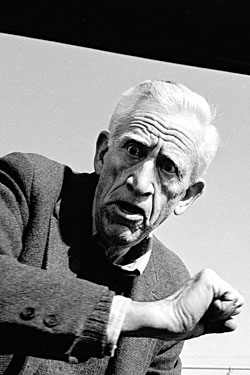
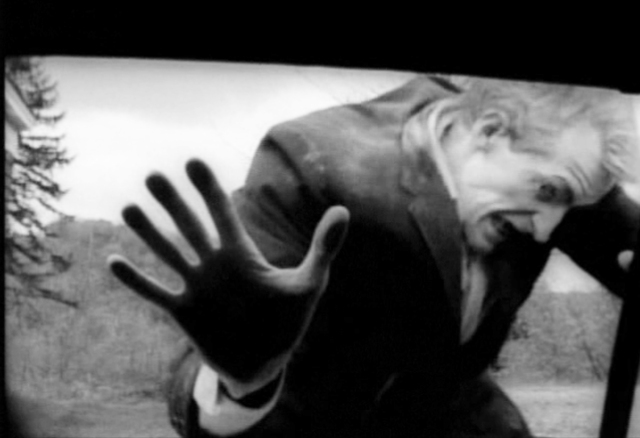
    You know that photo of an angry wizened J. D. Salinger at a car window? Remind you of anything? Why, of course. The graveyard zombie at the car window in the opening scene of George Romero’s Night of the Living Dead.

    J.D. Salinger (1988)
    Night of the Living Dead (1968)

    April 8, 2010
    George Romero, J. D. Salinger, Night of the Living Dead

  • Judy Endow profile in New York Times

    Cambridge Book Review Press author Judy Endow (Making Lemonade: Hints for Autism’s Helpers) was recently profiled in the New York Times. Story includes photos and an audio interview. Congratulations, Judy!

    April 8, 2010
    Autism, Cambridge Book Review Press, Judy Endow, Making Lemonade: Hints for Autism’s Helpers, New York Times

  • Cottonbound: An Audio Chapbook

    Madison poet Norma Gay Prewett visited us in Cambridge to record several pieces of poetry and prose centered around her mother, who died four years ago on Prewett’s 56th birthday. Cottonbound: An Audio Chapbook is now online at Cambridge Book Review. Here’s a sample:

    Bill of Lading / Norma Gay Prewett

    https://cambridgebookreview.files.wordpress.com/2010/04/billoflading11.mp3

    A chewed-looking Styrofoam snowman head,
    ++++++Black felt pipe, googly stuffed-animal eyes
    ++++++(also the bag of eyes, I discover later)
    A sweater that smells disagreeable unless it is your mom’s
    ++++++An ocher clipping with a penned-in arrow
    ++++++To my head—”My Daughter” as if I don’t
    ++++++Recall sitting in turpentine at Methodist art camp
    Some recipes she never used, but carefully copied longhand
    ++++++Swedish meatballs, ham loaf, Hanukkah cookies
    ++++++Did she know we were not Jewish? Did she know
    The people in the multi-picture frame, never filled with us,
    ++++++So beautiful and fresh, having action-packed fun?
    ++++++She never saw the sea, but pictures of the sea—
    ++++++Did she long for the thrum of waves on pebble?
    Some hanks of yarn, maybe free, from the spinners where
    ++++++Her working life began at fifty, where she nearly
    ++++++Fell in love with her foreman, but for her bad heart
    Her bad heart, to my brother, who died with it in his chest.
    ++++++Her Ozark drawl, her temper, her madwalk to my sis-
    ++++++ter; her terror of twisters to all, her scrawl she left
    ++++++backwards, to her ma. After all, most say I got
    Her hazel eyes, her love of fun, her Irish hair, and the low
    ++++++Thyroid that left her brows and mine scant
    ++++++She left her death-day as my birthday, to me, alone.

    April 1, 2010
    Bill of Lading, Cambridge Book Review, Cottonbound: An Audio Chapbook, Norma Gay Prewett

  • Psalms

    Ralph Murre’s poetry sequence, Psalms (Little Eagle Press, 2008), has a solemn title but the work is playful and irreverent. The accompanying pen and ink drawings, also by Murre, add immeasurably to the experience, grounding the poems in intricate worldly detail and darkening webs of cross-hatching.

    The collection comprises fifteen psalms, eleven lines each, most of the psalms beginning with a variation on “I may go back…” and ending with “If I’m singing at all.” Memory is the theme. Restless memories that reach for transcendence but spiral instead toward resignation and regret.

    Murre’s psalms reflect Kerouac’s and Salinger’s America where sadness and ecstasy are inseparable:

    I may go back and build an ark, down by the lake,
    in the city park where we barked so long ago, you & I;
    build it to save mating pairs of military-industrialists,
    realists and realtors, nihilists and meat-cutters […] [Psalm II]

    The exuberance of Murre’s run-on catalogs and infectious wordplay keeps his psalms from sinking into despair. Like this wonderful blast from a farmland childhood: “Saturday bath and Sunday hath-nots and shalt- / nots, cow shit and old math and raspberries, dairies and cheese, / more weeds than corn, a real damned horn-of-plenty […]” (Psalm XIII).

    Ralph Murre illustration from “Psalms”

    He’s especially good at capturing the spark and manic rhythm of urban life:

    […] pickled herring, pickled beets, picking up the beat
    of trash-can slam, picking up jobs of poor-I-am and
    picking up women in good-night dreams, bad-night bars,
    rusted cars in South-Side parking-lot wake-ups, staggering
    to fourth-floor walk-ups, singing blue of our break-ups,
    if we’re singing at all. [Psalm VIII]

    When mania crashes, however, the outlook is terrifying:

    The affable, laughable you and I climbing to a sky
    of scaffolds on unapproved ladders, flattery
    getting us everywhere we ought to avoid,
    the void looming—booming sub-woofer void,
    passing in the night frightful bass-line of void,
    angels flying south in missing-man formations […] [Psalm VII]

    Murre’s psalms seem in the end to consider whether celebration is possible at all. The limitations of optimism. The struggle to keep afloat, to manage our moods. But above all, Ralph Murre’s Psalms offers us the salvation of poetry and art as reason enough for staying the course.

    March 24, 2010
    Little Eagle Press, Psalms, Ralph Murre

Previous Page Next Page

Blog at WordPress.com.


Loading Comments...
 

    • Subscribe Subscribed
      • Coffee Spew
      • Join 55 other subscribers
      • Already have a WordPress.com account? Log in now.
      • Coffee Spew
      • Subscribe Subscribed
      • Sign up
      • Log in
      • Report this content
      • View site in Reader
      • Manage subscriptions
      • Collapse this bar