
Category: Wisconsin
-
Sustainable Living

Sustainable Living
Elsa Nekola
Willow Springs Books 2021Reviewed by Bob Wake
Wisconsin writer Elsa Nekola’s debut collection of short stories, Sustainable Living, is so deeply knowing of the Upper Midwest that it functions as a kind of wisdom literature. Granted, the wisdom may not always be welcome. Disillusionment is a recurring theme, as is the fictional town of White Birch, where old habits die hard. A retired supper club owner (“Winter Flame”) can’t quit his mealtime routine of “folding his cloth napkin into a swan.” The betrayal of a fragile summer friendship (“River Through a Half-Burnt Woods”) replays itself in a woman’s memory like a wound that refuses to heal.
Fifteen-year-old Coral, the protagonist of “Oktoberfest,” feels preternaturally at home in the Northwoods, but less so in an adult world of struggling families and economic hardship. Addiction. Unwanted sexual attention. “She’s beginning to think,” we’re told, “that being a woman means staying where you’re needed, not where you want to go.”
Coral, by story’s end, may not know where she wants to go, or where she fits in. But readers will recognize in the achingly fine-tuned descriptions of landscape and wildlife that Coral has a near-mystical connection to her surroundings:
Today, there’s frost on the grass, and a chill that won’t leave the air until April. The mallards and black ducks have begun to court, and in midwinter the hairy woodpeckers will drum on hollow trees.
Nekola is especially good on the complexities of mother-daughter relationships, whether a grown daughter in “Meat Raffle” returning from Chicago to visit her eccentric literary mom in southeastern Wisconsin (“She thinks she’s the first sixty-year-old widow to discover Shakespeare,” fumes the daughter), or the title story’s resourceful fourteen-year-old Myra Pavelka, abandoned to relatives and afternoon barrooms when her mother hastily takes flight under possible criminal circumstances.
Sustainable Living won the 2020 Spokane Prize for Short Fiction from Willow Springs Books, whose top-notch book design compliments the jeweled precision of these stories. Elsa Nekola’s work has appeared in numerous literary journals, from Ploughshares and Passages North, to Rosebud Magazine and Midwestern Gothic.
-
Mudstone
Thrilled and honored that my short story “Mudstone” won First Place in this year’s Wisconsin People & Ideas fiction contest. The story will appear online and in print next month in their summer issue. [Update 7/18/17: “Mudstone” can be read online here.]

-
Tom Connor’s Gift
Tom Connor’s Gift
David Allan Cates
Bangtail Press 2014Reviewed by Bob Wake

The time frame of David Allan Cates’s bravura new novel, Tom Connor’s Gift, covers roughly three weeks that Janine McCarthy spends alone in a Montana cabin both evading and confronting her grief over her husband Mark’s recent cancer death. Janine, a 49-year-old doctor, is in a bad way, not even certain she wants to join her two grown children for Thanksgiving back at their family farm outside of Madison, Wisconsin. She’s soon drinking more than she should. Smoking cigarettes. Neglecting her appearance. The cluttered cabin begins to smell bad from piled garbage. She can’t muster the energy to name the small dog she’s acquired, simply christening him “Puppy.” Cates fashions a rich and elaborate narrative by recognizing that we are never really “alone” with grief. Memories loom large and become persistent companions. Reality takes on the heightened near-mystical quality of a waking dream.
Consider, for instance, Janine’s standoff with a bear snooping and foraging ever closer to the cabin:
I sit up in bed and turn my feet onto the floor and struggle with my boots. I suddenly remember the terrible, slow breathing of the bear through the door and remember shooting the pepper spray and it feels as if it were a dream. Did I really do that? Did I really have a bear right outside the door and still dare to open the door? Did I spray into the wind?
After all, we experienced the bear at the door too—at least we read about the bear in Janine’s own telling—and the pepper spray blowing back into Janine’s face causing acute distress to her eyes and throat. Pretty much, we’re convinced. But other times, Janine imagines seeing the bear outside in the shadows. On another occasion, the bear’s face appears at the cabin window and morphs into the smiling face of her dead husband. Despite her steely ER-tested nerves, Janine warily muses: “Do dream memories and other memories get stored in the same place? And if you forget which memory is a dream and which is a waking event, does that mean you’re insane?”
Deeply entwined with Janine’s story is the parallel narrative of the novel’s eponymous gift-giver, Tom Connor. They were briefly lovers when Janine was sixteen and Tom was twenty. Sorted into stacks on a table in the cabin are nearly one hundred and fifty letters she subsequently received from Connor—freelance journalist, frustrated novelist, drunkard—through the years. Janine doesn’t merely share many of Connor’s vivid letters with us, she struggles to contextualize them for us and for herself. The violence that Tom Connor is witness to in 1980s Central America—era of the CIA-funded Contras and the civil wars in Guatemala, El Salvador, and Nicaragua—is unflinchingly recounted. (Cates’s work has never shied away from articulating the brutality at the heart of so much U.S. history, most notably in his powerful 2008 novel on the subject of slavery, Freeman Walker.)

David Allan Cates. Photo: Bangtail Press. Cates is a seasoned storyteller—this is his fifth novel—and Tom Connor’s Gift is awash in stories that are by turns raucous, hair-raising, and heartfelt. The author orchestrates a series of climactic chapters that range across memory and time with breathless page-turning dramatic force. While Cates has spoken of his new novel as completing a “homecoming trilogy” begun with his well-received 1992 debut Hunger in America and 2012’s award-winning Ben Armstrong’s Strange Trip Home, each of these novels can be experienced on their own as satisfying individual works. Taken together, however, they represent a unique and eye-opening expression of epic American themes encompassing landscape and desire, love and loss, social justice and historical accountability.
-
Ad for “The G.O.D. Club” in Madison Magazine
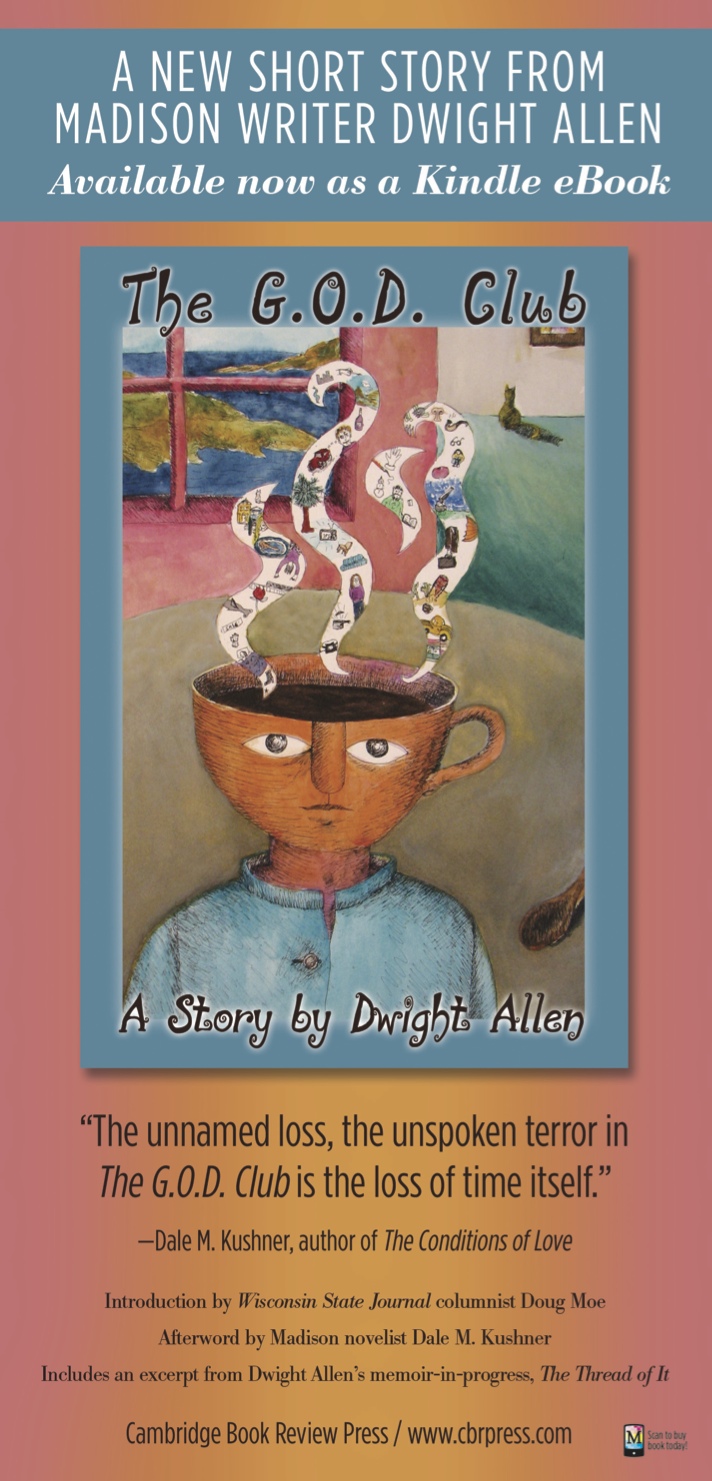
Ad for The G.O.D. Club appears in the September 2014 issue of Madison Magazine.
-
Dave & Phil Alvin in Madison

Dave & Phil Alvin, July 25, 2014. High Noon Saloon, Madison, Wisconsin. Photo: Bob Wake. A capacity crowd at Madison’s High Noon Saloon last night greeted brothers Dave and Phil Alvin performing with their three-piece backup band, The Guilty Ones. In a word (or two) we were blown away. They played for two and a half hours without a break, including four encore numbers. The Big Bill Broonzy tunes from their new album, Common Ground, were only a portion of the ambitious set list, which ranged through 80s Blasters songs, material from Dave’s solo albums, and a cover of James Brown’s “Please, Please, Please.” Phil’s voice was spellbinding and powerful, confirming a miraculous recovery from 2012 health concerns.
Couple of highlights: a monstrous drum solo from Lisa Pankratz on Dave’s song “Dry River”; and Dave telling the story of composing “What’s Up With Your Brother?” after a Madison solo gig a few years ago at High Noon Saloon: he kept getting interrupted on his way to use the bar’s bathroom by audience members asking about his brother. The story, of course, was followed by Dave and Phil’s bang-up rendition of the song.
-
The G.O.D. Club
Now Available from
Cambridge Book Review Press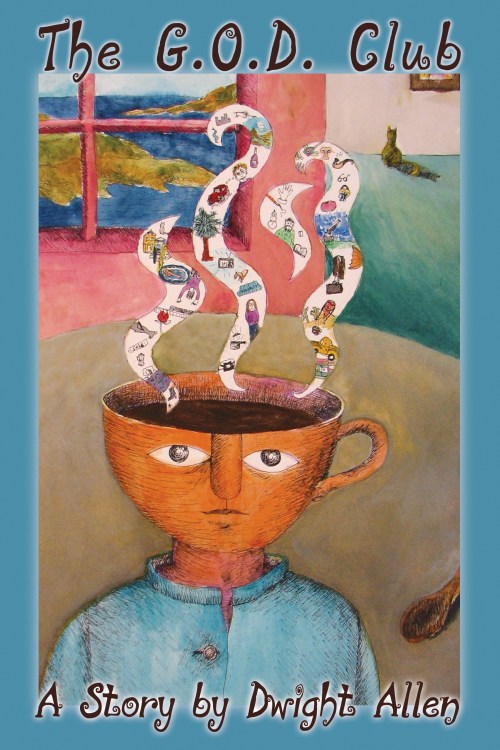
The G.O.D. Club
A Story by Dwight Allen$2.99 Kindle ebook
“The G.O.D. Club” is a new short story by Dwight Allen, author of two novels, Judge (2003) and The Typewriter Satyr (2009), and a collection of short stories, The Green Suit, reissued in 2011. Bonus features of this exclusive ebook single from Cambridge Book Review Press include an introduction by Wisconsin State Journal columnist Doug Moe, and an afterword by novelist and poet Dale M. Kushner (The Conditions of Love). Also included is “The Thread of It,” an excerpt from Dwight Allen’s memoir-in-progress.
“The unnamed loss, the unspoken terror in ‘The G.O.D. Club’ is the loss of time itself.”—Dale M. Kushner, author of The Conditions of Love.
-
Medium Cool
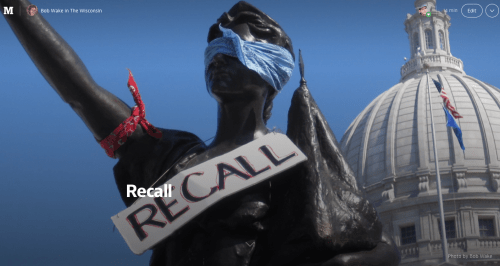
I just posted a new short story of mine, “Recall,” to the website Medium. What I love about the site is the elegant simplicity of the page design, which makes for one of the very best environments I’ve seen for digital reading. The brainchild of Twitter’s co-founder, Evan Williams, Medium wants to do for long-form work what Twitter has done for focused brevity. Techcrunch.com has an excellent write-up on Medium from last fall.
[Update: Also worth checking out is David Carr’s May 25, 2014 New York Times column: “A Platform and Blogging Tool, Medium Charms Writers.”]


 Coffee Spew