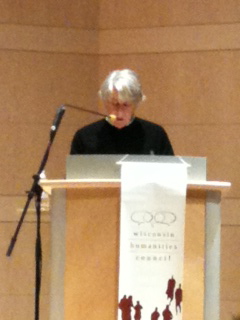
Larry Watson at the Wisconsin Book Festival 10/19/11.
Opening night of the 10th annual Wisconsin Book Festival featured a lively reading/Q&A with Milwaukee-based novelist Larry Watson (Montana 1948, American Boy) and Madison novelist and short story writer Dwight Allen (The Green Suit, The Typewriter Satyr) at the Madison Museum of Contemporary Art. Novelist Mary Gordon, who was scheduled to join them, had to cancel due to an airline delay, although it was promised that she’d be at the festival for a reading the following evening. Watson read from his just-released American Boy(Milkweed Editions), a coming-of-age novel set in fictional Willow Falls, Minnesota in 1962. The title might suggest a Young Adult novel, but American Boy isn’t so easily categorized. It’s suffused with the volatile sexual tension and barely suppressed violence that mark Watson’s best work. (I’ll be reviewing the novel in an upcoming issue of Wisconsin People & Ideas.) [Update 1/31/12: my review of American Boy is now posted on the Wisconsin Academy website.]
Dwight Allen at the Wisconsin Book Festival 10/19/11
Dwight Allen read the opening pages of his mordantly funny short story “Succor” from The Green Suit, a collection first published in 2000 and just reissued, with an added story, from the University of Wisconsin Press. “Succor” concerns an unlikely friendship that develops between Allen’s recurring character, Peter Sackrider (whose perfect name manages to suggest both a lewd euphemism and the mopey bemusement with which Sackrider views the world), and a disreputable force-of-nature named Larry Hale, who may or may not have stolen a necklace belonging to Sackrider’s wife. Props to Allen for mentioning during the Q&A that he recently read and enjoyed David Foster Wallace’s posthumous novel, The Pale King. He also candidly admitted an inability to get beyond the first three-hundred pages of Wallace’s woolly-mammoth masterpiece, Infinite Jest, a novel which, Allen felt, exemplified “the limitations of brilliance.”
Today’s mail brought copies of the Elkhorn, Wisconsin Popcorn Press anthology, The Hungry Dead, edited by Popcorn’s founder, Lester Smith. The delightfully disgusting cover was designed by Smith’s daughter, Katheryn. The collection is cool from several perspectives (aside from the fact that my poem “The Last Supper” is included). First, Lester solicited submissions during October via social networking platforms like Twitter and Facebook, as well as a sharp website, and then announced the chosen selections on Halloween with a mockup of the book ready for printing. Planning, executing, and printing a book this quickly is a crazy challenge, but the proof is in the blood pudding, as they say. The Hungry Dead is a classy production: sixty-five works of poetry and fiction from eighteen authors, including several well-versed Wisconsinites familiar to us such as John Lehman, Sarah Busse, Michael Kriesel, and Dead editor Lester Smith. The Hungry Dead is available from Popcorn Press and Amazon (you can peek at the contents with Amazon’s Look Inside the Book feature).
My short story collection, Caffeine & Other Stories, is now available as a Kindle download for $2.99. It’s a newly expanded edition that includes four bonus stories not found in the $12.95 paperback.
Blurbs from the 1997 edition:
“We see stimulants from caffeine to cocaine, alcohol and marijuana to nicotine. His characters glean intelligence (however wacky, artificial, or genius) and courage from their personal favorite highs. In a rather dark interpretation, I often felt as though many of his characters were on a bumpy ride to suicide. Yet, just when we are shaking our heads at them, Wake surprised me with his unfaltering wit and I laughed my fears away. After all, this is the human spirit he is so masterfully portraying …” —Tracy Walczak, BookLovers.
“Caffeine is a book of constant surprises. In this collection of linked stories set in south-central Wisconsin, Wake sets before us the confusions of life in yuppie heaven. And he does so with tough love, and a wit which will have you laughing wickedly along. Bob Wake has a great sense of where he lives, Madison, Wisconsin, postmodern America. I, for one, look forward to continuing words from this bright writer.” —Jim Stevens, editor of The Journey Home: The Literature of Wisconsin Through Four Centuries.
“The range shown by Bob Wake in creating this series of interconnected, readable stories that stand well on their own is a considerable accomplishment. Reading Caffeine & Other Stories is like being a kid again and reaching into a grab bag at a rich friend’s birthday party: you can’t know what you are going to get, but you can be sure it’s going to be damn good.” —Chris Lott, Eclectica.
“Bob Wake writes likes Ralph Steadman draws: a few choice words and boom! there’s a real, living, breathing character … Caffeine & Other Stories kicks ass, rocks hard, and leaves you wanting more.” —Marie Mundaca, Erupture.
“Mr. Wake writes with confidence and polished prose, and obviously knows well how to craft a short story.” —J. Allen Kirsch, author of Madlands, and God’s Little Isthmus.
“Wake is a first class teller of tales and spinner of stories.” —Midwest Book Review.
Horror writer Jack Lehman stopped by the Coffee Spew crawlspace studio last night and videotaped what is either a chilling Edgar Allan Poe-inspired short story or else a deeply disturbing autobiographical confession.
“Tell-Tale Camera” by Jack Lehman
“We need one to keep a record of things. My garden, the cats…they are all changing and we don’t have photographs of them.”
“Yes,” I said, fumbling with the compact digital camera no larger than an old-fashioned metal cigarette case. The last camera we’d owned, I’d dropped in a shopping center parking lot. It had slipped right out of my pocket as I swung my sport coat out from the back seat of the car. Now I tend to keep a camera in my front shirt pocket. What are the chances of it falling out from there unless I really bend over? Anyway, I’d brought the broken camera to several places and they told me it would cost over a hundred dollars to repair, “You might as well get a new one for that amount.”
I hadn’t. But mother took the big step. Oh, it was to be a present for my birthday, but I knew better. This would be our camera. I would figure out how to use it and she would take all the pictures. But until I pressed the “on” button, I hadn’t realized, it talked.
I was struck by its soothing female voice. And as someone who was, or would soon be, a 55 year old man still living at home, I didn’t often hear soothing female voices, at least not young, sexy ones.
“You are in the narrow focus zone.” This was still better to hear than what Cynthia, owner of Cynthia’s bar down the street, said to me later that day, when she stopped her car as I was walking my dog.
“Robert, you must keep your mother away from karaoke nights at my place. She’s an embarrassment and actually driving away customers.”
“I’ll see what I can do,” was my sheepish reply. But I could do nothing. That, I thought, was why she bought a camera. She wanted pictures of herself on the bar’s deck, swaying with the microphone, a 300 pound woman in a miniskirt, with her hair piled on top of her head and sparkle around her eyes. She wouldn’t let me attend. Not that I wanted to. She would invite highway construction workers, UPS delivery men, even the guy who drove the big green garbage truck. She didn’t want them to know she had a son. Not that it mattered, I knew as I listened to the music from Cynthia’s Place down the street. These men never came anyway.
So what am I to do, I wondered. My Internet gift business was just getting started, I need a home and my computer. She owns this place outright, and will live forever. Plus she gets $400 each month in Social Security disability payments. I couldn’t live without that. I knew I could deposit the SSI checks in our joint account. I’d done this before. The bank didn’t care; after all I was the one who paid the bills. They didn’t want to deal with my mother any more than anyone else did.
She would steal the camera from my room and take it to Cynthia’s. The bartender reluctantly took photos of her. She forced him to somehow. Sometimes I clicked through the pictures. How disgusting. I could hear her toneless voice singing along to the recorded karaoke music. It was a bad Bob Dylan imitation: “But lately I see her ribbons and her bows have fall-en from her curls. She takes just like a wom-an, yes, she does. She makes love just like a wom-an, yes, she does. And she aches just like a wom-an. But she breaks like a little girl.”
To which my camera might add: “Low battery power.”
And then someone knocked at the front door. It was a miracle disguised as a man. He wore the orange vest of a highway worker. They had been widening County Hwy B, that went in front of our house, all summer. It was the main thoroughfare through the little village. In order to make the most of this the town board had allowed the state department of transportation not only to add curbs and gutters but also a sidewalk to the West side of the road. This cut into my mother’s hillside property by fifteen feet, but the result, I knew, would increase its value in the long run.
“My name is Ralph Switchgrass, I’m an engineer with DOT.” I stared at this strange little man. He looked like pictures I’d seen of the American author Edgar Allan Poe.
“How can I help you?” I asked.
“Well,” Switchgrass replied, “I’m afraid we’ve made a little discovery in bulldozing part of your hill today. It’s near where we are going to put some new steps down to the street.”
“Discovery?”
“Yes, we’ve uncovered an abandoned well. As I said, close to the place the stairway will go. It’s quite interesting, actually. You can come out and see the top circle of yellow stones. There was a makeshift wooden cover, but…”
“But what?”
“I’m afraid it doesn’t meet legal requirements. You will have to get it sealed off and inspected by a license plumber before we can go any further.”
“Listen,” I replied angrily, pushing past the man and walking quickly twenty feet toward the excavation, “this construction wasn’t our idea. We’re not paying for anything. You want it sealed off and some plumber to certify that, then you’re the ones who are going to arrange it.”
Switchgrass caught up to me and stood by my side.
I mellowed a bit looking at the hole. “Why would they close up this well and drill another right by the house. Does that makes sense?” I asked.
Ralph Switchgrass simply took an apple-sized rock and dropped it down the old well. It made a clunk thirty or forty feet below, but not a splash.
“Let me see what we can do,” the engineer said, blinking over at me.
But I was already lost in the world of possibility. The hole was round enough and deep enough for my mother.
“What do you want?” she asked impatiently, early that evening. She was wearing her karaoke outfit ready for another night out. “Why do we have to go out there and look at this now!”
I will never hear that grating, whining, peevish voice again, I thought as I looked quickly both ways and then— twe were standing on the edge of the old well— swung the baby sledge hammer I’d been holding behind my back, and wacked mom on the top of the head. For a moment, nothing happened. She just stood there. And then as her knees started to buckle I dropped the sledge and gently guided her body so that she collapsed not to the ground but into the gaping black hole before us. It was ugly, I have to admit. How her head had smacked against the outer rim before gravity sucked her huge body into the abyss. And the sound of her hitting bottom was grotesque.
But I couldn’t think about that now. I had work to do before dark. I got the rusty wheelbarrow from around back, dumped the water that was sitting in it and with a spade went down the rear road to a spot where the highway crew had dumped some of the earth they’d scraped up from the expansion. I filled one load, wheeled back to the old well and dropped it down the hole. Then I did this four more times. It wouldn’t do much in terms of filling the well, but it would hide any sight of mother’s body. The highway people would cap this, put the appropriate ground cover on top and that would be that.
Who would ask about her? Neighbors might notice she wasn’t riding her old balloon-tired bike toward town anymore, but they would assume it had fallen apart, or that she was sick, or maybe she’d gone to visit a relative in Florida and never returned. Even the most polite of them would not hazard asking me, her son, about her. Better to imagine the best. Let sleeping dogs, or in her case, let a dead, overweight, obnoxious cat, lie.
That night I took a warm bath. I opened a bottle of cheap Australian red wine and even found an old leather-bound copy of Poe to read in the tub. Afterwards, for the first time in years, I slept peacefully. Not even dreaming of “Annabel Lee” in her “sepulcher there by the sea, in her tomb by the sounding sea.”
Late the next afternoon Ralph Switchgrass was back at my door. This time. with him he had a plumber, Jim Lean, and Switchgrass’s boss, Rich Benson. DOT would take care of the well. Take care of everything. Cementing it closed, getting the signed legal documents, finishing the steps and seeding that part of the hill they had excavated to make way for the steps. This of course they had to point out to him on the property, by the old well.
“It’s a shame to cover an antique well like this,” Benson felt compelled to say to the group, “but who knows, in another hundred years there might be reason to unearth it once again.”
“What was that?” Jim Lean asked.
None of the rest of us standing there in the late-August twilight heard anything.
“It was a woman’s voice,” he insisted. “Listen.”
There was the slight ruffling of leaves, some distant earth-moving equipment from farther down the road, and then… A soothing female voice. Young, sexy and damning, echoed up from deep within the old well.
“You are in the narrow focus zone.”
“We’ve got to go down there and find out what that voice is,” Benson demanded.
In the distance, the sound of karaoke music began.
In Envy Country
Joan Frank
University of Notre Dame Press 2010
Reviewed by Bob Wake
There’s not a false note in Joan Frank’s short story collection, In Envy Country, winner of the 2010 Richard Sullivan Prize in Short Fiction from the University of Notre Dame Press. Her stories combine rapturous surface detail and harrowing psychological acuity. Frank’s characters, like most of us, can’t resist measuring themselves against those friends, family and business associates who seem blessed with beauty or success, privilege or power.
“The very beautiful owned a secret,” declares the forty-year-old narrator of “Savoir Faire, Savoir Vivre,” a displaced Californian in Paris (“trying to write, and to read all I can”), where she has met up with a former high school friend, a professional swimmer from Sacramento, whose sister Nikki, a painter, had been “the most dazzling girl in school.” Sipping wine cocktails in a French café, the two women reminisce and commiserate, sharing their nearly morbid fascination with the unbearably gorgeous Nikki. (“You could never come to terms with beauty like that, but even at fourteen you could see that the world was ruled by it.”) As we learn of the rise and fall of Nikki’s fortunes, the birth of a daughter, a broken marriage, artistic struggles, and finally “showing her age, like other mortals,” we’re asked to consider beauty as an abstract force, troubling and destructive to all who fall within its orbit. “Beauty torches the place,” the narrator insists.
Perception is a prism that changes with the light. In Frank’s stories, a character’s epiphany is no sure bet or shortcut to the truth of the matter. Her characters always respond in character. Point of view is everything. We’re uncertain at times where to place our allegiance. Reader anxiety is half the fun here, but it requires a willingness to step outside of our comfort zone. Frank works unsettling magic with awkward social situations like dinner parties and family gatherings, all of which invariably erupt with repressed hostilities and dark revelations.
In the title story an ostentatiously wealthy couple argue and storm out of their mansion at dinnertime, leaving their guests—a married couple of modest middle-class means—to watch the oven as well as the argument itself framed in the picture window like a silent movie. The visiting couple find themselves reevaluating their own marriage. In “A Thing That Happens” a dinner party is derailed when two guests describe an experience from a recent European vacation: the different way men vs. women respond to the sight of a twentysomething blonde with enormous breasts (“way out of proportion to the rest of her… like a neon sign… a wheelbarrow”). The men, predictably, are delighted, whereas the women’s gaze is fraught with anger and, yes, envy. (“Because that is what men want.”) The anecdote, told by an aging couple, is set against the short story’s central character, a young woman coming into her sexuality, whom we meet in the opening sentence: “Sara Bream gathered her breath so that her pillowy twenty-year-old chest, in its soft China-blue sweater, filled to even greater, lovelier loft: she let it out slowly and forcefully.”
Frank’s range is impressive. She can write funny and sharp about modern office politics (“A Note on the Type” and “Betting on Men”), craft a heartbreaking coming-of-age tale about growing up in 1960s Sacramento (“Rearview”), and even take us on a wildly disturbing transgressive visit to a Spanish sex club (“Sandy Candy”). While In Envy Country hasn’t received the high-profile attention of, say, Wells Tower’s Everything Ravaged, Everything Burned, or Elizabeth Strout’s Pulitzer Prize-winning Olive Kitteridge, Joan Frank’s provocative short story collection is fully deserving of similar praise and wide readership.
The L.A. Times has a previously unpublished Kurt Vonnegut story, “Look at the Birdie.” Clever and polished (if dialogue heavy) with a couple of fun twists. Very Vonnegut, I’d say, mixing social satire and noirish pulp with a dash of Weird Tales horror. About a discredited psychotherapist using paranoid schizophrenics as “muscle” in a blackmail scheme. It’s the title story in a posthumous collection just out from Delacorte Press in hardback.
The Summer/Fall 2009 issue of Rosebud should be arriving in bookstores. Also available for purchase online. The featured artist is watercolorist Chris Hartsfield. Dig that crazy, vibrant cover illustration. More of Hartsfield’s work can be found on the back cover and scattered throughout the issue. And you’ll find my short story “Liquidity” on pages 118-127.




 Coffee Spew