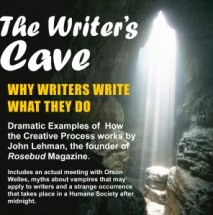
John Lehman’s The Writer’s Cave: Why Writers Write What They Do has seen several incarnations over the last few years. First as a two-part essay in Rosebud issues 39 & 40. Then as a two-person theatrical piece presented last year in Madison’s Frederic March Play Circle as part of the Wisconsin Book Festival. This summer Lehman went into a recording studio and produced an audio version of The Writer’s Cave, now available on CD. It’s Lehman’s own voice sharing his homebrew memoir and writer’s handbook, with fascinating forays into film criticism (touching on Orson Welles and Ingmar Bergman) and literary biography (about the great Wisconsin poet Lorine Niedecker).
Our CBR review of her 2002 chapbook Pencil Test referred to Karla Huston as “one of Wisconsin’s most arresting contemporary poets.” Since then she has won the Main Street Rag chapbook contest for Flight Patterns and published Virgins on the Rocks with the University of Wisconsin’s Parallel Press. Just out for 2009 from Centennial Press is her latest collection, An Inventory of Lost Things. Visit Karla’s website for ordering info. She graciously agreed to read two poems for us:
*
Pencil Test / Karla Huston
In 1969, I tucked a pencil
under a breast and when it failed
to cling, I went braless. Brassieres
uncoupled, and everywhere women
waved them like flags, filled
incinerators with nylon and lace.
Later I wore a nursing bra, flap
agape, nipple pulsing while my baby
sucked, and I wrote notes on what not
to forget. One night the neighbor boys
watched through tilted blinds, rubbed
their crotches and spilled their own
milk under a tree in the yard.
Years later when the Wonderbra arrived,
I tried it, felt cables and wire
cantilevered against my skin
to lift and point even the most
desperate tissue. Today they tell me
they need additional views of a routine
mammogram. As the doctor pulls out
the slides, some taken years earlier,
I learn the history of my breasts.
I stare at the brilliant panels, and there it is,
a transparent web and outlined
in red pencil, the sinister cell, thick
and alarming. As I press fingers
to the circled spot, my worst
fears alight there and flicker.
“Pencil Test” was published in Pearl (2003), in the chapbook Pencil Test (Cassandra Press, 2002), Silt Reader (2004) and in the chapbook, Flight Patterns, winner of the Main Street Rag chapbook contest, Main Street Rag Press, 2003.
*
Flight Pattern / Karla Huston
Four mourning doves huddle atop Hemingway,
a five by five litho hung high in the commons.
Someone let them in, a senior prank, a tradition,
the kids said. The birds wait captive and afraid,
sitting on Papa’s head to roost and bobble.
Sometimes one flies down the hall, helter skelter,
too close to the talking heads below.
Another searches for light through windows,
finds only the trick of glass. Kids below
hurl shoes, empty soda bottles, anything
to scare up some action. The birds oblige,
flying down and into the hall, screaming
mercy mercy have mercy.
Hemingway stares, his cap cocked, while he considers
every word. He knows about farewells
to arms, hills filled with white elephants, how the sky
can become a cacophony of bells.
This place is filled with killers, he seems to say
and later, the birds will be shot while blood
and feathers fall like the last day on earth.
“Flight Pattern” was published in the Wisconsin Academy Review in 2002 and in the chapbook, Flight Patterns.
Prairie Fire Poetry Quartet: John Lehman, Robin Chapman, Richard Roe, Shoshauna Shy
Coffee Spew had a front row seat at Avol’s Books in Madison on March 12 for a reading by the members of the Prairie Fire Poetry Quartet: John Lehman, Robin Chapman, Richard Roe, and Shoshauna Shy. The night was dubbed Stage Left in honor of John Lehman’s new chapbook, Acting Lessons, recently published by the University of Wisconsin’s Parallel Press.
Enjoy these audio clips of the evening:
*
Abundance / Robin Chapman
Yes, write of it, here right now,
in the middle of winter, snow
pock-marked with tracks
of squirrels and the backyard rabbit,
mice that spiral the long grass
into nests, the pair of cardinals
who own the house and all the trees
surrounding it, the raccoon family
from the water drain at the end
of the block (their eyes gleam
through the sewer grate on cold
night walks) who stop on their own
nightly rounds to pour the feeder seed
down their throats, the housefinches
from the front porchlight, heads
soaked in berry-red, foraging leftovers,
the chickadees dry and two-note calling
in the arborvitae, finishing off from a claw
the single sunflower seed that each
takes to a branch: we are wealthy,
wealthy in the black oil of seed, the gold
of cracked corn, the brushy thickets
of security from cats, the abundant lives
of our neighbors.
Last night I heard the whistle of a distant train.
Today instead of going to work, I walk down
a block to talk with the garbage man who is
waiting inside his truck for the drizzle to let up.
It’s not one of those two-story, Frankenstein
giants with weightlifter arms that hoists trash
over its head to dump it with a grunt, but a
sports car-sleek garbage truck, flaunting sort-
at-the-curb bins that are politically correct. I’ve
the urge to break away from my life for a while.
And sometimes in the rain, strange alliances
are made.
At the next stop the driver shows me how to
lift a can—most are plastic now—and deposit
its bags of spilling guts, then swing it ‘round
and grab another to a banging beat. I put my
feet on the running board, he shifts the gears
and when he brakes, I play it solo. I catch the
rhythm. He nods. Garbage men are not the stuff
of TV shows, but that’s their mystique. They are
everywhere, unnoticed, but aware of everything.
From magazines we read to hair we’ve lost,
to the degree that our discarded underwear
is frayed.
They are anthropologists studying a world we
furnish with debris. They smell our smells, taste
what we taste, feel the cans and boxes that
contain the food that shapes our shapes. And
here’s my house. What waste our lives become.
Once I was in an experimental drama. Tom,
a mid-level accountant, and I played hobos. He
needed a release from the minutia of the “day
by day.” To prepare for our roles we went to the
freight yard. I was chicken, but he hopped into
the open yellow boxcar of a slow-moving train.
I never saw Tom again.
Imagine the tallest tree in a forest
and you looking past clouds and mountain peaks.
Grip like a hawk and breathe until you sense
the tree’s roots, trunk’s length, the sap
rising, and push off. Feel the top of your skull
pulled by a taut string into sky’s depths,
you shushing the wind; laugh in short bursts.
Fall and rise, ride to the knife-sharp edge of a draft,
giving the ride voice, calling you, you, and we
to anyone who could listen.
Believe you have a third eye, a space
sound rushes to like water from a pump.
Release that sound and draw lip-crisped
air past your teeth, form your abdomen
like the roundest of hills. Push your midriff
at the hard wood of your backbone, release,
letting an egg rest on your tongue
like the hollow space of a nest.
This is your sound. You are ready
to begin your first song.
Richard Roe’s books include Knots of Sweet Longing (Wolfsong Publications, 2001), What Will You Find at the Edge of the World (Fireweed Press, 2001), and Bringer of Songs (Fireweed Press, 1994).
*
Wife / Shoshauna Shy
He wanted to want her
but being able to have her
at any given time
diminished desire.
It was only in sleep he was aroused
as he tilted through dreams where she became
the Kwik-Trip cashier, Eddie’s sister-in-law
or the sub from sixth grade.
Her plumping of pillows, her mashing potatoes
sang of aprons and Mama and pink medicine
which left him as flaccid as a fish on a dock
till the evening he happened
to be hosing the begonias
while she was undressing
at their bedroom window.
Out of her slip he saw her shimmy,
spread her skirt on the wingback chair,
the parted lace curtains a picture frame
to their dark yard that fanned
like a bellows behind him.
He watched as she leaned
and brushed loose her hair,
then he raced inside ready
to shuck off his trousers.
Now she ponders why he disappears
following the finish of NewsLine at ten.
He claims he forgot to fertilize the roses.
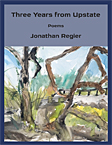
Not yet thirty years old, Jonathan Regier is a gifted, word-mad poet whose style owes as much to rock ‘n’ roll lyricism as to William Blake and Baudelaire. His debut collection, Three Years from Upstate (Six Gallery Press, 2008), blends bohemian wanderlust and religious allegory in a manner reminiscent of the Beats, which is not surprising for a writer born in Indianapolis and currently living in Paris. Regier is adept at portraying urban bleakness in “New York” (“Unctuousness of the subways, beyond midnight, / in the earliest morning, when the steel and plaster / Do their rotting …”), as well as pastoral beauty in “The Country” (“The stars are wild tonight, and the air is in frost. / I’m stepping on old pine cones through the snow”). There is large-scale ambition on display: Three Years from Upstate is distinguished by four long narrative poems, diverse in themes and imagery. Rabbit holes and parallel worlds abound, crumbling slums give way to hidden kingdoms, wooded farmlands trail off into haunted prairies. My favorite of the longer pieces is “The Hunting of the Beast,” a noirish murder mystery with Val Lewton overtones (“A large cat might have done it. A tiger. / The nearest zoo is so long away, it’s got to be a big dog. Possibly, / A bear”). Jonathan Regier is a poet to watch.
Rebecca Foust has won the Robert Phillips Poetry Chapbook Prize two years running. Last summer in CBR:15 we reviewed her 2007 award winning debut, Dark Card, a forceful collection of linked poems about her son with Asperger’s syndrome. Foust’s 2008 winning chapbook, Mom’s Canoe, is just out from Texas Review Press. Once again sequenced around a thematic thread—Foust’s upbringing in the Allegheny Mountains of Pennsylvania—these are terrific poems, flinty and tough like the quarries and strip mines she writes about and, like her work in Dark Card, devoid of sentimentality and easy emotions. Nothing is left unscarred. “Gills burned, drowned in air …” she writes in “How the Fish Feels.” In “Things Burn Down,” the same air that chokes the unlucky hooked fish is killing us too: “Thick smoke from the papermill / all day and night, understand? No one asked // in those days if that shit could kill you …”
Hardship and loneliness become stark forces of nature in poems like “Allegheny County Winter Day” (“Everyone’s going / or gone. Sunset bleeds / through bare boughs; / snow hollows go blue”) and “The Mountains Come Close When It Rains” (“And say it’s ten below zero, skies gray so long you / forget what blue looks like, and you can’t find a job”). The twenty-four poems in Mom’s Canoe evoke a world rich in novelistic detail. A traffic light is made memorable in “November”: “The traffic / light is wanton, / an exotic / painted parrot / or harlot— // Emerald. / Burnt gold. / Then / throat-catching / scarlet.” And this glorious cascade of childhood images of her mother’s canoe in the collection’s title poem: “Frail origami, vessel of air, / wide shallow saucer suspended where / shallows met shadows near the old dam.”
The Spring 2009 issue of Cambridge Book Review is now online. It includes four poems from Madison writer Sarah Busse and a review of Eric Baus’s Tuned Droves.
Recorded exclusively for Coffee Spew, here’s Wisconsin poet John Lehman reading from his work. First, from Acting Lessons (Parallel Press, 2008), a film noir reverie:
Things More Distant Than They Appear / John Lehman
Let’s say that you had just two choices. The first, to leave
Rick’s Club, walk the six blocks down to your girl’s place
and apologize. The second, to stay and finish your drink.
The entranceway—stark, mail on the floor, broken buzzer
and unlocked door—with a little Scotch, takes on a movie
musical glow. A set where you tap dance up the staircase
into the arms of someone who is young and silken-robed.
In fact, the place is shabby. One, two, three stories of fried
onion smell. Then, of course her apartment door is locked
and at this time of night, why would she answer anybody’s
knock? So, it would be back to Rick’s anyway, right? No,
not quite, because you see the door is inexplicably ajar,
though all is dark inside. Now there are two more choices:
to call out “hello”—the only sensible thing to do—or push
the door open and, very quietly step within, the idea being
that you’ll make your way to her room, kneel beside her
bed and whisper your affection in her delicate ear as she
dreamily awakes. In you go, for this is the night of fools,
feeling furniture with your toes stealthily as a cat. Each
step takes days, each day is a week. Your lifetime passes
as you breathe through the doorway to her bed which is
—What did you expect?—empty. All you know for sure,
is that you’re tired and drunk and sad. You want to tumble
on top of that bed for a minute’s rest. You do, and dream
that you are back at Rick’s, and this time she comes in.
She puts her fingers to your lips; there’s no need for you to
speak. “My place or yours,” she smiles and since you already
smell the lavender candles of her room and feel the softness
of her pillows on your cheek, there are no choices, anymore.
But you’re not in her dreams, like she’s in yours. You don’t
need to leave Rick’s to discover that. So you sit and listen
to Chet Baker’s trumpet on the jukebox, to remember and forget.
*
Next, from Dogs Dream of Running (Salmon Run Press, 2001), an affectionate encounter with the late, great author:
John Updike Spills the Beans Riding through New Jersey / John Lehman
It was about this same time of year. We
were driving through a rural New Jersey
night, the wife of a Princeton Italian pro-
fessor, Tom Kennedy and me. She had
organized a day for us to conduct writing
workshops and now after the culminating
event, a lecture by the legendary John
Updike, we were headed to a reception
at the house of a dean. “Wasn’t Updike
something?” we all asked, remembering
the eloquence of his extemporaneous
words as they blended seamlessly with
excerpts which he read, like some vast
swelling on a literary sea, to raise us, not
to truth or beauty, but to a profound, new
level of sleep. Tom admitted to nodding
off several times and I to once awakening
with a start. Even our hostess could not
deny, “with the warmth, the lights, the ‘oh
so busy’ day …” But now how deliciously
refreshed we were, ready over cocktails
and hors d’oeuvres to impress each other,
all over again, with cleverness and wit.
Later, in the Cadillac en route to the motel,
we three were joined by the man himself.
He proved humble in a way the successful
are humble, dismissing their genius, though
mindful the rest of us be sure to disagree.
A lanky man slightly bending an enormous
head, he said, “I couldn’t help but notice
there was one person who … fell asleep.”
Was that the engine or his rising voice that
roared? He continued, “All I could think of
was how I might rouse this poor soul in the
third row from her stuporous dreams.” At this
pronoun Tom and I exhaled, and our driver
let us know, from where she was sitting in the wings she didn’t see anything. “Well,”
he sighed, “that reminds me of when T.S.
Eliot came to Yale. We had waited hours
in line to hear him speak. Student seats
were high in the balcony and amidst the
rising radiator heat …” And here the courtly
Updike chortled to himself, like a spent
wave tickling the sand on a distant beach.
“Can you imagine,” he said, “I fell asleep.”



 Coffee Spew