Today’s mail brought copies of the Elkhorn, Wisconsin Popcorn Press anthology, The Hungry Dead, edited by Popcorn’s founder, Lester Smith. The delightfully disgusting cover was designed by Smith’s daughter, Katheryn. The collection is cool from several perspectives (aside from the fact that my poem “The Last Supper” is included). First, Lester solicited submissions during October via social networking platforms like Twitter and Facebook, as well as a sharp website, and then announced the chosen selections on Halloween with a mockup of the book ready for printing. Planning, executing, and printing a book this quickly is a crazy challenge, but the proof is in the blood pudding, as they say. The Hungry Dead is a classy production: sixty-five works of poetry and fiction from eighteen authors, including several well-versed Wisconsinites familiar to us such as John Lehman, Sarah Busse, Michael Kriesel, and Dead editor Lester Smith. The Hungry Dead is available from Popcorn Press and Amazon (you can peek at the contents with Amazon’s Look Inside the Book feature).
Category: Poetry
-
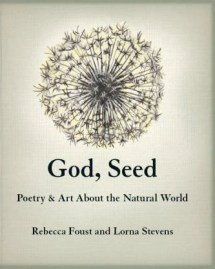
God, Seed: Poetry & Art About the Natural World
Lavish is the word that comes to mind when beholding God, Seed: Poetry & Art About the Natural World (Tebot Bach, 2010) by poet Rebecca Foust and artist Lorna Stevens. Well established in their respective mediums, Foust and Stevens’ collaboration in God, Seed is one of those felicitous combustions of text (forty-three poems) and illustration (thirty full-color images) that result in a brilliant hothouse hybrid.
Readers should prepare themselves for sensory overload if not an outright short-circuit when experiencing a two-page spread of, say, Stevens’ lush eye-popping watercolor of a parsimmon opposite Foust’s sensual accompanying poem, “Parsimmons” (“ … rich river pudding, plush and pulp, / soft-slide swallow delight / and sweet, sweet”).
Conversely, later on, we are chilled to the bone by Stevens’ austere black brushwork depicting galloping bison that mimics the timeless mysteries of a prehistoric cave drawing. Foust’s chastising poem is “Last Bison Gone” (“We love what we love / in the scientific way, efficient, empiric, / vicious, too much …). Thus are the contrasting poles of God, Seed established: rapturous pleasure in nature’s bounty on the one hand, while, on the other, rapacious misuse and abuse of all that humanity surveys.
Rebecca Foust’s poetry has always struck at the heart of hard truths. Her first two tough-minded chapbooks (consecutive winners of the Robert Phillips Poetry Chapbook Prize in 2007 and 2008) were reviewed favorably in our online pages. Dark Card, Foust’s debut, shook a righteous fist at doctors and gods alike for the plight of her son, diagnosed with Asperger’s syndrome. Mom’s Canoe, the follow-up, bracingly recaptured the poet’s own childhood growing up in the depressed strip-mining region of western Pennsylvania.
Although ostensibly casting a wider impersonal net in God, Seed, it is a testament to Foust’s raw unflinching truth-telling that a poem like “Frog”—about genetically mutated amphibians in a PCB-poisoned pond—spirals instead toward the son whom we remember from Dark Card:
Still, sleeping,
I dreamt of my son,
his genes expressednot as autism, but as
four thumbs on two
extra handsand I want to blame
someone. I want
to drain that pond.God, Seed respects and encourages full immersion in the world—politically and personally—an attainable if too often lost connection to our surroundings. The poem “Now,” for instance, erases all borders between our bodies and nature’s enraptured seasonal rebirth: “… places in the body’s uncharted waters, new worlds / lying green and deep off winter’s bow // and now, spring. Bone-ache thaw, wind sough / through snow-scoured woods, bud swell …”
And yet, lest we fall prey to the ecstasy of hubris, the final poem in Foust and Stevens’ God, Seed, “Perennial,” gives nature the last word by writing us out of the picture altogether: “When you’re gone, it won’t matter to the musk rose / twining the old trellis over the eaves. Willow / will continue to pour her yellow-green waterfall // next to forsythia, one half-tone better on the scale / of bright …”
-
Popcorn Press is scary hungry again!
Enterprising Wisconsin micropublisher Popcorn Press is once again sponsoring an ambitious October literary contest. Last year, press owner and editor Lester Smith accepted vampire-themed poetry and fiction submissions during the month for an anthology, Vampyr Verse, readied by Halloween and, within a matter of days, delivered to the public in a quality printed edition. This year’s theme is “the hungry dead,” which doesn’t preclude vampires, but widens the cemetery gate to include zombies, ghosts, and, in the words of the contest website, “other dead things that want to eat you.” Find all the details and contest rules, as well as an easy-to-use online submission page, at hungrydead.com.
-
Verse Wisconsin Reading at Avol’s Bookstore
Verse Wisconsin co-editors Sarah Busse and Wendy Vardaman joined six other poets—Karl Elder, Fabu, Susan Firer, Max Garland, Derrick Harriell, and John Koethe—for a stellar Book Festival reading at Avol’s Bookstore in downtown Madison on Thursday, September 30th. Below is a video of the closing poem of the evening, a new work, John Koethe’s elegiac meditation on the 1960s, “ROTC Kills.” Wendy Vardaman’s interview with Koethe in the latest issue of Verse Wisconsin can be found online at the VW website.
-
Cottonbound: An Audio Chapbook
Madison poet Norma Gay Prewett visited us in Cambridge to record several pieces of poetry and prose centered around her mother, who died four years ago on Prewett’s 56th birthday. Cottonbound: An Audio Chapbook is now online at Cambridge Book Review. Here’s a sample:
Bill of Lading / Norma Gay Prewett
A chewed-looking Styrofoam snowman head,
Black felt pipe, googly stuffed-animal eyes
(also the bag of eyes, I discover later)
A sweater that smells disagreeable unless it is your mom’s
An ocher clipping with a penned-in arrow
To my head—”My Daughter” as if I don’t
Recall sitting in turpentine at Methodist art camp
Some recipes she never used, but carefully copied longhand
Swedish meatballs, ham loaf, Hanukkah cookies
Did she know we were not Jewish? Did she know
The people in the multi-picture frame, never filled with us,
So beautiful and fresh, having action-packed fun?
She never saw the sea, but pictures of the sea—
Did she long for the thrum of waves on pebble?
Some hanks of yarn, maybe free, from the spinners where
Her working life began at fifty, where she nearly
Fell in love with her foreman, but for her bad heart
Her bad heart, to my brother, who died with it in his chest.
Her Ozark drawl, her temper, her madwalk to my sis-
ter; her terror of twisters to all, her scrawl she left
backwards, to her ma. After all, most say I got
Her hazel eyes, her love of fun, her Irish hair, and the low
Thyroid that left her brows and mine scant
She left her death-day as my birthday, to me, alone.
-
Psalms
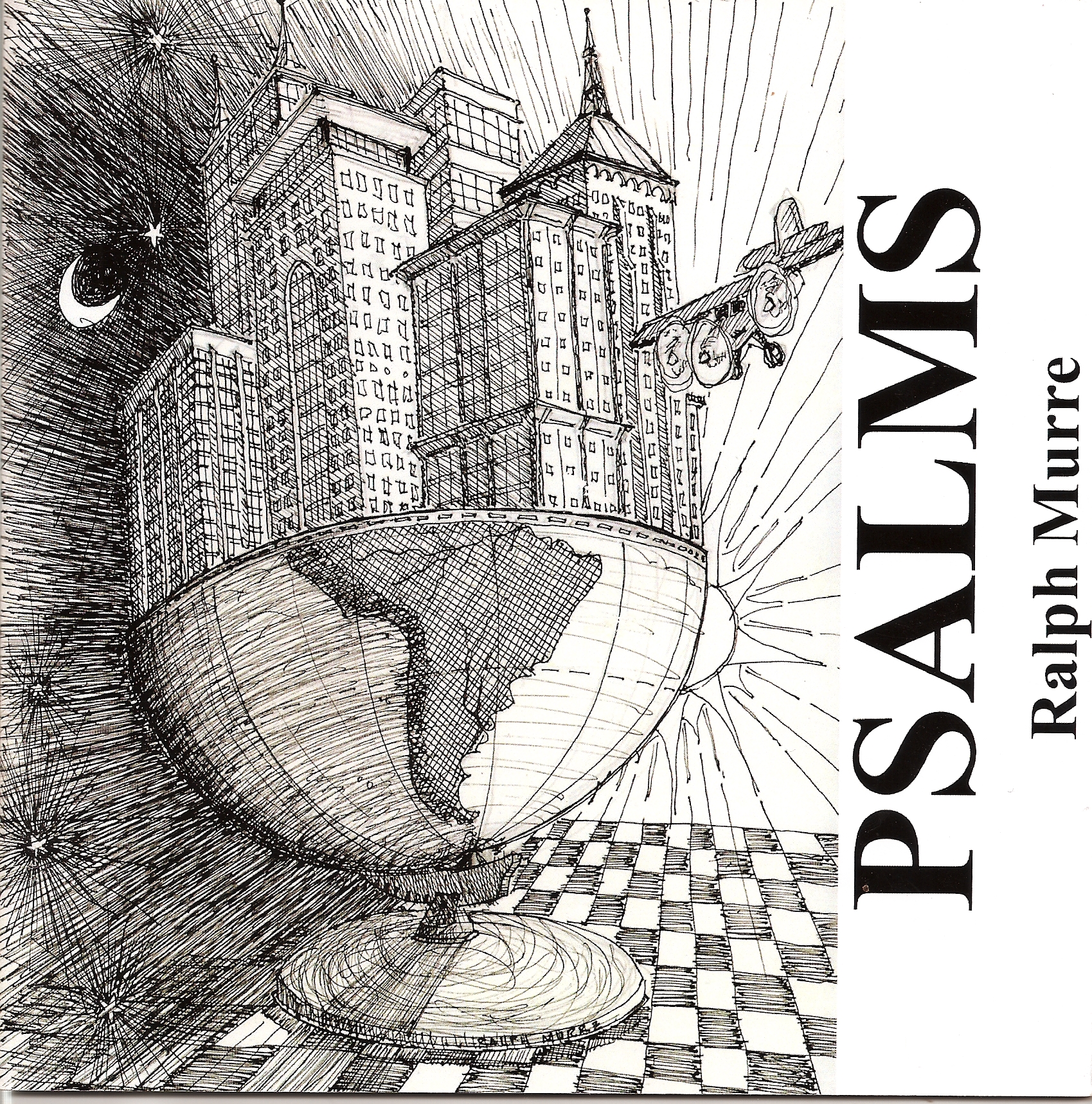
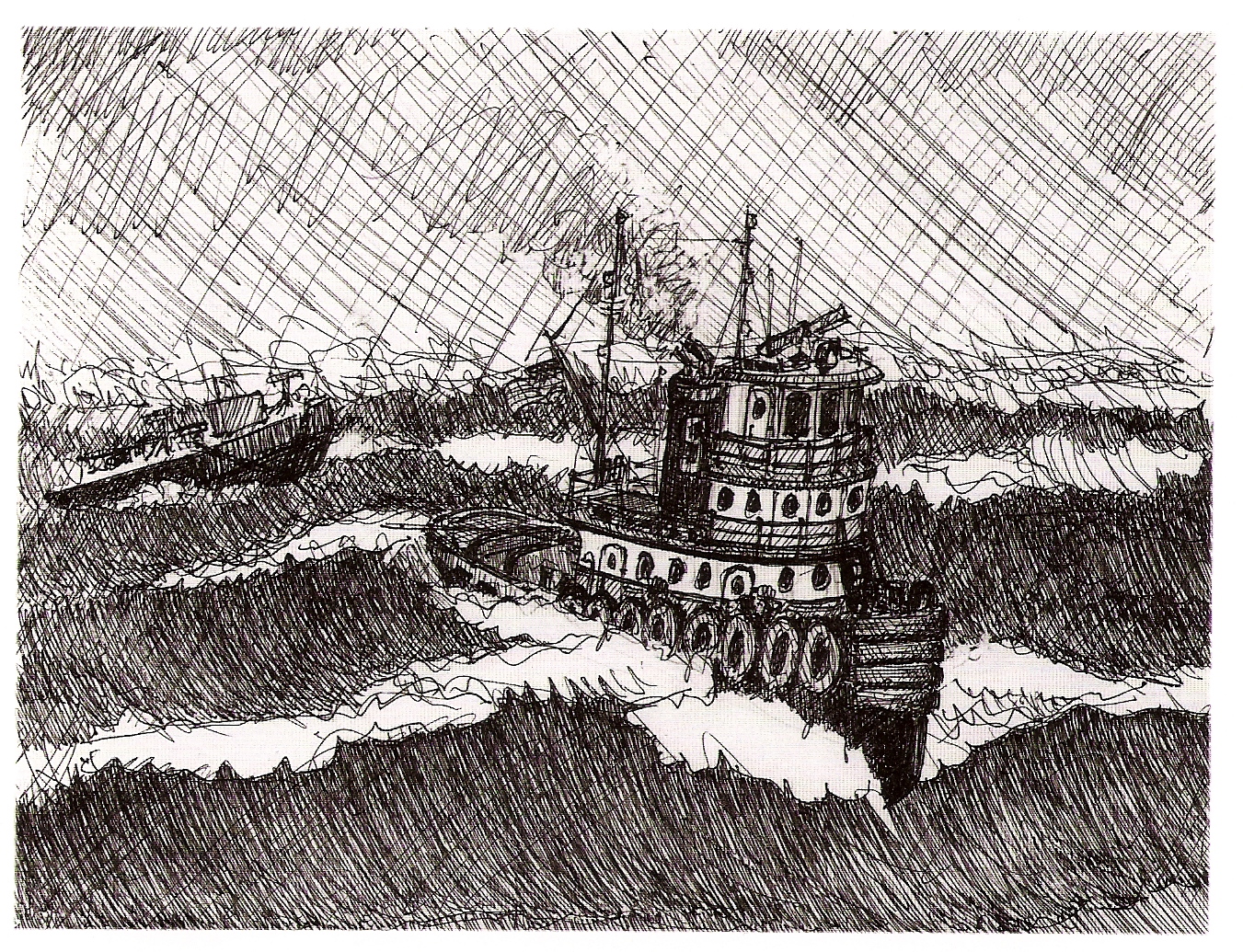
Ralph Murre’s poetry sequence, Psalms (Little Eagle Press, 2008), has a solemn title but the work is playful and irreverent. The accompanying pen and ink drawings, also by Murre, add immeasurably to the experience, grounding the poems in intricate worldly detail and darkening webs of cross-hatching.
The collection comprises fifteen psalms, eleven lines each, most of the psalms beginning with a variation on “I may go back…” and ending with “If I’m singing at all.” Memory is the theme. Restless memories that reach for transcendence but spiral instead toward resignation and regret.
Murre’s psalms reflect Kerouac’s and Salinger’s America where sadness and ecstasy are inseparable:
I may go back and build an ark, down by the lake,
in the city park where we barked so long ago, you & I;
build it to save mating pairs of military-industrialists,
realists and realtors, nihilists and meat-cutters […] [Psalm II]The exuberance of Murre’s run-on catalogs and infectious wordplay keeps his psalms from sinking into despair. Like this wonderful blast from a farmland childhood: “Saturday bath and Sunday hath-nots and shalt- / nots, cow shit and old math and raspberries, dairies and cheese, / more weeds than corn, a real damned horn-of-plenty […]” (Psalm XIII).

Ralph Murre illustration from “Psalms” He’s especially good at capturing the spark and manic rhythm of urban life:
[…] pickled herring, pickled beets, picking up the beat
of trash-can slam, picking up jobs of poor-I-am and
picking up women in good-night dreams, bad-night bars,
rusted cars in South-Side parking-lot wake-ups, staggering
to fourth-floor walk-ups, singing blue of our break-ups,
if we’re singing at all. [Psalm VIII]When mania crashes, however, the outlook is terrifying:
The affable, laughable you and I climbing to a sky
of scaffolds on unapproved ladders, flattery
getting us everywhere we ought to avoid,
the void looming—booming sub-woofer void,
passing in the night frightful bass-line of void,
angels flying south in missing-man formations […] [Psalm VII]Murre’s psalms seem in the end to consider whether celebration is possible at all. The limitations of optimism. The struggle to keep afloat, to manage our moods. But above all, Ralph Murre’s Psalms offers us the salvation of poetry and art as reason enough for staying the course.
-
Verse Wisconsin Publishers Lunch
A terrific Saturday afternoon of good food and literary talk with small press publishers at Edenfred arts residency in Madison. The event was sponsored by Verse Wisconsin, a newly launched poetry magazine edited by Wendy Vardaman and Sarah Busse. The magazine is a reboot and redesign of Linda Aschbrenner’s much-admired Free Verse, which flourished for over ten years until Linda decided to pass the torch last year.
Wendy Vardaman and Sarah Busse were kind enough to spend a few minutes talking with Coffee Spew at Edenfred about their co-editorship of Verse Wisconsin:
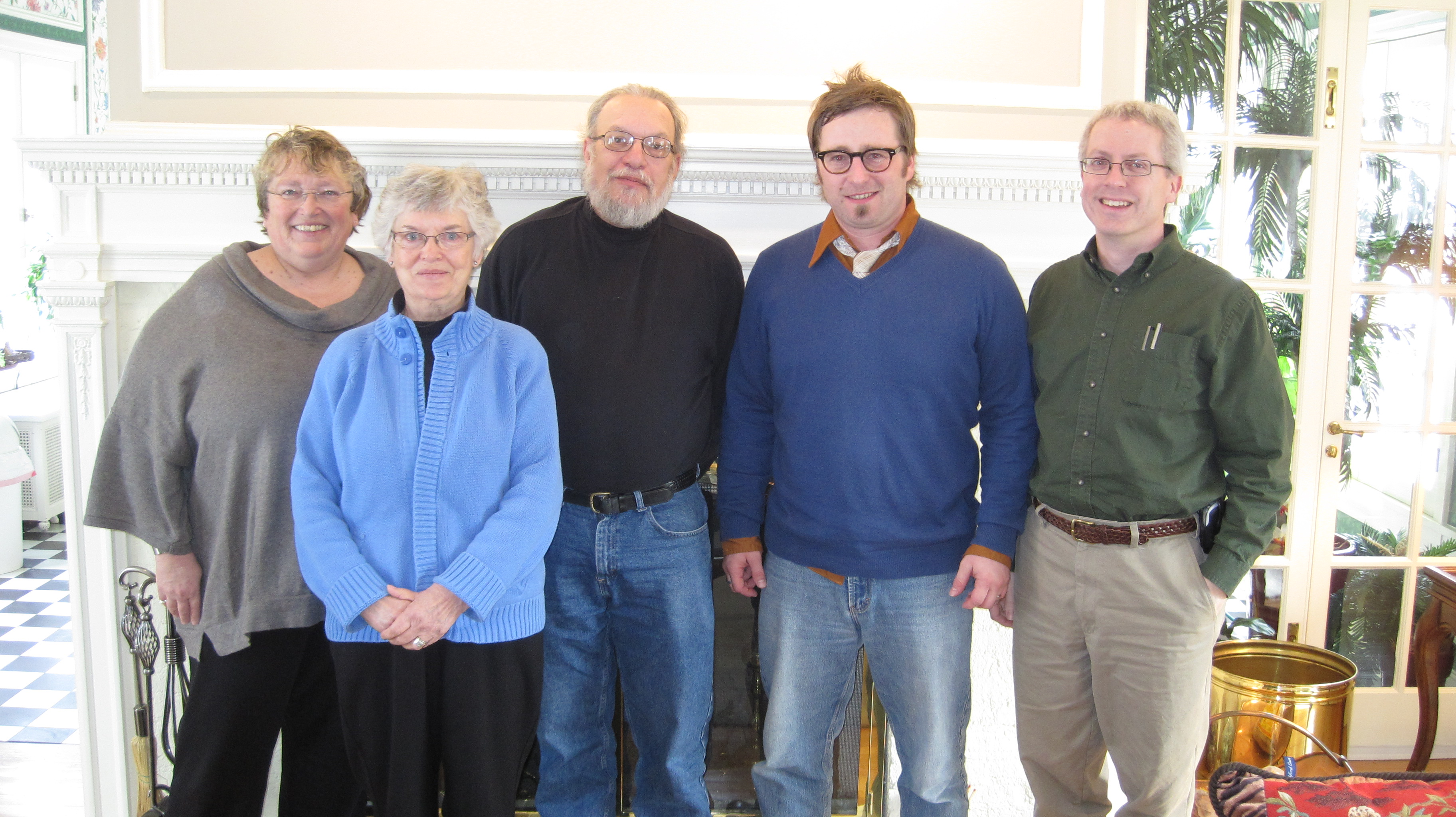
Thanks is due Edenfred executive director David Wells for preparing a startlingly upscale gourmet lunch. See below for photos of the attendees:
Left to right: Jerry and Paula Anderson (Echoes), B.J. Best (Arbor Vitae), Sarah Busse (Verse Wisconsin), Rod Clark (Rosebud), John Lehman (The Village Poet).
Left to right: Linda Lenzke (Our Lives), Jeri McCormick (Fireweed Press), Ralph Murre (Little Eagle Press), Charles Nevsimal (Centennial Press), Erik Richardson (Signs and Wonders).
Left to right: Wendy Vardaman (Verse Wisconsin), Lester Smith (Popcorn Press), Shoshauna Shy (Poetry Jumps Off the Shelf), F.J. Bergmann (Mobius), Jason A. Smith (Wisconsin People & Ideas).
Arbor Vitae, B.J. Best, Centennial Press, Charles Nevsimal, Echoes, Edenfred, Erik Richardson, F.J. Bergmann, Fireweed Press, Jason A. Smith, Jeri McCormick, John Lehman, Lester Smith, Linda Aschbrenner, Linda Lenzke, Little Eagle Press, Mobius, Our Lives, Paula Anderson, Poetry Jumps Off the Shelf, Popcorn Press, Ralph Murre, Rod Clark, Rosebud, Sarah Busse, Shoshauna Shy, Signs and Wonders, The Village Poet, Verse Wisconsin, Wendy Vardaman, Wisconsin People & Ideas
-
Inside, Outside, Morningside
Marjorie Kowalski Cole
Ester Republic Press 2009Reviewed by Bob Wake
Alaskan poet Marjorie Kowalski Cole’s collection, Inside, Outside, Morningside, won me over on the first page in the concluding lines of “Desire”:
The aspens shake in the wind
like the bells of a prayer wheel.
I would have what is within and without
arrive at one still moment
together.
A rare balance is struck “within and without” that continues poem after poem. The natural world astounds (“Walk into the soft breeze and astonish your skin” runs a memorable line from “Mediterranean Evening”) while our fragile lives seem destined for departure and loss (“The young are strong enough; / We can go now,” she eulogizes in “Lessons Learned”). Cole’s Catholicism infuses these poems, an appreciation and thirst for the sacred. Our humanness doesn’t so much interfere as intermingle:
In a blazing new parish in Fairbanks, Alaska,
the one great room is white with light.
It could be a dentist’s office: globes like snowballs
press on my eyes, threaten to conquer sin with wattage.
+++[“Light and Its Absence”]Her larger spiritual concerns are ecological:
Gravel roads lead past tin warehouses, generations
of derricks on their sides, earthmovers
with outsize tires like herds of thirsty elephantsI drop off the road and step across the tundra
around fox shit, foam cups, crumpled packs
of Camels, arrive to my surprise at a lake.
+++[“Colleen Lake, Deadhorse, Alaska”]Themes coalesce around Cole’s multiple roles as mother, daughter, wife, world traveler, spiritual seeker and environmentalist. None of these categories are mutually exclusive. Connectedness is everything. She writes equally well and movingly of her mother’s illness, of art, of forest wildfires, of Ireland, Spain, Sweden. She returns again and again to nature’s healing harmonies, as in “Summer Night”: “Past midnight, the woods below those buttered treetops / are stirring with animals, wondrous with light.”
The living world never fails to generate surprise, to snap us out of ourselves, our melancholy, our self-centeredness:
I remember times of wailing
into my couch, alone
and utterly baffled by life,
when suddenly a cat
would be sitting on my head.
+++[“Pushkin”]I was several poems into Inside, Outside, Morningside before I glanced at the back cover and learned of Marjorie Kowalski Cole’s death last year just as the book was going to press. She was in her mid-fifties. This graceful, luminous collection is a precious legacy. (Cole is also the author of a well-received 2006 novel, Correcting the Landscape.)
-
The Village Poet
John Lehman, aka The Village Poet, has a new chapbook showing up around the Cambridge-Rockdale community. Free copies can be found just about everywhere, from the library to the state bank to the Piggly Wiggly. John says he’ll send out free copies to anyone interested, far and wide. Email name and address to John@VillagePoet.com.
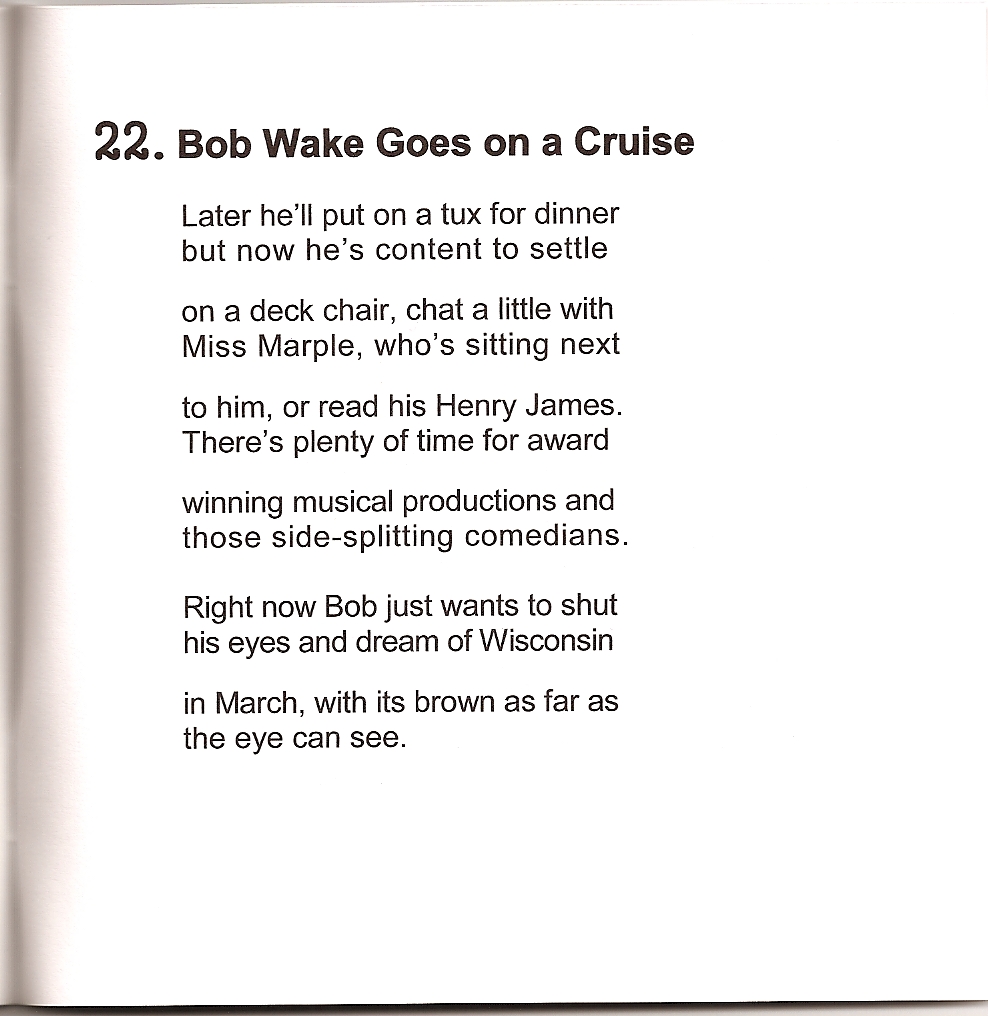
Local residents abound throughout John’s work. I myself was honored to discover on returning home last year from a family vacation at sea that a commemorative poem had been issued. Reprinted below exactly as it appears in the Village Poet chapbook:
-
Verse Wisconsin
Here’s the press release about Verse Wisconsin, now accepting submissions (some of co-editor Sarah Busse’s own poetry appears in CBR:16):
NEW ONLINE RESOURCE FOR WISCONSIN POETS
The new poetry magazine, Verse Wisconsin, has gone online as of September 1, 2009. Featuring information for poets across the state and beyond, the website ushers in the next phase of Verse Wisconsin’s project, and offers a place for poets across the state to post their local events and learn of others.
Co-editors Wendy Vardaman and Sarah Busse welcome everyone on board. “We know our links page isn’t nearly complete. Far from it! But we also wanted poets to feel free to share information with each other, rather than for us to pose as the experts,” explains Busse.
The magazine will publish poetry and prose about poetry and is currently accepting submissions. “We’re hoping to reach a broad cross-section of poets in the state, and beyond,” says Busse. “Our predecessor, Linda Aschbrenner, published a variety of styles and voices in Free Verse. In moving the magazine to Madison, and updating it, we’re hoping to continue her tradition and expand upon it.”
The editors are accepting poetry submissions from poets now, with the intention of publishing a first issue, online and in print, in January 2010. The online and print versions will offer different, but complementary, material.
Learn more at www.versewisconsin.org.
###
Published from 1998-2009 as Free Verse, Verse Wisconsin publishes poetry and serves the community of poets in Wisconsin and beyond. In fulfilling our mission we:
• showcase the excellence and diversity of poetry rooted in or related to Wisconsin
• connect Wisconsin’s poets to each other and to the larger literary world
• foster critical conversations about poetry
• build and invigorate the audience for poetry