Rod Clark’s Redshift: Greenstreem with illustrations by Spencer Walts is now available in a Kindle edition for $2.99 and includes two bonus stories! The 2011 paperback second-printing is also available for $8.00 from PayPal and Amazon.
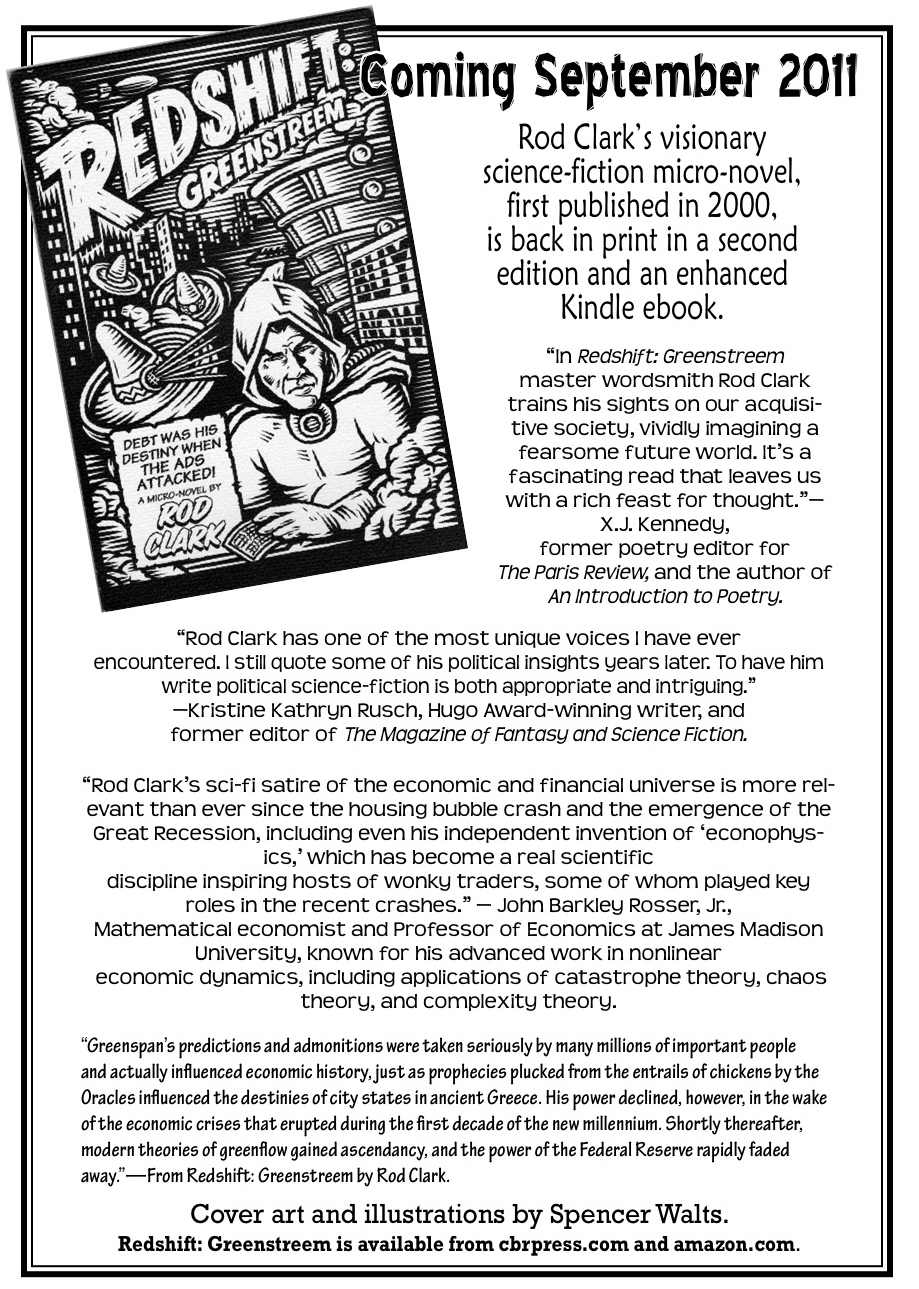
Rod Clark’s Redshift: Greenstreem with illustrations by Spencer Walts is now available in a Kindle edition for $2.99 and includes two bonus stories! The 2011 paperback second-printing is also available for $8.00 from PayPal and Amazon.

~
~
Eleven Poems: An Audio Chapbook
Elli Hazit
J.D. Salinger: A Life
Kenneth Slawenski
Reviewed by Norma Gay Prewett
Birds of Wisconsin
B.J. Best
Reviewed by Amy Lou Jenkins
Lord of Misrule
Jaimy Gordon
Reviewed by Bob Wake
The Masturbator
A short story by John Lehman
Consultation
A short story by Ruben Varda
From the Archives
Origins of FIS (Factory in a Suitcase)
An excerpt from Redshift: Greenstreem
Rod Clark

By definition an unfinished novel shouldn’t be capable of supplying readers the satisfaction of closure, of completion. The late David Foster Wallace’s The Pale King, by this standard, is an anomaly. For starters, at 547 pages, it’s a lot of novel. Thematically, the center holds, aided by Michael Pietsch’s sensitive editing, but also because the material feels composed with a consistent core vision. As the author of the ambitious and gargantuan Infinite Jest (his career-making 1996 novel about addiction and recovery which in its own self-willed fashion refused conventional narrative closure), Wallace left behind fragments for The Pale King that are themselves large-scaled, suggesting a work that was intended to rival if not surpass the size and scope of the earlier novel. Many chapters are as fleshed-out and polished as substantive short stories or novellas.
Wallace chose for The Pale King a workplace setting that in the popular imagination probably represents the sine qua non of tedium: a regional IRS office circa 1985 where workers sit at desks for hours on end processing tax returns.
He imagined that the clock’s second hand possessed awareness and knew that it was a second hand and that its job was to go around and around inside a circle of numbers forever at the same slow unvarying machinelike rate, going no place it hadn’t already been a million times before, and imagining the second hand was so awful it made his breath catch in his throat and he looked quickly around to see if any of the examiners around him had heard it or were looking at him.
Moreover, the office is located in the underwhelming middle America of Peoria, Illinois. (“The sky the color of motel ice—no color, no depth. It’s like a bad dream.”)
John Berryman’s famous poem from The Dream Songs begins, “Life, friends, is boring. We must not say so.” The Pale King says so, brazenly says so, but also poignantly asks if there isn’t a means within reach of our mental apparatus (the “inner resources” that Berryman’s poetic persona claims to lack) that might transcend the void. This is ultimately a mystical pursuit, so it should come as no surprise that the novel is populated at the margins with ghosts and phantoms (a very funny chapter helpfully distinguishes between the two forms of apparition) haunting the IRS examiners’ cubicles and disturbing their monkish concentration. One accountant, when his focus is fully engaged, levitates above his desk like Teresa of Avila.
Much of David Foster Wallace’s fiction takes aim at consciousness itself, particularly the mechanisms of distraction and solipsism that lead us so easily astray. The Pale King, even in its unfinished form, pursues this investigation of our inner lives further than its author has taken us before. From this measure alone the novel must necessarily be ranked among his best work. Wallace’s ability to recognize and depict both the humor and the horror in depression, anxiety, and addiction, is one of his strengths as a writer. Even before his suicide in 2008 at age forty-six, fans of his work sensed a more than casual investment on the author’s part in capturing not just the “stream” of consciousness but also its unchartered tributaries, its splintered mudflats, and its black oceanic depths.
“It turns out,” runs an intriguing passage in the Notes and Asides appendix that closes out The Pale King, “that bliss—a second-by-second joy + gratitude at the gift of being alive, conscious—lies on the other side of crushing, crushing boredom.” Wallace’s compassion for the book’s troubled cast of bureaucratic misfits, drudges, and savants seems warm and real, but also fragile in its own right, helpless finally to intervene. In fact, by inserting himself, “David F. Wallace,” as one of the characters employed at the labyrinthine Peoria IRS facility, the author mind-melds with the collective unconscious of his novel. If Infinite Jest showed us the manic pitfalls of a hyper-stimulated existence for which Alcoholics Anonymous offers sanctuary, then The Pale King is a quest for quietude inscribed between the lines of the Serenity Prayer.
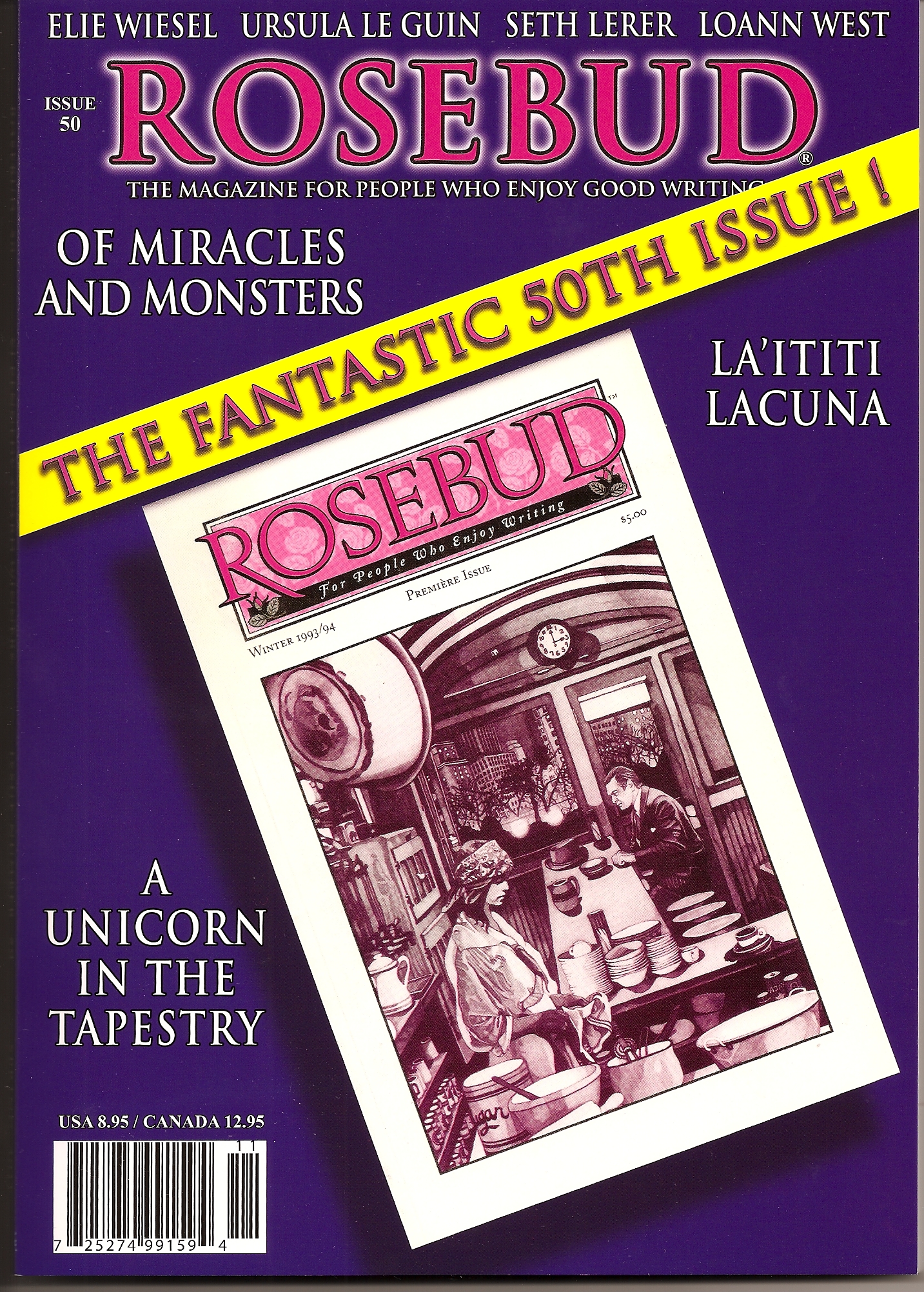
Rod Clark stopped by this morning with the much anticipated fiftieth issue of Rosebud magazine. Congratulations are in order. Certainly to Mr. Clark and his tireless editorial helmsmanship. To graphic designer Parnell Nelson. To associate publisher John Smelcer. To founder and editor emeritus John Lehman. And to the general excellence—past and present—of the magazine’s contributors and its masthead personalities who have kept Rosebud running and the quality unwavering since the inaugural winter 1993/94 issue. The 50th brings back the artist showcased in the first issue: the wildly original and often disturbing Wisconsin illustrator Dierdre Luzwick. There’s a wealth of new fiction, essays, and poetry. Known names like Ray Bradbury, Elie Wiesel, and Ursula Le Guin combine with new voices. Wonderful, too, to see contemporary Wisconsin poetry represented by work from Sarah Busse, Michael Kriesel, and Wendy Vardaman.

Talk about a catch of the day. How about netting 175 remaindered copies of George Vukelich’s masterful 1962 Wisconsin novel, Fisherman’s Beach, selling for ninety-eight cents each on the bargain table at the UW Bookstore at Hilldale in Madison. Originally published by St. Martin’s Press, the novel was reprinted in 1990 under Vukelich’s own North Country Press imprint, which is the edition UW Bookstore is selling.
It seems likely that Vukelich, who died in 1995 at 67, had access to St. Martin’s original printer’s plates. There’s a striking use of pen and ink seagull silhouettes on the cover, title page and chapter headings, as well as a small fish icon beside each page number. It’s the kind of elegant layout and textual design that was common enough in 1962 when publishers had in-house graphic designers, but seems like a classical lost art form today.
The story of a struggling Catholic fishing clan—Old Man LeMere, his wife, and five sons—on the shores of Lake Michigan, Fisherman’s Beach manages vivid characters across generations and is written in an assured naturalistic style that hasn’t aged and probably never will:
They spent half an hour getting the tug ready for the run out to the fish grounds. Out of the shanty gear shack came the empty fish boxes they hoped to fill by noon. Raphael and Gabriel lugged these aboard while Roger gassed up the tug and Germaine carried out the foul-weather gear. They moved quickly, quietly, anxious to have the joework over with and be underway. Once they cleared the dock, they could relax and smoke during the seven-mile run back up the coast to the nets. Now there were hundreds of pounds of ice to be put aboard and steel oil drums into which they could fling the trout guts when they cleaned them on the way back. The offal would be sold to the area farmers. It wasn’t much but every little penny helped now.
The plot is set in motion when the oldest son, 35-year-old Germaine, returns home to Wisconsin from living abroad after the Second World War. Unbeknownst to his family, Germaine is a widower with a 5-year-old daughter. Old sibling rivalries resurface. A former girlfriend—currently dating Germaine’s brother Roger—enters the picture. The family business is threatened by politicians in Madison considering legislative limitations on commercial fishing.
Nestled within the larger narrative of Fisherman’s Beach is a beautifully evoked coming of age tale of ten-year-old Reuben LeMere. It’s a chilling moment when Reuben receives a 22-calibre rifle for his eleventh birthday, and, tiring of target practice with tin cans, begins “to want to kill something.” In the grip of bloodlust, he recklessly fires at seagulls overhead.
Then he jerked the trigger and the rifle moved a little and the wind carried away the noise of the shot so it sounded almost flat. The gull he had aimed at was still flying and starting to sweep away and he knew he had missed. He pulled back the bolt and the empty smoking shell spun out, end over end: he could smell the smell of burnt powder. The shot didn’t seem to scare the gulls away although most of them had risen now and were twisting over the rocks like pieces of paper caught in an air current. He had loaded up and was aiming again when he heard the shout. He lowered the rifle. It was a big dark man in a blue shirt leaning out of a window in the lighthouse and hollering at him. The wind was blowing away most of what the man was saying but Reuben could hear two words very clearly. “Goddamn you!” the man was yelling. “Goddamn you!”
Fisherman’s Beach is George Vukelich’s only novel. He had a long career as a journalist and essayist and radio host in Madison. He published two strong collections of his essays, North Country Notebook, Vol. I (1987) and Vol. II (1992). There’s a useful biographical sketch of Vukelich in James Roberts’ 2002 book, Famous Wisconsin Authors (online at Google Books).

The current issue of Wisconsin People & Ideas (Winter 2011) includes my essay on August Derleth’s 1961 Walden West. The book is a portrait of the people and landscape of Sac Prairie, a lightly fictionalized composite of Derleth’s Sauk City hometown and the adjacent village of Prairie du Sac. It’s an evocative literary work that’s never really gotten its due. Here’s a brief passage from my piece:
In Walden West Derleth captures a small-town populace increasingly alienated from a natural world to which their rhythms are still connected. It is a book written by a stubborn, unapologetic regionalist, who, in 1961, seemed out of step with the forward-looking optimism and youthful vigor of John F. Kennedy’s New Frontier. While not outright ignored, Walden West was critically panned upon publication. “These sketches have little distinction, no particular chronology or unifying drama,” sniffed a critic for Kirkus Reviews.
My thanks to the magazine’s editor, Jason Smith, and literary editor, John Lehman. An earlier version of this essay won the Council for Wisconsin Writers Rediscovering Wisconsin Writers Award in 2004.

Today’s mail brought copies of the Elkhorn, Wisconsin Popcorn Press anthology, The Hungry Dead, edited by Popcorn’s founder, Lester Smith. The delightfully disgusting cover was designed by Smith’s daughter, Katheryn. The collection is cool from several perspectives (aside from the fact that my poem “The Last Supper” is included). First, Lester solicited submissions during October via social networking platforms like Twitter and Facebook, as well as a sharp website, and then announced the chosen selections on Halloween with a mockup of the book ready for printing. Planning, executing, and printing a book this quickly is a crazy challenge, but the proof is in the blood pudding, as they say. The Hungry Dead is a classy production: sixty-five works of poetry and fiction from eighteen authors, including several well-versed Wisconsinites familiar to us such as John Lehman, Sarah Busse, Michael Kriesel, and Dead editor Lester Smith. The Hungry Dead is available from Popcorn Press and Amazon (you can peek at the contents with Amazon’s Look Inside the Book feature).

My short story collection, Caffeine & Other Stories, is now available as a Kindle download for $2.99. It’s a newly expanded edition that includes four bonus stories not found in the $12.95 paperback.
Blurbs from the 1997 edition:
“We see stimulants from caffeine to cocaine, alcohol and marijuana to nicotine. His characters glean intelligence (however wacky, artificial, or genius) and courage from their personal favorite highs. In a rather dark interpretation, I often felt as though many of his characters were on a bumpy ride to suicide. Yet, just when we are shaking our heads at them, Wake surprised me with his unfaltering wit and I laughed my fears away. After all, this is the human spirit he is so masterfully portraying …” —Tracy Walczak, BookLovers.
“Caffeine is a book of constant surprises. In this collection of linked stories set in south-central Wisconsin, Wake sets before us the confusions of life in yuppie heaven. And he does so with tough love, and a wit which will have you laughing wickedly along. Bob Wake has a great sense of where he lives, Madison, Wisconsin, postmodern America. I, for one, look forward to continuing words from this bright writer.” —Jim Stevens, editor of The Journey Home: The Literature of Wisconsin Through Four Centuries.
“The range shown by Bob Wake in creating this series of interconnected, readable stories that stand well on their own is a considerable accomplishment. Reading Caffeine & Other Stories is like being a kid again and reaching into a grab bag at a rich friend’s birthday party: you can’t know what you are going to get, but you can be sure it’s going to be damn good.” —Chris Lott, Eclectica.
“Bob Wake writes likes Ralph Steadman draws: a few choice words and boom! there’s a real, living, breathing character … Caffeine & Other Stories kicks ass, rocks hard, and leaves you wanting more.” —Marie Mundaca, Erupture.
“Mr. Wake writes with confidence and polished prose, and obviously knows well how to craft a short story.” —J. Allen Kirsch, author of Madlands, and God’s Little Isthmus.
“Wake is a first class teller of tales and spinner of stories.” —Midwest Book Review.

Lavish is the word that comes to mind when beholding God, Seed: Poetry & Art About the Natural World (Tebot Bach, 2010) by poet Rebecca Foust and artist Lorna Stevens. Well established in their respective mediums, Foust and Stevens’ collaboration in God, Seed is one of those felicitous combustions of text (forty-three poems) and illustration (thirty full-color images) that result in a brilliant hothouse hybrid.
Readers should prepare themselves for sensory overload if not an outright short-circuit when experiencing a two-page spread of, say, Stevens’ lush eye-popping watercolor of a parsimmon opposite Foust’s sensual accompanying poem, “Parsimmons” (“ … rich river pudding, plush and pulp, / soft-slide swallow delight / and sweet, sweet”).
Conversely, later on, we are chilled to the bone by Stevens’ austere black brushwork depicting galloping bison that mimics the timeless mysteries of a prehistoric cave drawing. Foust’s chastising poem is “Last Bison Gone” (“We love what we love / in the scientific way, efficient, empiric, / vicious, too much …). Thus are the contrasting poles of God, Seed established: rapturous pleasure in nature’s bounty on the one hand, while, on the other, rapacious misuse and abuse of all that humanity surveys.
Rebecca Foust’s poetry has always struck at the heart of hard truths. Her first two tough-minded chapbooks (consecutive winners of the Robert Phillips Poetry Chapbook Prize in 2007 and 2008) were reviewed favorably in our online pages. Dark Card, Foust’s debut, shook a righteous fist at doctors and gods alike for the plight of her son, diagnosed with Asperger’s syndrome. Mom’s Canoe, the follow-up, bracingly recaptured the poet’s own childhood growing up in the depressed strip-mining region of western Pennsylvania.
Although ostensibly casting a wider impersonal net in God, Seed, it is a testament to Foust’s raw unflinching truth-telling that a poem like “Frog”—about genetically mutated amphibians in a PCB-poisoned pond—spirals instead toward the son whom we remember from Dark Card:
Still, sleeping,
I dreamt of my son,
his genes expressednot as autism, but as
four thumbs on two
extra handsand I want to blame
someone. I want
to drain that pond.
God, Seed respects and encourages full immersion in the world—politically and personally—an attainable if too often lost connection to our surroundings. The poem “Now,” for instance, erases all borders between our bodies and nature’s enraptured seasonal rebirth: “… places in the body’s uncharted waters, new worlds / lying green and deep off winter’s bow // and now, spring. Bone-ache thaw, wind sough / through snow-scoured woods, bud swell …”
And yet, lest we fall prey to the ecstasy of hubris, the final poem in Foust and Stevens’ God, Seed, “Perennial,” gives nature the last word by writing us out of the picture altogether: “When you’re gone, it won’t matter to the musk rose / twining the old trellis over the eaves. Willow / will continue to pour her yellow-green waterfall // next to forsythia, one half-tone better on the scale / of bright …”
 Coffee Spew