Late night streaming on Vudu: The Humbling is an adroit adaptation of Philip Roth’s novella. Co-scripted by Buck Henry, who adapted The Graduate and Catch-22 for Mike Nichols. Al Pacino as a morose suicidal actor. Greta Gerwig is his bisexual love interest. Zaniness ensues. Comparisons to Birdman are not misplaced: The Humbling employs fantasy sequences (in a departure from Roth’s novella) that dramatize Pacino’s scrambled state of mind, including a Birdman-like dream of Pacino locked out of a theater mid-performance. The movie substitutes a more ambiguous ending than the novella’s brutal finish, but it’s well worth a look. Directed by Barry Levinson of Rain Man and Wag the Dog.
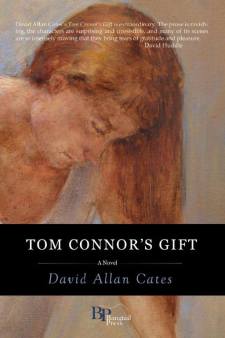
Tom Connor’s Gift
David Allan Cates
Bangtail Press 2014
Reviewed by Bob Wake
The time frame of David Allan Cates’s bravura new novel, Tom Connor’s Gift, covers roughly three weeks that Janine McCarthy spends alone in a Montana cabin both evading and confronting her grief over her husband Mark’s recent cancer death. Janine, a 49-year-old doctor, is in a bad way, not even certain she wants to join her two grown children for Thanksgiving back at their family farm outside of Madison, Wisconsin. She’s soon drinking more than she should. Smoking cigarettes. Neglecting her appearance. The cluttered cabin begins to smell bad from piled garbage. She can’t muster the energy to name the small dog she’s acquired, simply christening him “Puppy.” Cates fashions a rich and elaborate narrative by recognizing that we are never really “alone” with grief. Memories loom large and become persistent companions. Reality takes on the heightened near-mystical quality of a waking dream.
Consider, for instance, Janine’s standoff with a bear snooping and foraging ever closer to the cabin:
I sit up in bed and turn my feet onto the floor and struggle with my boots. I suddenly remember the terrible, slow breathing of the bear through the door and remember shooting the pepper spray and it feels as if it were a dream. Did I really do that? Did I really have a bear right outside the door and still dare to open the door? Did I spray into the wind?
After all, we experienced the bear at the door too—at least we read about the bear in Janine’s own telling—and the pepper spray blowing back into Janine’s face causing acute distress to her eyes and throat. Pretty much, we’re convinced. But other times, Janine imagines seeing the bear outside in the shadows. On another occasion, the bear’s face appears at the cabin window and morphs into the smiling face of her dead husband. Despite her steely ER-tested nerves, Janine warily muses: “Do dream memories and other memories get stored in the same place? And if you forget which memory is a dream and which is a waking event, does that mean you’re insane?”
Deeply entwined with Janine’s story is the parallel narrative of the novel’s eponymous gift-giver, Tom Connor. They were briefly lovers when Janine was sixteen and Tom was twenty. Sorted into stacks on a table in the cabin are nearly one hundred and fifty letters she subsequently received from Connor—freelance journalist, frustrated novelist, drunkard—through the years. Janine doesn’t merely share many of Connor’s vivid letters with us, she struggles to contextualize them for us and for herself. The violence that Tom Connor is witness to in 1980s Central America—era of the CIA-funded Contras and the civil wars in Guatemala, El Salvador, and Nicaragua—is unflinchingly recounted. (Cates’s work has never shied away from articulating the brutality at the heart of so much U.S. history, most notably in his powerful 2008 novel on the subject of slavery, Freeman Walker.)
David Allan Cates. Photo: Bangtail Press.
Cates is a seasoned storyteller—this is his fifth novel—and Tom Connor’s Gift is awash in stories that are by turns raucous, hair-raising, and heartfelt. The author orchestrates a series of climactic chapters that range across memory and time with breathless page-turning dramatic force. While Cates has spoken of his new novel as completing a “homecoming trilogy” begun with his well-received 1992 debut Hunger in America and 2012’s award-winning Ben Armstrong’s Strange Trip Home, each of these novels can be experienced on their own as satisfying individual works. Taken together, however, they represent a unique and eye-opening expression of epic American themes encompassing landscape and desire, love and loss, social justice and historical accountability.
1997 Northwestern Univ. Press edition of Ashes and Diamonds.
The 1948 Polish novel Ashes and Diamonds by Jerzy Andrzejewski (1909-1983) is probably less appreciated today as a literary work in its own right than as the basis for Andrzej Wajda’s 1958 film adaptation. The wildly entertaining movie, designated an “Essential Art House” choice in Criterion’s DVD catalog, owes more to Orson Welles’s baroque cinematic influence than Andrzejewski’s blend of socialist realism and tragic irony. Both novel and film are compact (239 pgs./103 mins.), while at the same time reflecting a panoramic near-epic cross-section of Poland’s clashing societal and political factions at the close of the Second World War. Neither the novel nor the film have escaped criticism over the years, although for different reasons.
Poet Czeslaw Milosz (1911-2004), who defected from Communist Poland in 1951, wrote a scathing smackdown of his former friend Jerzy Andrzejewski in The Captive Mind (1953), the Nobel Prize-winning poet’s classic study of writers and intellectuals “adapting” themselves to totalitarian regimes. Milosz—who refers to Andrzejewski pseudonymously as “Alpha, the Moralist”—is especially tough on what he sees as pulled-punches in Ashes and Diamonds (discussed at length in The Captive Mind without mentioning the novel’s title). According to Milosz, the novelist was nicknamed “the respectable prostitute” by fellow-writers who saw Andrzejewski as a Stalinist suck-up.
Zbigniew Cybulski in Andrzej Wajda’s Ashes and Diamonds (1958)
Film director Andrzej Wajda, in a fascinating interview included on the Ashes and Diamonds Criterion DVD, talks candidly of having initially refused to read the novel because of its state-sanctioned popularity in the 1950s. In the notes to a 2007 translation of Andrzejewski’s earlier novel, Holy Week, commentator Oscar Swan writes: “The year 1954 found Andrzejewski politically sanitizing a new edition of Ashes and Diamonds, which had become required reading in the schools.”
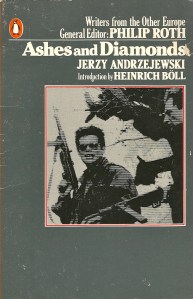
1980 Penguin paperback edition of Ashes and Diamonds.
German writer Heinrich Böll (1917-1985), like Milosz a recipient of the Nobel Prize for Literature, is altogether kinder to Ashes and Diamonds in his introduction written for the 1980 Penguin “Writers from the Other Europe” paperback edition of the novel, and reprinted in the 1997 Northwestern University Press edition. Almost as an aside, Böll notes that “the reader feels” that Andrzejewski “has a sense of kinship” with the novel’s “young Socialist and Communist functionaries.”
While both the Penguin and NUP editions of Ashes and Diamonds use D. J. Walsh’s 1962 British translation (with its battle-hardened Polish adults and nihilistic teenagers alike saying “cheerio” and “bloke” and “rotter” to one another), only the NUP edition includes five pages of previously deleted text. No explanation is given as to whether this was perhaps material removed by censors or, more likely, added in later to placate censors (possibly for the 1954 “sanitized” edition). A long speech by Stefan Szczuka, the sympathetically portrayed Communist Party official marked for assassination by the Polish underground, goes on and on for a mind-numbing two full pages of Soviet-era boilerplate:
For only those truly die who believe in isolation or who serve false truths which are illusory and incompatible with the one great truth of our time. Future generations will only despise them and will blame them or condemn them to oblivion. Those people, however, who have understood the forces of history and who have been in solidarity with their comrades, will discover in the future the praise of soldiers fighting for humanity, for one’s own fatherland and for mankind, for the world order.
Wajda sharpened the book’s edges by infusing the film with the Catholic iconography of Polish nationalism and by emphasizing the charged performance of Zbigniew Cybulski as the Home Army resistance fighter tasked with assassinating Szczuka. The combined effect was a cleverly coded rebuke to the postwar Soviet control of the country. Although the movie’s striking visual metaphors have sometimes been criticized as heavy-handed, the stylistic strategy clearly succeeded in Wajda’s intended aim of circumventing Communist Party censorship.
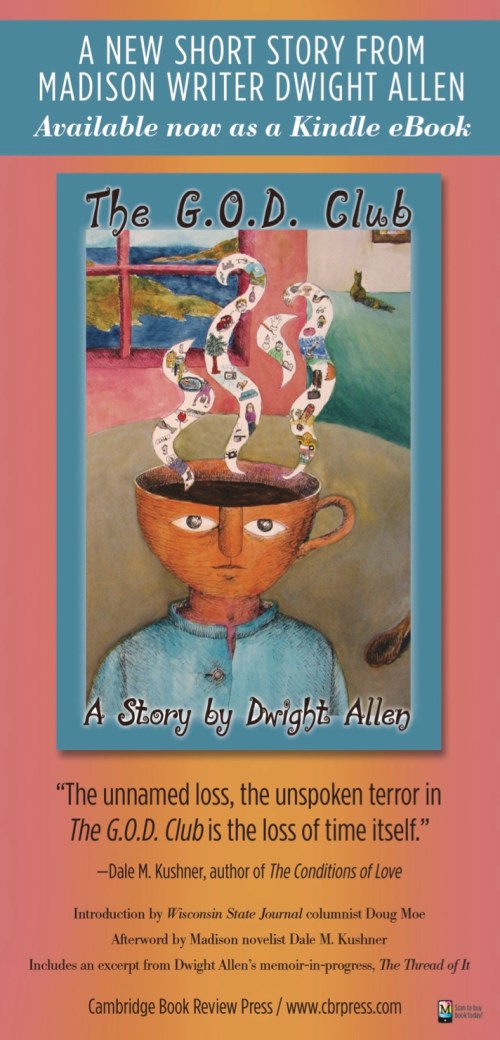
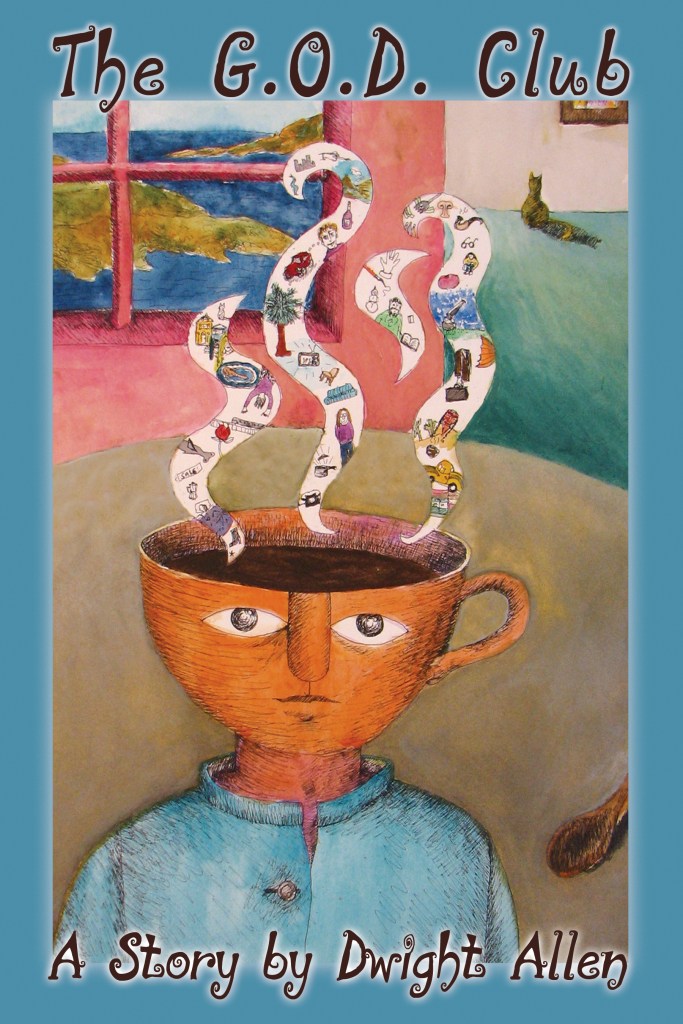
“The G.O.D. Club” is a new short story by Dwight Allen, author of two novels, Judge (2003) and The Typewriter Satyr (2009), and a collection of short stories, The Green Suit, reissued in 2011. Bonus features of this exclusive ebook single from Cambridge Book Review Press include an introduction by Wisconsin State Journal columnist Doug Moe, and an afterword by novelist and poet Dale M. Kushner (The Conditions of Love). Also included is “The Thread of It,” an excerpt from Dwight Allen’s memoir-in-progress.
“The unnamed loss, the unspoken terror in ‘The G.O.D. Club’ is the loss of time itself.”—Dale M. Kushner, author of The Conditions of Love.
I just posted a new short story of mine, “Recall,” to the website Medium. What I love about the site is the elegant simplicity of the page design, which makes for one of the very best environments I’ve seen for digital reading. The brainchild of Twitter’s co-founder, Evan Williams, Medium wants to do for long-form work what Twitter has done for focused brevity. Techcrunch.com has an excellent write-up on Medium from last fall.
[Update: Also worth checking out is David Carr’s May 25, 2014 New York Timescolumn: “A Platform and Blogging Tool, Medium Charms Writers.”]
Spent a pleasurable Sunday barnstorming through Nickolas Butler’s buzzworthy debut novel, Shotgun Lovesongs. My baby boomer sensibilities detected a Big Chill for Millennials familiarity to some of the material, but this was always offset by Butler’s keen eye for rural Wisconsin seasonal detail (“The October air filled with corn dust enough to make each sunset a postcard, with colors like a benign nuclear explosion”), and, above all, the novel’s clever use of the mythology that’s grown up around the music of Bon Iver’s Justin Vernon, who shares with Butler the hometown of Eau Claire.
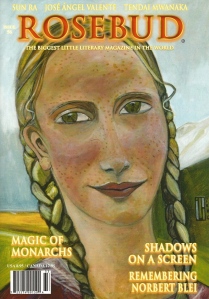
Rosebud 56 (Winter 2013/14) has arrived and it’s as strong an issue as editor Rod Clark has given us in twenty years of Rosebud goodness: From the vibrant nature-fueled Americana of featured Vermont artist Patricia LeBon Herb, to a selection of poetry from postwar Spanish writer José Ángel Valente newly translated by Thomas Christensen. Another must-read highlight is Rod’s Voice Over column, “Recuerdos: Guatamala 1976,” a harrowing first-person recounting of a notorious Latin American earthquake.
Film lovers will find a treasure trove in issue 56: “Shadows on a Screen,” a knowing coming-of-age short story by Thomas Fuchs, son of Hollywood screenwriter Daniel Fuchs (Criss Cross [1949]); Victor A. Walsh’s fascinating essay on Nellie Crawford (a.k.a. Madame Sul-Te-Wan), “Breaking the Color Barrier: Hollywood’s first African-American actress”; and Jack Lehman’s haunting “fictional autobiography,” “Orson Welles in Wisconsin.”
Also included are a pair of warm reminiscences of two iconic Wisconsin authors: Robert Zoschke’s “Norbert Blei (1935-2013): A writer with a capital ‘W,’” and Wisconsin State Journal columnist Doug Moe’s classic piece on Madison poet John Tuschen (1949-2005), “Poet is a Stranger in His Own Land.”
Believe me, I’m only scratching the surface of this issue (cf., P.S. Mueller’s illustrated exploration of Baby Boomer obsolescence, “Fader”; Rick Geary’s cheerfully sinister Afterwords comic, “My Home Town”). And, sure, let’s not forget to mention my short story, “Ty-D-Bol Blue,” which I’m delighted to see in print after first appearing online in last summer’s Cambridge Book Review.
From Shame to Sin: The Christian Transformation of Sexual Morality in Late Antiquity
Kyle Harper
Harvard University Press 2013
Reviewed by Bob Wake
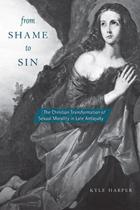
Kyle Harper’s From Shame to Sin: The Christian Transformation of Sexual Morality in Late Antiquity from Harvard University Press is rigorously academic in its range and depth. The good news for the rest of us is how lucid and enjoyable Harper’s writing is throughout. He describes, for instance, the escalating denunciations of Roman carnality by early theologians as an “arms race of sexual invective.” Monks helping to reform the life of a prostitute are “like a modern sports team that courts away its rival’s most valuable player.”
While pagan Rome represented a more open sexual culture—legal brothels, tolerance of homosexuality, equality of property and divorce rights between men and women—Harper is quick to remind us that their worldview and economy were framed by slavery and a strict hierarchy of social status.
Photo: Roman Terracotta Erotic Lamp, c. 2nd century CE. Value: $6,000.
On the one hand, eroticism’s secular deregulation lost out to the Church’s decreeing procreative marriage as the singular outlet for sexual expression. However, Harper also sees epochal societal gains with Christianity’s forceful condemnation of prostitution and the redemptive cloistering and rebuilding of broken lives. But there’s plenty of tyrannical exploitation on both sides in From Shame to Sin to suggest that abuse and victimization were no less disentangled from Eros two millennia ago than today.
Harper, a 2007 Harvard Ph.D. history grad, is currently an associate professor in the University of Oklahoma’s Department of Classics and Letters. More than the work of a first-rate historian of antiquity, From Shame to Sin is equally a supreme work of literary criticism. Harper’s analysis of ancient Greek novels and the Apocryphal Acts and Gospels—with a nod to influential literary critics like Northrop Frye and Stephen Greenblatt—is fascinating for the manner in which he detects recurring themes and shifts in emphasis that are shown to emerge alongside cultural changes.
Even on a rainy and foggy Halloween morning, it was a pleasure to drive 50 miles to Sauk City to deliver six cases of one of our Cambridge Book Review Press titles to the school district for an upcoming conference. Sauk City is the hometown of August Derleth, master of spooky stories and founder of the still active Arkham House Publishers. (Also after whom our son Augie is named.)
Commemorative plaque on downtown Sauk City bridge spanning the Wisconsin River. (Click on photo to enlarge.)








 Coffee Spew