
Category: Literature
-
Late Work
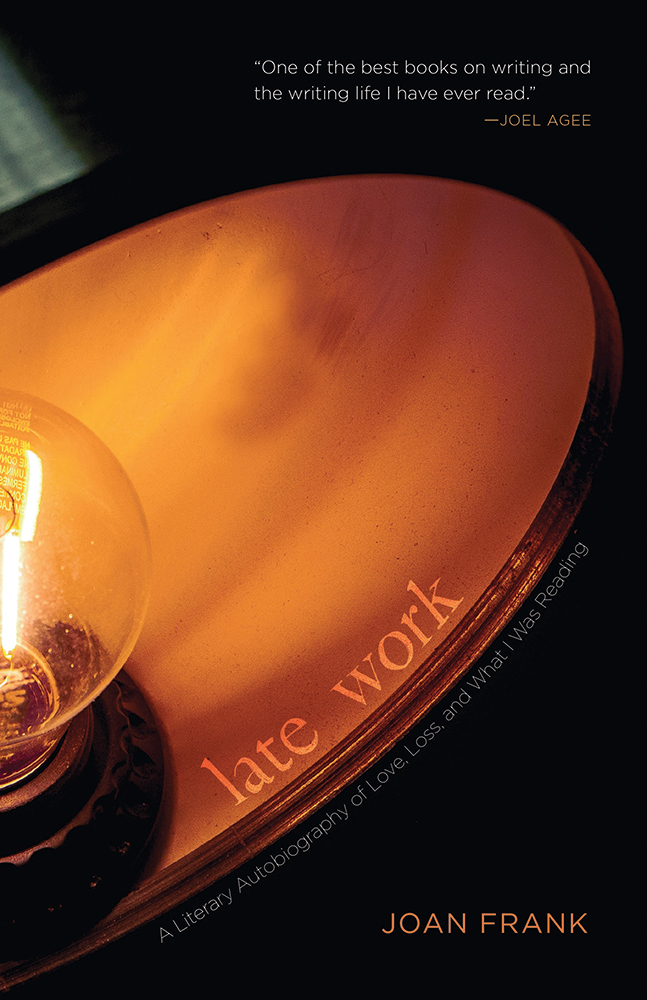
Late Work: A Literary Autobiography of Love, Loss, and What I Was Reading
Joan Frank
University of New Mexico Press 2022Reviewed by Bob Wake
Few writers are as honest and uncompromising about their art as Joan Frank. The essays collected in Late Work: A Literary Autobiography of Love, Loss, and What I Was Reading address “writers who’ve been at it awhile.” Readers and writers at any stage will find it both inspiring and sobering to learn that one of her novels, The Outlook for Earthlings, took fifteen persevering years to find a publisher.
Frank disputes the notion that writers and introverts in general are somehow better equipped to withstand the isolating effects of a global pandemic. In “Make It Go Away,” the COVID lockdowns are depicted in all their hallucinatory disorientation. “We’ve had terrible trouble sleeping,” she writes. “We’ve felt spaced out or angry or glum, tired or twitchy, scared or numb or listless…”
She admits to a post-pandemic loss of “clarity and conviction” (“It Seemed Important at the Time: The New Doubt”) and suggests the feeling may be more widespread than we realize. Her cultural analysis is persuasive. Frank’s New Doubt, like Hunter Thompson’s fear and loathing, portends bad vibes ahead:
Why lie about the sad drooly bony smelly Black Dog plopping down upon one’s chest at all hours, groaning and farting in its nightmare-riddled sleep?
Late Work is wide-ranging. Other highlights include an encomium to the practice of letter-writing (“Just anticipating letter-writing is erotic for me—the way approaching a bloc of private writing time and space is erotic”), and a bookstore reading gone horribly wrong (“Gird yourself, earnest artist. When attention comes it will contain naysayers”).
Two essays are devoted to the “now-classic-but-once-unknown” 1965 novel by John Williams, Stoner, about the struggles and muted transcendence of a Midwestern literature professor. “The novel’s arc feels—like all our very greatest art—inevitable,” Frank writes. “Its particulars shine with the relevance of the universal. It is timeless.”
The advice to writers in her essay “What Are We Afraid Of?” becomes advice to anyone feeling unmoored right now. “Despair can paralyze,” she warns. “If we’re paralyzed, nothing gets made.” We must teach ourselves to “shut out the roar.” Joan Frank offers strategies to help us find our way back to doing the work we care about.
-
The Transcendentalists and Their World
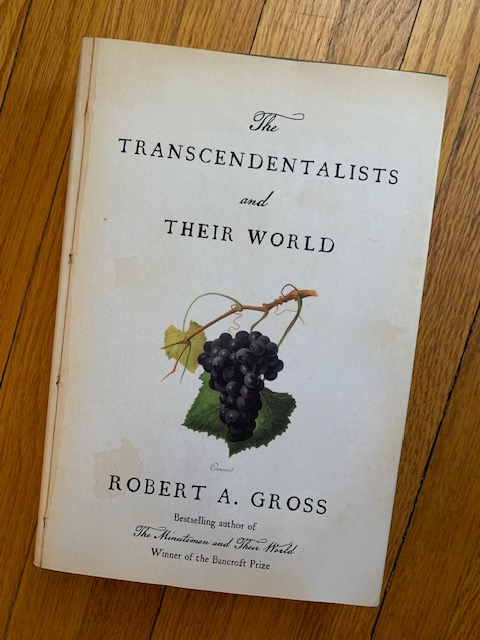
The Transcendentalists and Their World
Robert A. Gross
Farrar, Straus and Giroux 2021Reviewed by Bob Wake
Emphasis on “their world,” meaning Concord, Massachusetts in the first half of the nineteenth century. You will learn tons about manufacturing “the common pencil,” the family business that bored the shit out of Henry David Thoreau. Agricultural and educational reform. Industrialization and railroads. Internecine church discord. The unconscionably slow awakening of the abolitionist movement. Rich in granular census data, court records, diaries, letters. This approach to history—dubbed “new social history” when author Robert A. Gross began championing it in the 1970s—pays bountiful dividends. Transcendentalism’s nonconformity and romantic idealism go nowhere without a receptive “rising generation” seeking countercultural “newness.” Emersonian self-reliance is about bestowing wonderment and dignity upon human consciousness. Gross shows us what was happening on the ground—literally—in Concord (e.g., the cultivation of the Concord grape, and Thoreau’s storied bean-field). The book’s nearly 200 pages of endnotes comprise citation upon citation, and, in the best David Foster Wallace tradition, often include entertaining nested mini-narratives. All of which is to say: Transcendentalism rightfully deserves context, and by God, Gross’s 864-page career-capping masterpiece supplies it.
-
The Power of the Dog
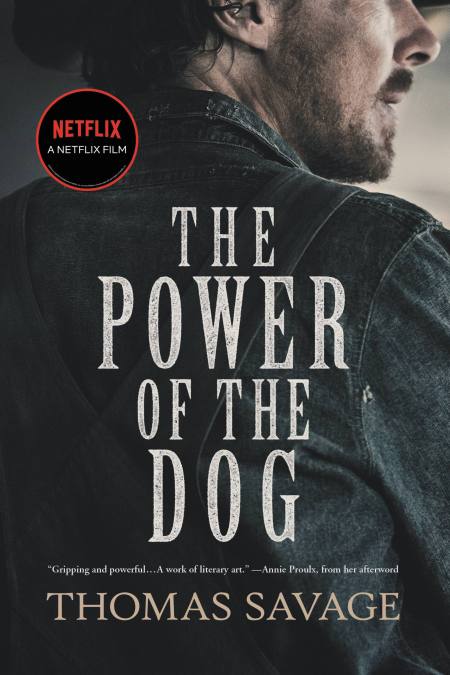
The Power of the Dog
Thomas Savage
Afterword by Annie Proulx
Back Bay Books 2021 [2001]Reviewed by Bob Wake
Back Bay Books’ 2001 reprint of Thomas Savage’s 1967 Western novel, The Power of the Dog, with a laudatory afterword by Annie Proulx, brought serious reconsideration to Savage’s largely forgotten book. (Not unlike the rediscovery of John Williams’ Stoner from 1965, recognized only in the last ten years as a classic American novel.) New Zealand director/screenwriter Jane Campion’s adaptation of The Power of the Dog, and its twelve Oscar nominations, should further burnish the book’s reputation. As Proulx writes, “Savage created one of the most compelling and vicious characters in American literature.” That would be Phil Burbank, played with menacing brio by Benedict Cumberbatch. Montana ranch owner, bully, and sexually repressed homophobe. “He is, in fact, a vicious bitch,” says Proulx. Ahead of its time? Possibly. But as a revisionist Western, even an anti-Western, Savage’s novel precedes Robert Altman’s McCabe & Mrs. Miller (1971) by a mere four years. Campion gets it. Kodi Smit-McPhee, in one of the best fakeout performances in recent years, seems to consciously echo Keith Carradine’s brief but unforgettable role in Altman’s film as a bumpkin out of his depth. What really seals the homage is Carradine’s cameo as the governor in Campion’s film.
-
Sustainable Living

Sustainable Living
Elsa Nekola
Willow Springs Books 2021Reviewed by Bob Wake
Wisconsin writer Elsa Nekola’s debut collection of short stories, Sustainable Living, is so deeply knowing of the Upper Midwest that it functions as a kind of wisdom literature. Granted, the wisdom may not always be welcome. Disillusionment is a recurring theme, as is the fictional town of White Birch, where old habits die hard. A retired supper club owner (“Winter Flame”) can’t quit his mealtime routine of “folding his cloth napkin into a swan.” The betrayal of a fragile summer friendship (“River Through a Half-Burnt Woods”) replays itself in a woman’s memory like a wound that refuses to heal.
Fifteen-year-old Coral, the protagonist of “Oktoberfest,” feels preternaturally at home in the Northwoods, but less so in an adult world of struggling families and economic hardship. Addiction. Unwanted sexual attention. “She’s beginning to think,” we’re told, “that being a woman means staying where you’re needed, not where you want to go.”
Coral, by story’s end, may not know where she wants to go, or where she fits in. But readers will recognize in the achingly fine-tuned descriptions of landscape and wildlife that Coral has a near-mystical connection to her surroundings:
Today, there’s frost on the grass, and a chill that won’t leave the air until April. The mallards and black ducks have begun to court, and in midwinter the hairy woodpeckers will drum on hollow trees.
Nekola is especially good on the complexities of mother-daughter relationships, whether a grown daughter in “Meat Raffle” returning from Chicago to visit her eccentric literary mom in southeastern Wisconsin (“She thinks she’s the first sixty-year-old widow to discover Shakespeare,” fumes the daughter), or the title story’s resourceful fourteen-year-old Myra Pavelka, abandoned to relatives and afternoon barrooms when her mother hastily takes flight under possible criminal circumstances.
Sustainable Living won the 2020 Spokane Prize for Short Fiction from Willow Springs Books, whose top-notch book design compliments the jeweled precision of these stories. Elsa Nekola’s work has appeared in numerous literary journals, from Ploughshares and Passages North, to Rosebud Magazine and Midwestern Gothic.
-
Crossroads
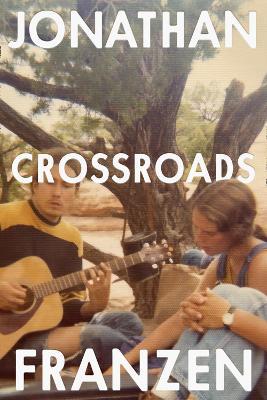
Crossroads
Jonathan Franzen
Farrar, Straus and Giroux 2021Reviewed by Bob Wake
At nearly 600 pages, Jonathan Franzen’s Crossroads reads like a binge-worthy premium cable series, complete with melodramatic cliffhangers between episodes. Chapters are composed in third-person intimate narration with POV alternating between members of the Hildebrandt family, parents Russ and Marion, and their four children, ranging in ages from nine to twenty. Russ is an associate minister at a church with a thriving youth group culture. It’s 1971 in the Chicago suburbs. The commingling of religion and politics is as vigorous on the antiwar left (liberation theology) as it is on the right. Crossroads is most assuredly a secular novel about religious faith and guilt, no less so than Nathaniel Hawthorne’s The Scarlet Letter (a novel winkingly alluded to in Crossroads, which isn’t without Franzen’s occasional metafictional side glances, up to and including Reverend Hildebrandt driving a Plymouth Fury wagon).
The teenagers are well-drawn, if reminiscent, perhaps unavoidably, of influential television series like Freaks and Geeks and My So-Called Life. The failed HBO project that Franzen and filmmaker Noah Baumbach undertook ten years ago in trying to adapt Franzen’s more challenging novel, The Corrections, may have pushed the author in the direction of ruthless narrative momentum at the expense of literary experimentation. Crossroads is Jonathan Franzen’s most conventional novel to date, but his psychological realism remains as always acute. This is engaging storytelling that bodes well for further installments of what promises to be a trilogy of novels following one American family through the years. (Nine-year-old Judson’s “unhealthy absorption” with an eight-millimeter movie camera, for example, suggests there might be a grown filmmaker inhabiting a future volume.)
-
A Swim in a Pond in the Rain

A Swim in a Pond in the Rain: In Which Four Russians Give a Master Class on Writing, Reading, and Life
George Saunders
Random House 2021Reviewed by Bob Wake
An unexpected delight. Sure to become a classic on the craft of short story writing. George Saunders’s discussions of the mechanics of seven Russian short stories (three by Chekhov, two by Tolstoy, and one each by Gogol and Turgenev, all included in the book) are so clear-eyed and openhearted as to be breathtaking. Additionally filled with revealing insights into his own idiosyncratic stories and his development as a writer. Jonathan Franzen attempted something similar in 2013 with The Kraus Project, his heavily annotated collection of essays by the Viennese satirist Karl Kraus. While Franzen’s autobiographical asides were disarming, the Kraus texts themselves were nearly impenetrable to modern readers. Not so with the Russian short stories collected here, which remain touchstones of high literary art, Shakespearean in their universality and timelessness.
-
The Outlook for Earthlings

The Outlook for Earthlings
Joan Frank
Regal House Publishing 2020Reviewed by Bob Wake
Melanie Taper and Scarlet Rand are Northern California-raised, self-searching, not always in sync, but supportive of one another since they were teenagers talking about boys and books at the school bus stop. Joan Frank’s ambitious new novel, The Outlook for Earthlings, is a puzzle-perfect narrative of interlocking flashbacks and flash-forwards, chapters qualifying and revising one another, circling elusive truths, charting the vicissitudes of Melanie and Scarlet’s decades-long friendship. Our perceptions and sympathies are jerked and jolted. Perspectives multiply. Consider a character’s anxiety when she ends a college affair with a married professor: “She felt like a cubist painting, pieces of her broken off and floating about the room. Mouth here, hand there, eyeball there.” The cubist dysmorphia foreshadows a medical illness.
Friendship cannot function without a measure of confoundedness. Melanie might privately think of Scarlet, “Heavens, the woman wore her emotions like a sandwich board.” Scarlet, in an unkind moment, casts Melanie as a “docile homemaker” to Scarlet’s “globetrotting roustabout.” (Just as quickly, Scarlet retracts the labels as “vain, reductive.”) As a columnist for the Chicago Tribune, Scarlet lives her dream. Both women will eventually hold down unfulfilling jobs to make ends meet. Melanie Taper, one of the most enigmatic characters in recent fiction, becomes a prodigious autodidact:
Mel knew all of Shakespeare, much of it by heart. She was reading Walter Benjamin, Nietzsche, Musil, Unamuno. She listened to postgraduate lectures on cassette while she drove to work: Philosophy of Religion, Foundations of Western Civ. She had lately told Scarlet, in perfect seriousness, she thought she should learn Italian so that she could read Montale and Morante in the original.
Melanie writes stories and novels and never seeks their publication. She’s preternaturally selfless in marriage and love. (“Subjugating oneself like some wretched servant” is Scarlet’s interpretation.) Melanie’s endlessly expanding and long-delayed graduate school thesis on Dostoyevsky’s The Idiot is conceived as a kind of emotional rescue of the epileptic Prince Myshkin. (“She felt this way about others, literary or real: poor Raskolnikov; poor Van Gogh. Somebody needed to make them some soup.”)
Joan Frank has a painter’s eye for the natural world. (“The early sun struggled through the fog, a light of dirty wet coins.”) And a keen appreciation for the way our senses are assaulted by institutional spaces, such as academic administration offices. (“Smells of cleaning fluid, aging paper, bookbinding, overcooked coffee.”) The Outlook for Earthlings doesn’t discount the possibility of spectral visitations within the naturalistic confines of our world, but neither does it comfortably decipher them for us when they perhaps appear. The author’s tough-minded body of work, which includes numerous award-winning novels, short story and essay collections, has long refused to do the reader’s necessary work. Our task is clear. Each of us must answer for ourselves when this forceful and singular novel, arguably Joan Frank’s finest work to date, asks of us, “Did any ending ever befit the life it capped?”


 Coffee Spew