Rosebud 51 is smokin’ hot off the press and ready for readers and coffee tables. Order the issue direct from the Rosebud website. Worth owning alone for the cover art and inside illustrations by Wisconsin watercolorist Geri Schrab. But there’s so much more: 144 pages of fiction, poetry, and art. “Go Figure” drollery from New Yorker cartoonist and Rosebud regular P. S. Mueller (“The town’s electricity is distributed from a large ceramic-looking wire thrusting out of what everyone calls ‘the Founder’s Rock’ in the basement of the old City Hall”). “Afterwords” comic strip from another Rosebud regular and former National Lampoon cartoonist Rick Geary. Editor Rod Clark’s “Voice Over” column with a grassroots homage to mowing the lawn (“Now and then I glance up to see a turkey vulture circling high above me. Does he imagine me to be a wounded animal nearing my final gasp?”). Fiction from Rosebud founder and editor-at-large John Lehman, and from Hugo Award-winning writer Kristine Rusch. And let’s just say: tons more stuff. Including, dear family and friends, my short story “Summer of the Cinetherapist.”
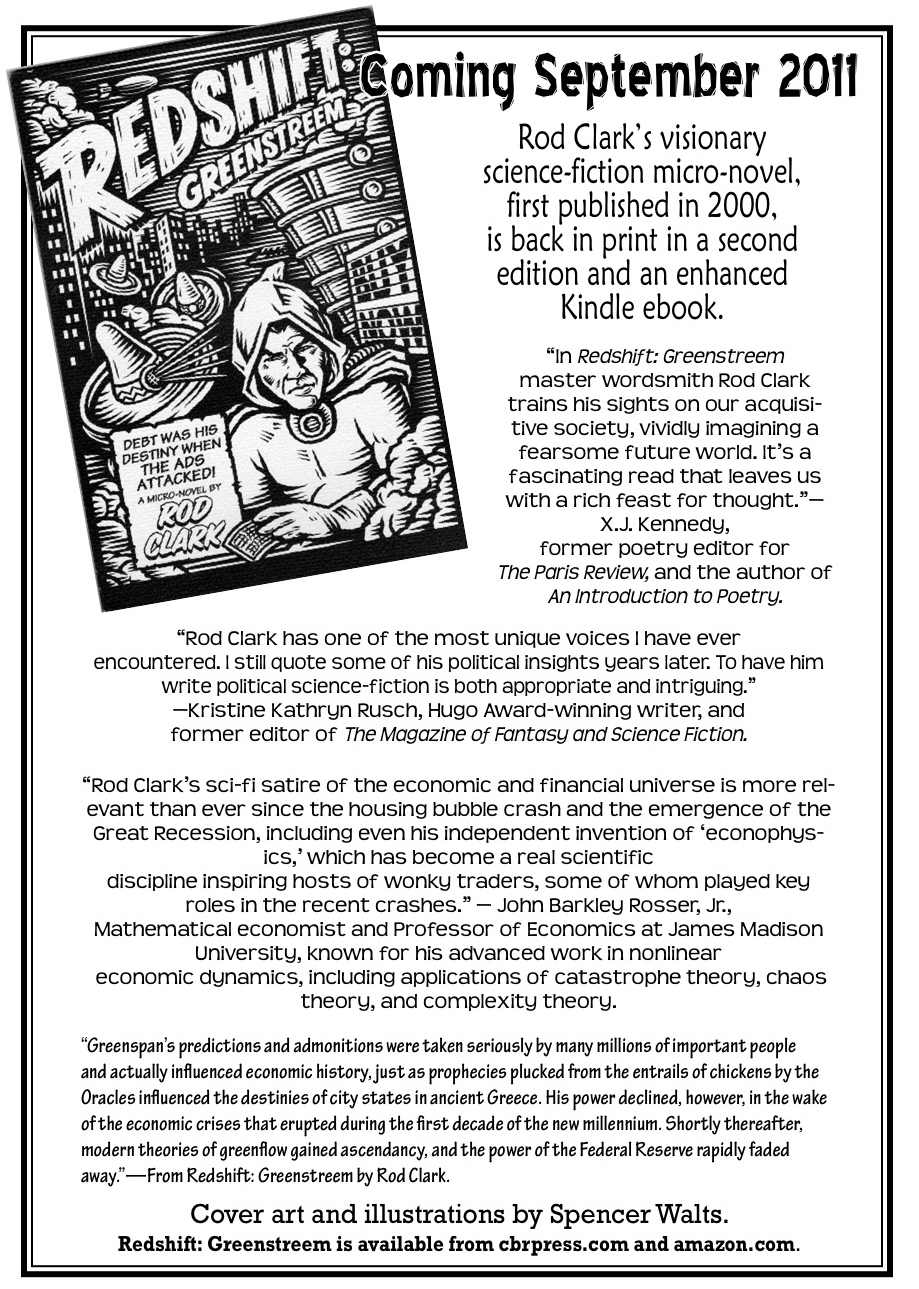
Rosebud readers of issue 51 can also look forward to excerpts from Rod Clark’s scarily prophetic sci-fi micro-novel Redshift: Greenstreem, first published in 2000 by Cambridge Book Review Press and now available in a 2011 second printing and as a Kindle ebook. And here’s a deal that no one should pass up: Anyone subscribing or re-subscribing to Rosebud can get a copy of Redshift: Greenstreem by putting “I WANT MY RG” on the note with your Paypal order at www.rsbd.net or in a letter with your check to: Rosebud, P.O. Box 459, Cambridge, Wisconsin, 53523.
St. Martin’s Press edition (1962). Design: Tom O’Brien.
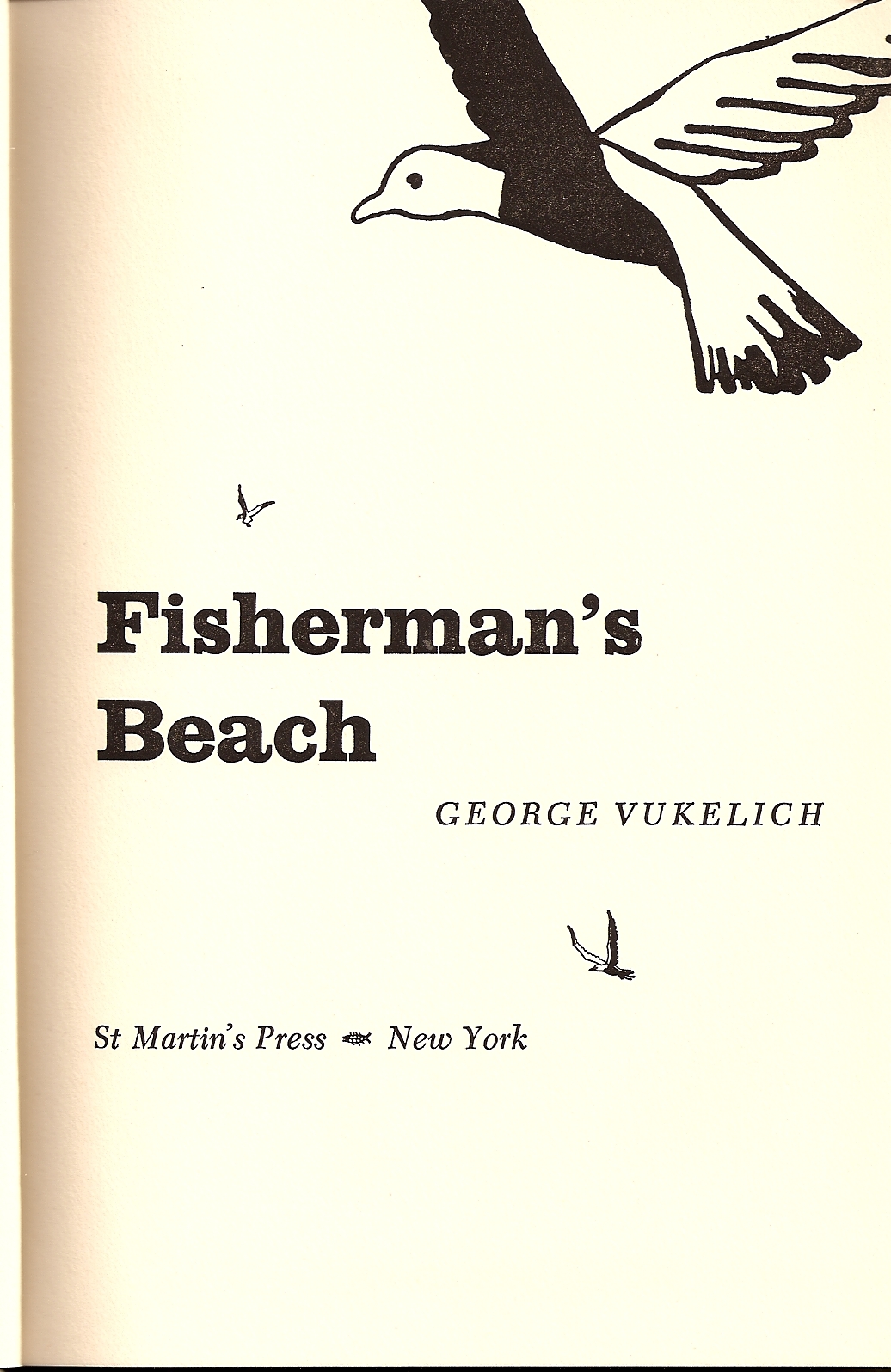
Pictured here is the cover to the 1962 St. Martin’s Press edition of Fisherman’s Beach by Wisconsin writer George Vukelich (1927-1995). Vukelich reprinted the novel in 1990 under his own North Country Press imprint, with a new cover, but using what appear to have been either the original printer’s plates of the inside pages or, more likely, newly shot photo-offset reproductions from the earlier edition. Cambridge Book Review Press is currently preparing an ebook edition of Fisherman’s Beach for release in spring 2012. The ebook will include a new introduction (by a Madison notable and Vukelich friend who we’re keeping a surprise for a while longer). Also included will be photos of Two Rivers, Wisconsin, where the novel is set, by fine arts photographer Thomas J. King. There’ll be additional supplemental material in the ebook, as well, such as a biographical sketch of George Vukelich by James P. Roberts, and a study guide that should make Fisherman’s Beach perfect for reading groups and classrooms.
Here’s the inside jacket copy from the 1962 edition:
Old Man LeMere was dying upstairs. He was a tough old gull, but nobody lives forever. Downstairs, Roger, his second son, was waiting to inherit the fisherman’s beach. He could not afford to wait long. The lamprey eels from the ocean were destroying the trout of Lake Michigan, and the fishermen were powerless to stop them. Also he was afraid of Germaine.
Germaine was the eldest son. He had left the family and the Church. He was a major, stationed in Europe, who had come home for the first time in many years when he heard of his father’s illness. The Old Man wanted Germaine to take over the beach. Roger—ambitious, brutal, suspicious—knew it and would not believe that Germaine wanted no part of the inheritance. Nor would Roger believe that Germaine had not come home to reclaim Ginny Dussault, Germaine’s high school sweetheart who, despairing of Gemaine’s return, had allowed Roger to become her lover.
From these elements George Vukelich has woven a first novel of astonishing power. He is a poet and his descriptions of the changing seasons on the lake shore of his native Wisconsin are woven with a lyricism too seldom found in contemporary writing. He is also a keen student of humanity—its frailties and its strengths. Fisherman’s Beach gives an unforgettable picture of a family of strong characters, closely united yet at war among themselves.
And here’s the back cover author’s photo and bio:
Author photo of George Vukelich from 1962. No photographer credited.
Mr. Vukelich is best known in Wisconsin as “Papa Hambone,” a disc jockey with the top rated night-time program in the Madison area. He writes “I’ve become a split personality to further a writing career. ‘Papa Hambone’ buys the groceries, meets the mortgage payments and maintains the menage; George Vukelich simply tries to write the best first novel of which he is capable.” George Vukelich also spent a year as a creative writing instructor at the University of Wisconsin, and another as a merchant seaman. His poetry and short stories have been published in many magazines, including The Atlantic Monthly and Botteghe Oscure.
Title page: North Country Press 1990.Title Page: St. Martin Press 1962.
Cover to the 1990 reprint edition published by Vukelich’s North Country Press.
Cambridge Book Review Press is delighted to announce that digital rights have been secured to publish a Kindle ebook edition of Fisherman’s Beach, the masterful novel by the late Wisconsin author and long-time Madison newspaper columnist and radio-host George Vukelich (1927-1995). Originally published in 1962 by St. Martin’s Press, Fisherman’s Beach is a remarkably assured debut novel charting the postwar struggles of a Catholic fishing clan in Two Rivers, Wisconsin. The family is headed by a dying patriarch, Old Man LeMere. Often at odds with his Irish wife, his five sons, not to mention his doctor and his priest, LeMere represents a tradition and moral force that seem to be breaking down around him. Writer August Derleth, with whom Vukelich studied following a stint in the Merchant Marine during the Second World War, said that Fisherman’s Beach is “one of the best family novels of our time—not the family novel that moves from one generation to another … but the novel that is the portrait of the family seen at a time of crisis.” Vukelich’s sturdy naturalism has kept the novel’s style timeless and fresh. And in its depiction of a family business battling state politicians over fishing rights, Fisherman’s Beach touches on an all-too-contemporary Wisconsin theme: political power and its abuse.
Watch for Fisherman’s Beach in ebook format coming in spring 2012 from Cambridge Book Review Press.
[Update 10/9/11: Read Doug Moe’s Wisconsin State Journal column about CBR Press and the origins of the Fisherman’s Beach ebook project.]
[Update 4/10/12: Fisherman’s Beachebook now available!]
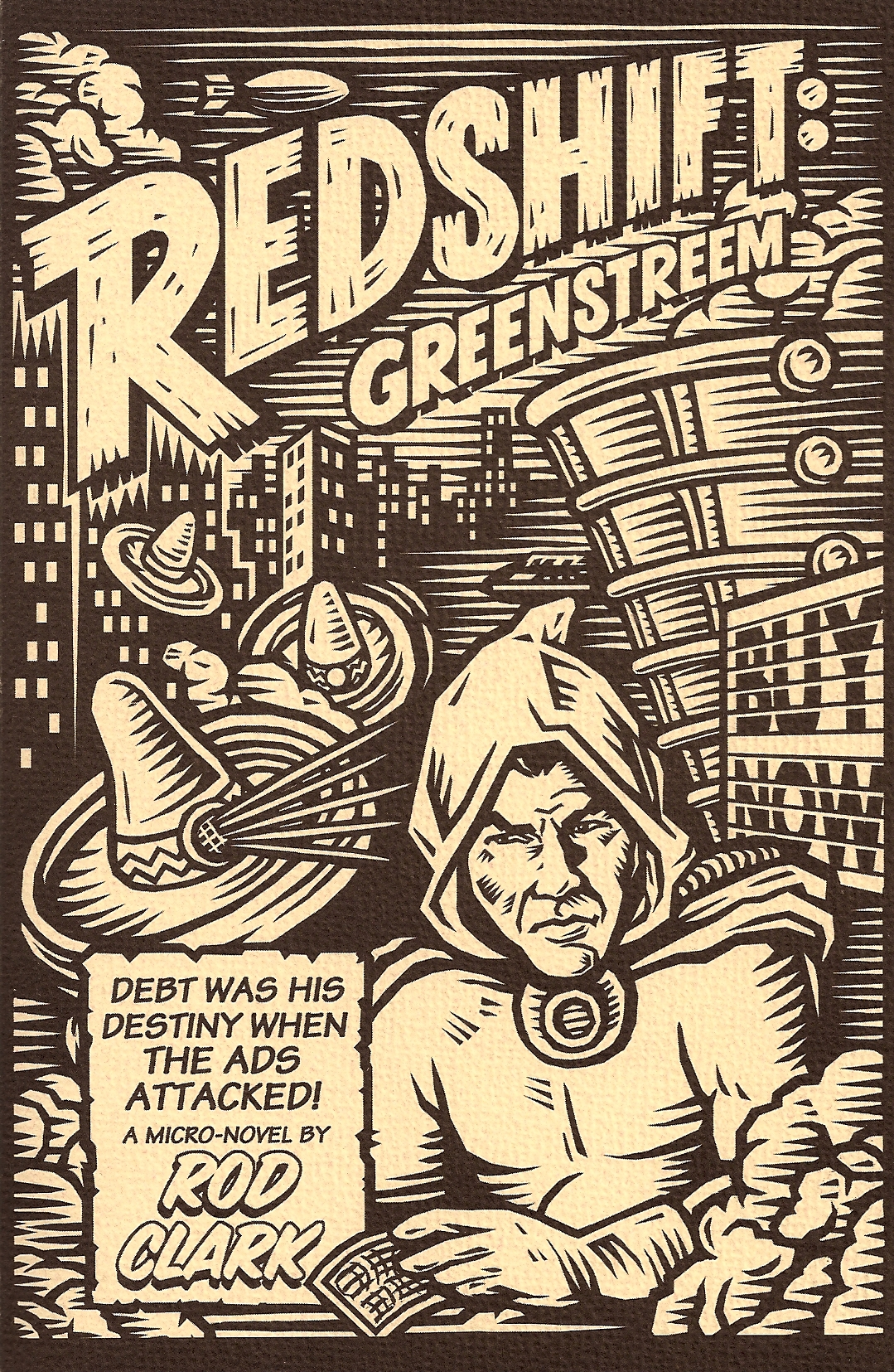
First published in 2000 by Cambridge Book Review Press, Rod Clark’s Redshift: Greenstreem is now available in a 2011 second-printing, and as a Kindle ebook. Not one word has been changed from the book’s first edition. Clark eerily predicted much of our collective fate since the turn of the millennium. Redshift: Greenstreem is visionary science fiction that has come frighteningly true in the decade since it was written. The future is now. Here are the facts.
∞
News Item (4/9/09): Greenspan’s reputation continues to decline: “He’s a historical relic at this point” [1].
Redshift: Greenstreem (p. 47): “Greenspan’s predictions and admonitions were taken seriously by many millions of important people and actually influenced economic history, just as prophecies plucked from the entrails of chickens by the Oracles influenced the destinies of city states in ancient Greece. His power declined, however, in the wake of the economic crises that erupted during the first decade of the new millennium. Shortly thereafter, modern theories of greenflow gained ascendancy, and the power of the Federal Reserve rapidly faded away.”
∞
News Item (7/18/11): The Tea Party National Committee / The Sins of Federal Debt: “This is the horrifying consequence of America’s sinful addiction to federal debt: Young Americans are waking up into adulthood to the heart-stopping realization that they have been sold into debt to such organizations as the Communist Party of China …” [2].
Redshift: Greenstreem (p. 20): “Smiling, sincere, so very, very Christian Gary [Bauer] who had ridden smugly into the White House in the year 2016 on the slogan ‘DEBT IS PUNISHMENT FOR OUR SINS.’ ”
∞
News Item(6/19/11): China’s ghost towns: New satellite pictures show massive skyscraper cities which are STILL completely empty [3].
Redshift: Greenstreem(pp. 29-30): “Upstairs, outstairs, into the endless night, leviathans folded and unfolded on distant moons, carving labyrinths in inanimate rock, unrolling real estate plats on ancient asteroids, inexplicably building airless condominiums by the thousand on the uninhabitable wastes of Uranus and the moons of Jupiter, constructing skyscrapers on Saturn and vast complexes on Venus that had no known purpose, and often did not function at all—only to rip them down, and start again.”
∞
Spencer Walts illustration from “Redshift: Greenstreem.”
News Item (8/30/11): Suitcase Nuclear Reactors to Power Mars Colonies [4].
Redshift: Greenstreem(p. 49): “The first experimental macroset was created by Engineer Jack Dougal McCool in 2042. He called it a ‘factory in a suitcase’ or FIS …”
∞
News Item (8/30/11): Clive Thompson on the Problem with Online Ads: “Consider Facebook: Each year, it redesigns its site to gradually nudge users to make more and more of their material public. This is partly because CEO Mark Zuckerberg seems to think publicness is inherently good—but it’s also a rational response to the demands of the ad market, which needs as many people looking at as many things as possible” [5].
Redshift: Greenstreem(p. 15): “ … [D]reemwaves … bathed the planet since early in the 21st century when the triple ‘M’ (mesmeric microwave merchandizing) consortiums had begun inserting microscopic holo-projectors and speakers in the texture of virtually every manufactured item in the solar system to leverage the power of advertising.”
∞
News Item(1/8/10): Making Fortunes in Milliseconds: “It’s called high frequency trading (HFT), but it’s also described as algorithmic trading or quant trading” [6].
Redshift: Greenstreem (p. 31): “A positive rivulet of solvency could only be generated by anchoring vats of biosentient or AI investment software to the arcane task of constantly buying assets every fraction of a second, letting their value amplitude rise microscopically, and then almost instantly selling them, sometimes microseconds before they dissolved into nothingness—reinvesting the profits in commodities or securities that would be (for a few instants at least) of slightly greater value and duration.”
∞
New Item(3/10/11): An Introduction to Hyperinflation: “Imagine taking a road trip. At the start of the day, a can of soda at a convenience store costs exactly $1. By nightfall, that same can of soda costs $3. This sounds impossible, right? … Money can become essentially worthless …” [7].
Redshift: Greenstreem(p. 20): “Glancing down at the bill in his hand through gray-tinted goggles, he saw with dismay that digital monetary decay was already in rapid progress. The inflationary readout on what had been a hundred-dollar bill only a few minutes ago was now down to ninety-six bucks and dropping.”
Rod Clark’s Redshift: Greenstreem with illustrations by Spencer Walts is now available in a Kindle edition for $2.99 and includes two bonus stories! The 2011 paperback second-printing is also available for $8.00 from PayPal and Amazon.
My short story collection, Caffeine & Other Stories, is now available as a Kindle download for $2.99. It’s a newly expanded edition that includes four bonus stories not found in the $12.95 paperback.
Blurbs from the 1997 edition:
“We see stimulants from caffeine to cocaine, alcohol and marijuana to nicotine. His characters glean intelligence (however wacky, artificial, or genius) and courage from their personal favorite highs. In a rather dark interpretation, I often felt as though many of his characters were on a bumpy ride to suicide. Yet, just when we are shaking our heads at them, Wake surprised me with his unfaltering wit and I laughed my fears away. After all, this is the human spirit he is so masterfully portraying …” —Tracy Walczak, BookLovers.
“Caffeine is a book of constant surprises. In this collection of linked stories set in south-central Wisconsin, Wake sets before us the confusions of life in yuppie heaven. And he does so with tough love, and a wit which will have you laughing wickedly along. Bob Wake has a great sense of where he lives, Madison, Wisconsin, postmodern America. I, for one, look forward to continuing words from this bright writer.” —Jim Stevens, editor of The Journey Home: The Literature of Wisconsin Through Four Centuries.
“The range shown by Bob Wake in creating this series of interconnected, readable stories that stand well on their own is a considerable accomplishment. Reading Caffeine & Other Stories is like being a kid again and reaching into a grab bag at a rich friend’s birthday party: you can’t know what you are going to get, but you can be sure it’s going to be damn good.” —Chris Lott, Eclectica.
“Bob Wake writes likes Ralph Steadman draws: a few choice words and boom! there’s a real, living, breathing character … Caffeine & Other Stories kicks ass, rocks hard, and leaves you wanting more.” —Marie Mundaca, Erupture.
“Mr. Wake writes with confidence and polished prose, and obviously knows well how to craft a short story.” —J. Allen Kirsch, author of Madlands, and God’s Little Isthmus.
“Wake is a first class teller of tales and spinner of stories.” —Midwest Book Review.








 Coffee Spew