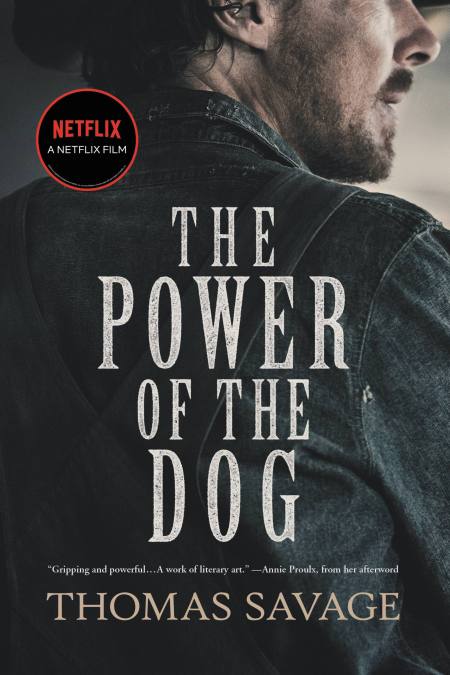
The Power of the Dog Thomas Savage Afterword by Annie Proulx Back Bay Books 2021 [2001]
Reviewed by Bob Wake
Back Bay Books’ 2001 reprint of Thomas Savage’s 1967 Western novel, The Power of the Dog, with a laudatory afterword by Annie Proulx, brought serious reconsideration to Savage’s largely forgotten book. (Not unlike the rediscovery of John Williams’ Stoner from 1965, recognized only in the last ten years as a classic American novel.) New Zealand director/screenwriter Jane Campion’s adaptation of The Power of the Dog, and its twelve Oscar nominations, should further burnish the book’s reputation. As Proulx writes, “Savage created one of the most compelling and vicious characters in American literature.” That would be Phil Burbank, played with menacing brio by Benedict Cumberbatch. Montana ranch owner, bully, and sexually repressed homophobe. “He is, in fact, a vicious bitch,” says Proulx. Ahead of its time? Possibly. But as a revisionist Western, even an anti-Western, Savage’s novel precedes Robert Altman’s McCabe & Mrs. Miller (1971) by a mere four years. Campion gets it. Kodi Smit-McPhee, in one of the best fakeout performances in recent years, seems to consciously echo Keith Carradine’s brief but unforgettable role in Altman’s film as a bumpkin out of his depth. What really seals the homage is Carradine’s cameo as the governor in Campion’s film.
Once Upon a Time in Hollywood: A Novel Quentin Tarantino Harper Perennial 2021
Reviewed by Bob Wake
Dwight Garner’s cautiously laudatory New York Timesreview of filmmaker Quentin Tarantino’s epic 400-page novelization of Once Upon a Time in Hollywood gets it right: “If it were written better, it’d be written worse.” Tarantino’s novel is pulp fiction best appreciated as a companion text, or better yet, a skeleton key to the movie. Lots of riotous untold backstory of how Hollywood stuntman Cliff Booth (played by Brad Pitt in the movie) comes by his casual proficiency with ultraviolence. There’s a deeper dive into Manson Family dynamics, perhaps not as nuanced as Emma Cline’s The Girls, but no less chilling. The novel even has its own surprise ending that cleverly subverts the movie’s surprise ending. There are seedy detours into Hollywood lore, including a poignant depiction of alcoholic actor Aldo Ray’s decline. Most enjoyable is the book’s torrent of geeky motor-mouthing film criticism, similar in tone to the engaging program notes that the director has been penning in recent years since purchasing the New Beverly Cinema in Los Angeles.
At 720 pages, Antkind succeeds as a large-scale comic novel. This is an impressive feat for a first-time novelist (albeit a first-time novelist who happens to be an Oscar-winning screenwriter). Line for line, page for page, Antkind is frequently deliriously funny. Kaufman’s 1990s TV scripts for comics like Chris Elliot are a clear influence. Antkind’s narrator and protagonist, B. Rosenberger Rosenberg, a self-important film critic, has the snotty arrogance that Elliot mastered so perfectly. Chris Elliot’s willingness to risk unlikeability is both his genius as a comic performer and probably his undoing with audiences (e.g. Cabin Boy). Charlie Kaufman seems to intuitively understand that an insufferable character is only as bearable as the jokes exposing the character’s pretensions and selfishness. Antkind has the jokes like Arby’s has the meats. As Kaufman has shown in his wildly inventive film scripts (Being John Malkovich, Adaptation, Eternal Sunshine of the Spotless Mind), he’s never met a meta gag that he can’t spin into comedy gold. Not unlike Martin Amis’s insertion of “Martin Amis” as a character in his novel Money, Antkind’s film critic is deeply hostile to the very real films of Charlie Kaufman (while extolling the more comfortably mainstream films, both real and imaginary, of Judd Apatow). Although the novel’s sci-fi trappings—time-travel and multiverses—seem at times like a lesser work by Philip K. Dick (name-checked in Antkind as an “American primitivist”), Antkind’s slapstick exuberance is like a live-action Tex Avery cartoon.
Late night streaming on Vudu: The Humbling is an adroit adaptation of Philip Roth’s novella. Co-scripted by Buck Henry, who adapted The Graduate and Catch-22 for Mike Nichols. Al Pacino as a morose suicidal actor. Greta Gerwig is his bisexual love interest. Zaniness ensues. Comparisons to Birdman are not misplaced: The Humbling employs fantasy sequences (in a departure from Roth’s novella) that dramatize Pacino’s scrambled state of mind, including a Birdman-like dream of Pacino locked out of a theater mid-performance. The movie substitutes a more ambiguous ending than the novella’s brutal finish, but it’s well worth a look. Directed by Barry Levinson of Rain Man and Wag the Dog.
1997 Northwestern Univ. Press edition of Ashes and Diamonds.
The 1948 Polish novel Ashes and Diamonds by Jerzy Andrzejewski (1909-1983) is probably less appreciated today as a literary work in its own right than as the basis for Andrzej Wajda’s 1958 film adaptation. The wildly entertaining movie, designated an “Essential Art House” choice in Criterion’s DVD catalog, owes more to Orson Welles’s baroque cinematic influence than Andrzejewski’s blend of socialist realism and tragic irony. Both novel and film are compact (239 pgs./103 mins.), while at the same time reflecting a panoramic near-epic cross-section of Poland’s clashing societal and political factions at the close of the Second World War. Neither the novel nor the film have escaped criticism over the years, although for different reasons.
Poet Czeslaw Milosz (1911-2004), who defected from Communist Poland in 1951, wrote a scathing smackdown of his former friend Jerzy Andrzejewski in The Captive Mind (1953), the Nobel Prize-winning poet’s classic study of writers and intellectuals “adapting” themselves to totalitarian regimes. Milosz—who refers to Andrzejewski pseudonymously as “Alpha, the Moralist”—is especially tough on what he sees as pulled-punches in Ashes and Diamonds (discussed at length in The Captive Mind without mentioning the novel’s title). According to Milosz, the novelist was nicknamed “the respectable prostitute” by fellow-writers who saw Andrzejewski as a Stalinist suck-up.
Zbigniew Cybulski in Andrzej Wajda’s Ashes and Diamonds (1958)
Film director Andrzej Wajda, in a fascinating interview included on the Ashes and Diamonds Criterion DVD, talks candidly of having initially refused to read the novel because of its state-sanctioned popularity in the 1950s. In the notes to a 2007 translation of Andrzejewski’s earlier novel, Holy Week, commentator Oscar Swan writes: “The year 1954 found Andrzejewski politically sanitizing a new edition of Ashes and Diamonds, which had become required reading in the schools.”
1980 Penguin paperback edition of Ashes and Diamonds.
German writer Heinrich Böll (1917-1985), like Milosz a recipient of the Nobel Prize for Literature, is altogether kinder to Ashes and Diamonds in his introduction written for the 1980 Penguin “Writers from the Other Europe” paperback edition of the novel, and reprinted in the 1997 Northwestern University Press edition. Almost as an aside, Böll notes that “the reader feels” that Andrzejewski “has a sense of kinship” with the novel’s “young Socialist and Communist functionaries.”
While both the Penguin and NUP editions of Ashes and Diamonds use D. J. Walsh’s 1962 British translation (with its battle-hardened Polish adults and nihilistic teenagers alike saying “cheerio” and “bloke” and “rotter” to one another), only the NUP edition includes five pages of previously deleted text. No explanation is given as to whether this was perhaps material removed by censors or, more likely, added in later to placate censors (possibly for the 1954 “sanitized” edition). A long speech by Stefan Szczuka, the sympathetically portrayed Communist Party official marked for assassination by the Polish underground, goes on and on for a mind-numbing two full pages of Soviet-era boilerplate:
For only those truly die who believe in isolation or who serve false truths which are illusory and incompatible with the one great truth of our time. Future generations will only despise them and will blame them or condemn them to oblivion. Those people, however, who have understood the forces of history and who have been in solidarity with their comrades, will discover in the future the praise of soldiers fighting for humanity, for one’s own fatherland and for mankind, for the world order.
Wajda sharpened the book’s edges by infusing the film with the Catholic iconography of Polish nationalism and by emphasizing the charged performance of Zbigniew Cybulski as the Home Army resistance fighter tasked with assassinating Szczuka. The combined effect was a cleverly coded rebuke to the postwar Soviet control of the country. Although the movie’s striking visual metaphors have sometimes been criticized as heavy-handed, the stylistic strategy clearly succeeded in Wajda’s intended aim of circumventing Communist Party censorship.
Rosebud 56 (Winter 2013/14) has arrived and it’s as strong an issue as editor Rod Clark has given us in twenty years of Rosebud goodness: From the vibrant nature-fueled Americana of featured Vermont artist Patricia LeBon Herb, to a selection of poetry from postwar Spanish writer José Ángel Valente newly translated by Thomas Christensen. Another must-read highlight is Rod’s Voice Over column, “Recuerdos: Guatamala 1976,” a harrowing first-person recounting of a notorious Latin American earthquake.
Film lovers will find a treasure trove in issue 56: “Shadows on a Screen,” a knowing coming-of-age short story by Thomas Fuchs, son of Hollywood screenwriter Daniel Fuchs (Criss Cross [1949]); Victor A. Walsh’s fascinating essay on Nellie Crawford (a.k.a. Madame Sul-Te-Wan), “Breaking the Color Barrier: Hollywood’s first African-American actress”; and Jack Lehman’s haunting “fictional autobiography,” “Orson Welles in Wisconsin.”
Also included are a pair of warm reminiscences of two iconic Wisconsin authors: Robert Zoschke’s “Norbert Blei (1935-2013): A writer with a capital ‘W,’” and Wisconsin State Journal columnist Doug Moe’s classic piece on Madison poet John Tuschen (1949-2005), “Poet is a Stranger in His Own Land.”
Believe me, I’m only scratching the surface of this issue (cf., P.S. Mueller’s illustrated exploration of Baby Boomer obsolescence, “Fader”; Rick Geary’s cheerfully sinister Afterwords comic, “My Home Town”). And, sure, let’s not forget to mention my short story, “Ty-D-Bol Blue,” which I’m delighted to see in print after first appearing online in last summer’s Cambridge Book Review.
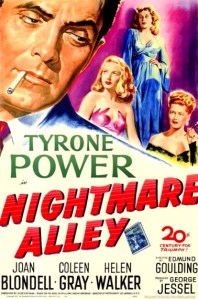
Copyright litigation kept Nightmare Alley (1947) out of circulation and generally unavailable for home viewing until a much-heralded DVD release in 2005. Since then, its reputation has grown from cult favorite to film noir classic. Running nearly two hours with a generous budget and A-list cast, Nightmare Alley is an anomaly for its genre (defined by crime novelist James Ellroy, in his introduction to The Best American Noir of the Century, as “cheap novels and cheap films about cheap people”). Swashbuckling matinee idol Tyrone Power leveraged his stardom to lobby for the starring role as carny con artist Stanton Carlisle, whose sole redemptive quality is his genuine bafflement—“I wonder why I’m like that?”—as to why he’s compelled again and again to act on his most ruthless instincts. The sexual heat generated between Tyrone Power and the film’s three supporting actresses is combustible and gives Nightmare Alley its strongest jolt of noir cred: ripe-to-bursting Joan Blondell as sideshow mentalist Zeena; Coleen Gray as Molly, a.k.a. Electra, scandalous to county sheriffs because of the tin-foil two-piece she wears in her sparks-a-flying electric-chair act; and, higher up the social ladder where Stanton longs to dwell, the movie’s femme fatale, Lilith (Helen Walker), a crooked psychotherapist to the wealthy.
Tyrone Power & Joan Blondell in Nightmare Alley.
Even with a prestige director in Edmund Goulding, and lurid expressionistic lighting by cinematographer Lee Garmes, Nightmare Alley was not a success. Tyrone Power subsequently returned to more conventional roles, which is a shame, because he’s clearly enjoying himself here, especially in the opening carnival scenes, all working-class T-shirt and chewing-gum and an oil-drum’s worth of pomade slicking his hair. In his early thirties at the time, Power initially seems beyond the ideal age for the role of Stan Carlisle, who is a youthful twenty-one in the first half of William Lindsay Gresham’s 1946 novel. The actor’s full-on commitment to the role, however, sells the characterization as handily as Stan’s doggedly mastered sleight-of-hand scarf and coin tricks. Power doesn’t evince a comparable set of skills in later scenes that are actually keyed closer to the actor’s age. Stan’s descent into alcoholism feels abrupt and unconvincing, in spite of our having been tipped off and conditioned to expect it. We’re meant to see parallels both to the drunken carny shill Pete Krumbein (played with aching pathos by veteran stage and silent film actor Ian Keith), whose death Stan inadvertently brings about earlier in the film, and the specter of the sideshow geek that so forcefully haunts the novel and the movie.
1949 paperback edition of Nightmare Alley by William Lindsay Gresham. Cover art: James Avati.
The geek is a severely alcoholic freak-show performer who earns his daily allotment of booze by savagely biting off the heads of live chickens for the amusement of wide-eyed rubes. Nightmare Alley never for a moment lets us forget the addiction-addled beast that presumably resides within each of us. The geek’s frenzied delirium tremens screams echo subliminally on the soundtrack as if erupting from Stan’s unconscious during several doom-laden moments throughout the movie. Alcohol unleashes monsters in Nightmare Alley. No amount of psychological insight is adequate to quelling or even comprehending our primal depravity. Psychotherapy, like telepathy and spiritualism, is exposed here as just another con game for exploiting human weakness.
William Lindsay Gresham’s novel doesn’t waste its breath suggesting that alcoholic Pete Krumbein might have benefited from taking “the cure,” a plot point added to the movie by ace screenwriter Jules Furthman in all likelihood to soften the story’s cynicism. For every pulled punch in the script adaptation of Gresham’s still shockingly grim novel (Nick Tosches, in his 2010 intro to the reissued book, goes as far as to suggest that Gresham may have been binge drinking while writing it), there is often a compensating layer of irony or ambiguity. At the film’s finish, where viewers usually note a more hopeful outcome than in the novel, our worst expectations are momentarily overturned by a glimmer of rescue—or is it enabling?—in the downward spiral of Stan’s now nightmarish life. In our guts we all know what’s in store for Stanton Carlisle. His fate was sealed the moment he first set eyes on the geek.
Photo: B & B Rare Books, Ltd. A 1941 First Edition of The Last Tycoon. Value: $4,000.
Inspired on several fronts (seeing Baz Luhrmann’s film adaptation of The Great Gatsby; rewatching the 1974 Gatsby; revisiting Elia Kazan’s 1976 film of The Last Tycoon), I just finished reading again after many years F. Scott Fitzgerald’s posthumous The Last Tycoon, edited by Edmund Wilson and published in 1941. The Last Tycoon is the title by which I still prefer to think of the novel. There’s an updated 1993 reconstruction by Fitzgerald scholar Matthew J. Bruccoli which uses what Bruccoli believed was Fitzgerald’s choice for the novel’s title, The Love of the Last Tycoon: A Western. Fitzgerald originally floated some curious titles for The Great Gatsby, too. How does Trimalchio grab you? By whatever title, The Last Tycoon is a great novel, even in its incomplete form. (A worthy contemporary comparison: David Foster Wallace’s unfinished but much-admired novel The Pale King, edited by Michael Pietsch and published in 2011.)
Thirty-five-year-old Hollywood producer Monroe Stahr’s obsession with an Englishwoman’s resemblance to his late actress wife might at first seem superficially similar to Gatsby. Fitzgerald in his letters and notes about The Last Tycoon, many of which were famously appended to Wilson’s reconstructed text, writes:
If one book could ever be “like” another, I should say it is more “like” The Great Gatsby than any other of my books. But I hope it will be entirely different—I hope it will be something new, arouse new emotions, perhaps even a new way of looking at certain phenomena.
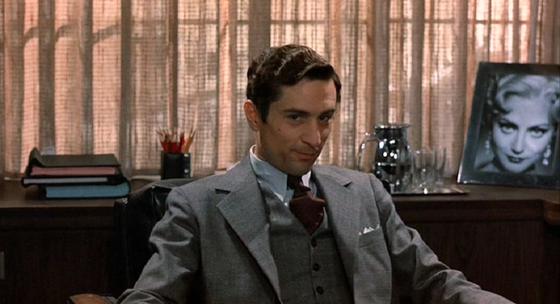
Robert De Niro as Monroe Stahr in The Last Tycoon (1976).
Stahr’s self-awareness evolves over the course of the narrative and differs significantly from Gatsby’s static and deluded nostalgia. This perhaps reflects Fitzgerald’s own battle with despair and loss in the years following Gatsby’s publication. (See Edmund Wilson’s posthumously edited collection of Fitzgerald’s autobiographical essays, The Crack-Up.) The Great Depression coincided with Fitzgerald’s falling fortunes: money woes, ill-health, his wife Zelda’s confinement to a mental hospital, and his career slide into near-obscurity. After living extravagantly as one of the country’s highest paid and most famous writers of the 1920s, he was an out-of-print and largely neglected author by the time he was writing his final novel. The romantic obsession at the core of The Last Tycoon is less about nostalgia than Stahr’s struggle to micromanage a psychological corner of his life while everything else seems to be spiraling beyond his control. As the novel progresses, it becomes clear that the Hollywood that Stahr once dominated as an autocratic whiz-kid producer is becoming decentralized. “At that time the studios feared mob rule,” runs one passage. Stahr’s preparation for a meeting with a communist union organizer has a political edge that signaled the author’s broadening skills as a satirist and social observer:
Afterwards Stahr told me that he prepared for the meeting by running off the Russian Revolutionary films that he had in his film library at home. He also ran off Doctor Caligari and Salvador Dali’s Le Chien Andalou, possibly suspecting that they had a bearing on the matter. He had been startled by the Russian films back in the twenties, and on Wylie White’s suggestion he had the script department get him up a two-page “treatment” of the Communist Manifesto.
Monroe Stahr is wonderfully alive in his sometimes cruel complexity (heightened by the novel’s occasionally spiteful narrator, a rival producer’s daughter secretly in love with Stahr). His confidence is shaken and something new and untested is awakened in him. “I want to show that Stahr left certain harm behind him just as he left good behind him,” Fitzgerald writes in another of the supplemental notes. Stahr isn’t adverse to change, but he wants change on his own terms, unshackled from the studio’s cash-driven bottom line. “For two years we’ve played it safe,” Stahr says at one point to a gathering of suspicious studio heads and money men. “It’s time we made a picture that’ll lose some money.” No dewy-eyed idealist, he adds: “Write it off as good will—this’ll bring in new customers.”
The Last Tycoon was also a reawakening of Fitzgerald’s preternatural talent for writing about romantic infatuation in a manner that manages to embrace clichés while at the same time reinvigorating them:
“I don’t want to lose you now,” he said. “I don’t know what you think of me or whether you think of me at all. As you’ve probably guessed, my heart’s in the grave—” He hesitated, wondering if this was quite true. “—but you’re the most attractive woman I’ve met since I don’t know when. I can’t stop looking at you. I don’t know now exactly the color of your eyes, but they make me sorry for everyone in the world—”
Robert De Niro and Jack Nicholson in The Last Tycoon (1976).
Elia Kazan’s 1976 film of The Last Tycoon never quite catches fire, but it’s a fascinating attempt nonetheless, in its Harold Pinter script (remarkably faithful to the more polished sections of the novel), and many of the performances, especially Robert De Niro’s elusive and darkly internalized portrayal of Monroe Stahr. A notorious flop when released, the movie ended Elia Kazan’s directing career. Kazan devotes seventeen painful pages to the making of the film in his 1988 autobiography, A Life. He was dealing with his mother’s failing health and, finally, her death, during production. Moreover, there were clashes with producer Sam Spiegel. The film deserves reevaluation. It’s never revived or talked about anymore. There’s a strong and richly amusing climactic scene with Jack Nicholson as Brimmer, the novel’s communist union organizer, playing a spirited match of Ping-Pong with De Niro’s Stahr. It’s taken nearly verbatim from the novel and it’s a highlight of the movie. Kazan’s film would make for a great double feature with Last Call, a surprisingly eloquent 2002 Showtime movie based on Francis Kroll Ring’s memoir about working for Fitzgerald during his final days in Hollywood writing The Last Tycoon.
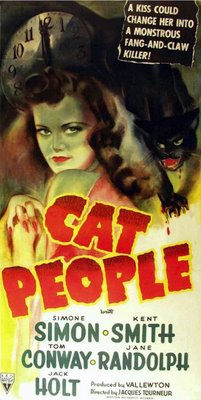
The original Cat People (1942), directed by Jacques Tourneur, is both an acknowledged classic of suggestive horror and one of the most famous Hollywood B-movies of all time. First in a series of low-budget RKO fright films produced by Val Lewton, Cat People became a surprise hit that saved the studio from near-bankruptcy following the failure of two iconic films that in their day were costly flops—Citizen Kane (1941) and The Magnificent Ambersons (1942)—directed by the mercurial boy-genius, Orson Welles. Lewton, while unpretentious by Wellesian standards, was no less hungry to make movies.
Cannily, Lewton found a creative path within the system by working fast and cheap. (And finding an economical use for abandoned sets like the ornate staircase from The Magnificent Ambersons that shows up in Cat People.) He’d been a deadline-driven journalist and pulp novelist. And before being offered his own production unit at RKO studios, Lewton worked his way up at MGM as an ambitious story editor and researcher. Cat People’s disquieting atmosphere of Old World otherness combined with New World dislocation can be traced in part to the European backgrounds of Lewton, born in 1904 in what is now Ukraine, and Tourneur, born the same year in France. The film evokes a haunted American melting pot of primitive mythologies and new-fangled superstitions (i.e., psychoanalysis) ill-equipped for securing one’s safety or survival in a modern impersonal cityscape. It should come as no surprise that after working with Val Lewton, director Jacques Tourneur (along with Cat People cinematographer Nicholas Musuraca) went on to make the influential film noir, Out of the Past (1947), which helped define the genre as doom-laden and populated with psychologically crippled outsiders and social misfits.
Cat People’s Irena Dubrovna (played by French actress Simone Simon) is an aspiring fashion designer of Serbian heritage living in New York City. Introspective and melancholic, she believes herself descended from a devil-worshipping were-leopard who survived an Eastern European witch-hunting pogrom in the 16th century. Irena finds herself drawn to the caged leopard in the Central Park Zoo. Her impromptu marriage to a marine engineer (Kent Smith) remains unconsummated because Irena fears that her own unleashed passion will destroy her husband just like, it’s implied, her mother may have killed Irena’s father in a sexual frenzy when Irena was conceived.
Val Lewton wrote a short story, “The Bagheeta,” published some 12 years earlier in Weird Tales magazine, about medieval villagers hunting a black leopard believed to be a were-beast capable of transforming itself into a beautiful woman of taunting, deadly sensuality. Which is to say, a kind of origin myth for Cat People’s folkloric equating of arousal with bestiality and bloodlust. The screenplay is credited to DeWitt Bodeen, although Lewton contributed heavily to its thematic construction and rewriting. Biographer Edmund G. Bansak, in his book Fearing the Dark: The Val Lewton Career, points to passages in “The Bagheeta,” such as the following, that clearly presage Cat People’s distinctive conjuring of fear and eroticized anxiety through the unseen:
Again he rode through the wood. Again he peered right and left for some sign of the beast, fearful always of seeing golden eyes glow at him from the pitch blackness of the night. Every rustle of the wind, every mouse that scampered on its way, flooded his heart with fear, and filled his eyes with the lithe, black bulk of the Bagheeta, stalking toward him on noiseless paws. With all his heart he wished that the beast would materialize, stand before him, allow him opportunities to slash and thrust and ward. Anything, even deep wounds, would be better than this dreadful uncertainty, this darkness haunted by the dark form of the were-beast.
Simone Simon in Cat People (1942).
Simone Simon’s complex portrayal of shapeshifter Irena Dubrovna is sympathetic in a manner not unlike that of Lon Chaney, Jr.’s bewildered lycanthropist Larry Talbot in The Wolf Man (1940), which had been a recent entry in the long line of lavish Universal studio horror hits that RKO wanted Val Lewton to replicate at a fraction of the cost. No time-consuming elaborate monster make-up for Simone Simon. Instead, characters are stalked by … something. Branches rustle. Shadows loom. Sinister growls echo from the locker room of an indoor swimming pool. Paw prints in the park appear to segue into high-heel shoe indentations.
Concerns that Lewton may have gone too far in substituting shadows and sound effects for in-your-face literal scares caused studio bosses to insist that a leopard be shown during the climactic mauling death of the psychotherapist (Tom Conway) who sexually assaults Irena in his office. Nevertheless, the film’s most frightening jump-in-your-seat moment—still effective 70 years later—is the oft-copied sudden lurching into the film frame of a city bus with its air-brakes hissing.
II. Cat People (1982)
The cult status of Paul Schrader’s 1982 remake of Cat People rests largely on a couple of tangential aspects of the production. First, the David Bowie/Giorgio Moroder theme song, “Cat People (Putting Out Fire),” endures as a great Bowie track and gained further pop culture permanence with Quentin Tarantino’s wildly effective use of the song in a climactic sequence of Inglourious Basterds (2009).
Second, director Paul Schrader’s cocaine-fueled obsession with the film’s star, Nastassja Kinski, as recounted in Peter Biskind’s guilty-pleasure history of 1970s Hollywood, Easy Riders, Raging Bulls: How the Sex-Drugs-and-Rock ’n’ Roll Generation Saved Hollywood, rivals the stories of Alfred Hitchcock’s creepy abuse of Tippi Hedren on the set of The Birds (1963). Schrader shot more nudity of Kinski than the actress was comfortable with. He then spitefully added much of it to the film in retaliation for Kinski quitting their turbulant relationship during production. After finishing the movie, she fled to Paris with Schrader in pursuit. Kinski reportedly told him: “Paul, I always fuck my directors. And with you it was difficult.”
The 1982 Cat People relocates the story to contemporary New Orleans, where Kinski’s character Irena Gallier arrives at the film’s opening to be reunited with her brother—a shapeshifting minister played with menacing brio by Malcolm McDowell—whom she hasn’t seen since childhood. Unfortunately, before we meet Kinski and McDowell, we’re treated to a turgid 6-minute prologue of cat people “mythology.” The film never really finds an effective juxtapositional tone between its gruesome modern-day tale of sexual violence and the primal symbolism of the prologue (and a later scene set in the same blood-red dreamscape). A not dissimilar film from the same era, Ken Russell’s Altered States (1980), found a way to integrate this kind of Jung-on-acid material so that the border between waking reality and the unconscious seemed radically porous.
There are compensatory pleasures to be found in Schrader’s Cat People, to be sure, beginning with its high-toned production design and sensational cast. In addition to Kinski and McDowell, there’s John Heard’s shy zoologist whose obsession with Irena brings out his inner fetishist; Annette O’Toole as Heard’s spurned love interest; Ruby Dee as McDowell’s Creole housekeeper; and Ed Begley, Jr. as the affable zoo-employee sidekick whose arm is graphically torn off in a memorable blood-spurting shock moment.
Nastassja Kinski & Malcolm McDowell in Cat People (1982).
Paul Schrader’s films have suffered somewhat unfairly in their critical reception over the years because his reputation as the brilliant screenwriter of two classic Martin Scorsese films—Taxi Driver (1976) and Raging Bull (1980)—has raised unfulfilled and probably unreasonable expectations for his own directorial efforts. Cat People was not a box office success. This resulted in Schrader being pushed out of studio-financed work and toward the rocky shoals of independent filmmaking. (He has grabbed a lot of attention and raised some eyebrows for his latest project, The Canyons, a Kickstarter-funded mock-exploitation film due out next year, with a script by Bret Easton Ellis and starring Lindsay Lohan and porn star James Deen.)
Further complicating any clear-eyed appraisals of Schrader’s work is his vaunted renown as a trenchant film critic in his own right, in particular as the author of Transcendental Style in Film: Ozu, Bresson, Dreyer, a remarkable examination of the “Holy” in the filmmaking styles of the three European directors addressed in the book title. The study grew out of a thesis written at UCLA Film School, where Schrader received an MA after studying theology at Calvin College. He’d fallen under the spell and personal mentorship of famed New Yorker critic Pauline Kael. Because Schrader’s intellectual background precedes him, film scholars have sometimes been misled in their desire to find deeper layers of philosophical intent to his movies. (To which one wishes to add: Good luck deconstructing The Canyons.)
My story “Summer of the Cinetherapist” was a runner-up in the 2011 Wisconsin People & Ideas short story contest and subsequently appeared in Rosebud Magazine (Autumn 2011). Now it’s a CBR Press ebook single. And for a limited time it’s a free download from Amazon. (Otherwise, 99 cents.) I’ve outfitted the text with a handful of public domain film stills courtesy of Wikimedia Commons. Curious fact: While films and publicity photos typically fall under copyright law, pre-1964 movie trailers often don’t, nor do trailer screenshots. Wikimedia, to my surprise and delight, has public domain trailer screenshots from movies that are integral to “Summer of the Cinetherapist,” such as The Treasure of the Sierra Madre, Mildred Pierce, and Kiss Tomorrow Goodbye. Voilà: an illustrated edition of “Summer of the Cinetherapist.” Enjoy!







 Coffee Spew