A Theory of Lipstick
Karla Huston
Main Street Rag Publishing Co. 2013
Reviewed by Bob Wake
“I only write poems about sex,” begins Karla Huston’s poem “My Husband Thinks.” The poet proceeds to catalog the more quotidian concerns she insists have graced her work over the years, from “the dentist’s office” and “rotting potatoes” to “paperboys peeing in the snow” and “even the guy who stole my parking place.” But damned if “My Husband Thinks” doesn’t suddenly spring to pulse-pounding life with the lines, “Today I wrote about how the pubic hair I shaved / for you has started to twirl and bend again, / how the skin itches, the way a healing // wound does …”
Huston has never shied away from the maddening predicament of desire, its commingling of love and spite, sacrifice and lust. She can be a brutal satirist of the tyrannical male gaze. The poem “Mona Lisa Imagines” is a stream-of-consciousness monologue of mounting irritation by the artist’s iconic model while Leonardo—“farting when you bend for a rag, / or scratching your balls”—demands prim stillness from his subject: “At least the twelve apostles could / gnaw meat off bones while they lingered / or leaned into a bit of gossip / or fingered silver coins. Today // you want my hands folded just this way.”
Karla Huston. Photo: Steve Huston.
A Theory of Lipstick, Huston’s first full-length collection (after more than a decade’s worth of six well-received chapbooks), is comprised of fifty-four poems. While not always about sex, they are never less than insightful about our shared messy humanness and the ecstasies of the natural world. The title poem, which originally appeared in Verse Wisconsin and was awarded a 2012 Pushcart Prize, is another of the poet’s masterful catalogs that blends the sensible and the sensual, this time into a rhapsody of Day-Glo images: “made from fruit pigment and raspberry cream, / a lux of shimmer-shine, lipstick glimmer, duo / in satin-lined pouch, Clara Bow glow: city brilliant / and country chick—sparkling, sensual, silks / and sangria stains, those radiant tints and beeswax liberty— // oh, kiss me now, oh, double agents of beauty …”
Especially memorable are Huston’s portraits of small-town inhabitants whose lives have the vivid contours of Chekhov or Welty characters. They include “The Dog Catcher’s Wife” (“She’s concerned / that even the nets, nooses or tranquilizer / darts won’t save him from the angry ones”) and “Vanishing Woman” (“But now / even bad sex would be better / than none, grinding blindly into / the night, mapping the smoky / landscape with her flesh”), as well as rueful group snapshots like “Girls Tanning”:
Stretched on benches the first warm day in May
so sure of their beauty with their firm arms
and thighs, their high-riding breasts, so content
knowing that they own the world
as the wind steals their hair and eyes, bright
with the strain of staring into the sun,
posing, white teeth flashing as they lick
cherry gloss from their lips. […]
Accessible and inviting even at its most acerbic, Karla Huston’s A Theory of Lipstick is no unproven hypothesis, it’s a fully vetted and means-tested map of the American heart and heartland.
Photo: B & B Rare Books, Ltd. A 1941 First Edition of The Last Tycoon. Value: $4,000.
Inspired on several fronts (seeing Baz Luhrmann’s film adaptation of The Great Gatsby; rewatching the 1974 Gatsby; revisiting Elia Kazan’s 1976 film of The Last Tycoon), I just finished reading again after many years F. Scott Fitzgerald’s posthumous The Last Tycoon, edited by Edmund Wilson and published in 1941. The Last Tycoon is the title by which I still prefer to think of the novel. There’s an updated 1993 reconstruction by Fitzgerald scholar Matthew J. Bruccoli which uses what Bruccoli believed was Fitzgerald’s choice for the novel’s title, The Love of the Last Tycoon: A Western. Fitzgerald originally floated some curious titles for The Great Gatsby, too. How does Trimalchio grab you? By whatever title, The Last Tycoon is a great novel, even in its incomplete form. (A worthy contemporary comparison: David Foster Wallace’s unfinished but much-admired novel The Pale King, edited by Michael Pietsch and published in 2011.)
Thirty-five-year-old Hollywood producer Monroe Stahr’s obsession with an Englishwoman’s resemblance to his late actress wife might at first seem superficially similar to Gatsby. Fitzgerald in his letters and notes about The Last Tycoon, many of which were famously appended to Wilson’s reconstructed text, writes:
If one book could ever be “like” another, I should say it is more “like” The Great Gatsby than any other of my books. But I hope it will be entirely different—I hope it will be something new, arouse new emotions, perhaps even a new way of looking at certain phenomena.
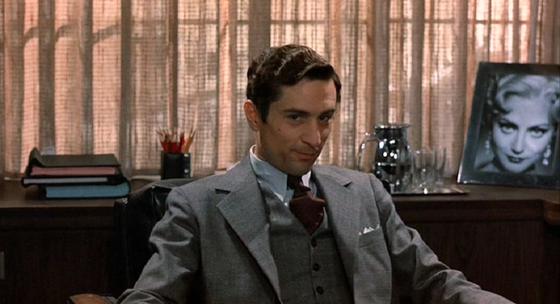
Robert De Niro as Monroe Stahr in The Last Tycoon (1976).
Stahr’s self-awareness evolves over the course of the narrative and differs significantly from Gatsby’s static and deluded nostalgia. This perhaps reflects Fitzgerald’s own battle with despair and loss in the years following Gatsby’s publication. (See Edmund Wilson’s posthumously edited collection of Fitzgerald’s autobiographical essays, The Crack-Up.) The Great Depression coincided with Fitzgerald’s falling fortunes: money woes, ill-health, his wife Zelda’s confinement to a mental hospital, and his career slide into near-obscurity. After living extravagantly as one of the country’s highest paid and most famous writers of the 1920s, he was an out-of-print and largely neglected author by the time he was writing his final novel. The romantic obsession at the core of The Last Tycoon is less about nostalgia than Stahr’s struggle to micromanage a psychological corner of his life while everything else seems to be spiraling beyond his control. As the novel progresses, it becomes clear that the Hollywood that Stahr once dominated as an autocratic whiz-kid producer is becoming decentralized. “At that time the studios feared mob rule,” runs one passage. Stahr’s preparation for a meeting with a communist union organizer has a political edge that signaled the author’s broadening skills as a satirist and social observer:
Afterwards Stahr told me that he prepared for the meeting by running off the Russian Revolutionary films that he had in his film library at home. He also ran off Doctor Caligari and Salvador Dali’s Le Chien Andalou, possibly suspecting that they had a bearing on the matter. He had been startled by the Russian films back in the twenties, and on Wylie White’s suggestion he had the script department get him up a two-page “treatment” of the Communist Manifesto.
Monroe Stahr is wonderfully alive in his sometimes cruel complexity (heightened by the novel’s occasionally spiteful narrator, a rival producer’s daughter secretly in love with Stahr). His confidence is shaken and something new and untested is awakened in him. “I want to show that Stahr left certain harm behind him just as he left good behind him,” Fitzgerald writes in another of the supplemental notes. Stahr isn’t adverse to change, but he wants change on his own terms, unshackled from the studio’s cash-driven bottom line. “For two years we’ve played it safe,” Stahr says at one point to a gathering of suspicious studio heads and money men. “It’s time we made a picture that’ll lose some money.” No dewy-eyed idealist, he adds: “Write it off as good will—this’ll bring in new customers.”
The Last Tycoon was also a reawakening of Fitzgerald’s preternatural talent for writing about romantic infatuation in a manner that manages to embrace clichés while at the same time reinvigorating them:
“I don’t want to lose you now,” he said. “I don’t know what you think of me or whether you think of me at all. As you’ve probably guessed, my heart’s in the grave—” He hesitated, wondering if this was quite true. “—but you’re the most attractive woman I’ve met since I don’t know when. I can’t stop looking at you. I don’t know now exactly the color of your eyes, but they make me sorry for everyone in the world—”
Robert De Niro and Jack Nicholson in The Last Tycoon (1976).
Elia Kazan’s 1976 film of The Last Tycoon never quite catches fire, but it’s a fascinating attempt nonetheless, in its Harold Pinter script (remarkably faithful to the more polished sections of the novel), and many of the performances, especially Robert De Niro’s elusive and darkly internalized portrayal of Monroe Stahr. A notorious flop when released, the movie ended Elia Kazan’s directing career. Kazan devotes seventeen painful pages to the making of the film in his 1988 autobiography, A Life. He was dealing with his mother’s failing health and, finally, her death, during production. Moreover, there were clashes with producer Sam Spiegel. The film deserves reevaluation. It’s never revived or talked about anymore. There’s a strong and richly amusing climactic scene with Jack Nicholson as Brimmer, the novel’s communist union organizer, playing a spirited match of Ping-Pong with De Niro’s Stahr. It’s taken nearly verbatim from the novel and it’s a highlight of the movie. Kazan’s film would make for a great double feature with Last Call, a surprisingly eloquent 2002 Showtime movie based on Francis Kroll Ring’s memoir about working for Fitzgerald during his final days in Hollywood writing The Last Tycoon.




 Coffee Spew