According to the L.A. Times literary blog Jacket Copy, George Saunders chose to leave “Fox 8” out of his recently published collection Tenth of December because he felt it was “asking one stretch too many from the reader.” I get that. In fact, I much prefer reading the occasional Saunders story in The New Yorker rather than compiled in short story collections. His stories, artfully spun and eccentrically self-contained, can seem overly precious and “worked up” when set side by side. That said, he’s written more than his share of masterful short stories. “Fox 8,” which began life as a failed children’s book, is as memorable as anything Saunders has written, which is to say it will stay with you because of qualities it shares with timeless, even mythic storytelling.
George Saunders. Photo: Chloe Aftel.
The story is narrated by a visionary fox struggling to convince his starving den comrades that their only chance for survival is to strike out in quest of food at the newly constructed shopping mall that has displaced their habitat. “Fox 8” is actually an epistolary fable, written as a beseeching letter to the humans whose language Fox 8 has learned, if not precisely mastered, as a kind of earthy Chaucerian Middle English: “Stay in your awesum howses, play your music lowd, however you make it play so lowd, yap your Yuman jokes, sending forth your crood laffter into the nite.” Also worth noting about this very cool 99-cent ebook are the wonderful illustrations by graphic designer Chelsea Cardinal (the sharp cover design is hers as well).
Proposals for the Recovery of the Apparently Drowned
Michael Sheehan Colony Collapse Press 2012
Reviewed by Bob Wake
The four short stories that comprise Michael Sheehan’s Proposals for the Recovery of the Apparently Drowned are ambitious and often darkly amusing fictions that adroitly mesh genre-busting experimental writing and rock-solid literary instincts. While each story succeeds well enough on its own ingeniously devised terms, the title story is perhaps the strongest in the collection. Stripped of the hypertextual footnotes and pop culture references that function as metafictional ballast in the other stories collected here, “Proposals for the Recovery of the Apparently Drowned” is instead a tightly composed narrative about the mounting internalized horror of a woman plunged into a coma-like state of “conscious paralysis” after stumbling and falling outside of a New York dance club. Passages of dryly delivered historical documentation on “suspended animation” are woven directly into the text and add to the story’s powerful effect. Sheehan never pushes the existential metaphor of an unmoored and despairing Beckettian consciousness, allowing us to intimately share the protagonist’s dislocation:
Deep inside herself, willing her body limp and empty and motionless and withdrawing every bit of her true self inside, away, acutely aware of everything around her and through this awareness focused more and more on nothing but staying still, hidden.
Michael Sheehan. Photo: Colony Collapse Press.
The final story, “September,” is the longest in the collection and its hilarious over-the-top self-indulgence is clearly intended as an homage to the influential writer for whom the story is dedicated: David Foster Wallace (1962-2008). Sheehan cleverly glosses aspects of Wallace’s Infinite Jest (the novel’s apocalyptic tennis court game of Eschaton—which also inspired the Decemberists’ video for their “Calamity Song”—becomes an epic round of Civilization in Sheehan’s story). More than mere parody, Sheehan’s “September” finds its own rhythms and drug-fueled conspiratorial compulsions, and the story’s final section (dated September 12, 2008, the date of Wallace’s death) is heartbreakingly beautiful as writing and as eulogy.
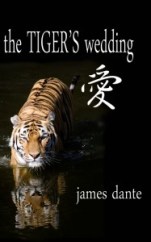
The Tiger’s Wedding
James Dante
Martin Sisters Publishing 2013
Reviewed by Bob Wake
“Moments of conventional bliss had a way of eluding me,” declares Jake St. Gregory, a young American accountant from dreamland, U.S.A.—Burbank, California—working as an English teacher in Seoul, South Korea. Jake, the 30-year-old protagonist and narrator of James Dante’s wry and wise debut novel, The Tiger’s Wedding, will thoroughly test the multicultural limits of convention and bliss by the finish of his tale.
There’s a tangled romance at the heart of The Tiger’s Wedding, with Jake falling in love with a married Korean woman, an aspiring musician with two young children. Dante finds enough page-turning complications and believable twists to both keep the plot percolating efficiently and to largely sidestep cliches. He grounds his story in solid characterization and skillful depictions of cultural and familial conflicts.
James Dante. Photo: Martin Sisters Publishing.
It’s no surprise to learn from his author’s bio that Dante, a Northern Californian by way of New York, spent time teaching in South Korea. The novel is lovingly awash in quotidian details of cuisine and landscape, as well as nightlife high and low. The story avoids lapsing into travelogue while at the same time taking Western readers to locations we’d be curious to see ourselves. Whether or not The Tiger’s Wedding was completed before the viral K-pop YouTube sensation of “Gangnam Style,” Dante’s description of the song’s locale provides an interesting gloss on its Day-Glo milieu:
We rode the subway into Gangnam, a chic section of Seoul. Even below ground, imitation Renaissance statues squirted water into flood-lit pools. Walking from the subway stop to street level involved passing boutiques … I had heard the stories about young Gangnam males who caroused in the nightclubs and eateries, terrorizing the staff and lighting cigarettes with money.
More ominous is Jake’s darkly funny visit to the Korean Demilitarized Zone with a photojournalist (a sardonic American from Columbus, Ohio whose character functions at times as Jake’s bad conscience):
On the other side of the border stood a 500-foot flagpole, which supported a 600-pound North Korean flag. Even with the steady wind, the flag hung limp from its own weight. Amplified rhetoric echoed from the enemy side. Through powerful loudspeakers, North Korea continuously reminded the Southern troops that the North had created a Workers’ Paradise. Big deal. In the South they drove Hyundais and listened to rap.
Dante’s strongest creation is the character of Jae-Min, the 33-year-old working mother and abused wife whom Jake befriends and whose life becomes increasingly enmeshed with his own. Jae-Min’s complexity keeps the story off-balance in a compelling manner: she can’t comfortably resolve the multiple conflicts complicating her life. Dante is at his best in showing us her resilience and allowing us, along with Jake, to second-guess—often with shameful inaccuracy—Jae-Min’s behavior.
Labor protests and a growing anti-Americanism in Seoul heighten the climactic sections of the novel. (“Lines of riot police, resembling a thousand Darth Vaders, pushed back with even greater force, knocking people to the ground.”) There’s much to recommend here, from the novel’s careful attention to detail and the shifting allegiances of its characters, to its cultural and political backdrop. The strong excerpts from The Tiger’s Wedding that ran in Rosebud Magazine have more than fulfilled their promise.



 Coffee Spew