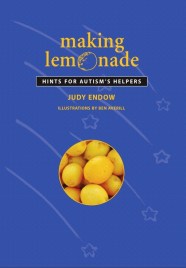
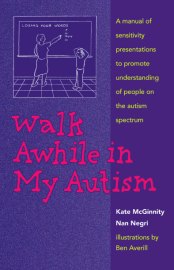
A significant article in the latest issue of Disability Studies Quarterly, “Rethinking Autism: Implications of Sensory and Movement Differences” by Anne Donnellan, David Hill, and Martha Leary, cites two of our Cambridge Book Review Press titles: Walk Awhile in My Autism (2005) by Kate McGinnity & Nan Negri, and Making Lemonade: Hints for Autism’s Helpers (2006) by Judy Endow.
Month: February 2010
-
Memories of Veep “Ted” Agnew
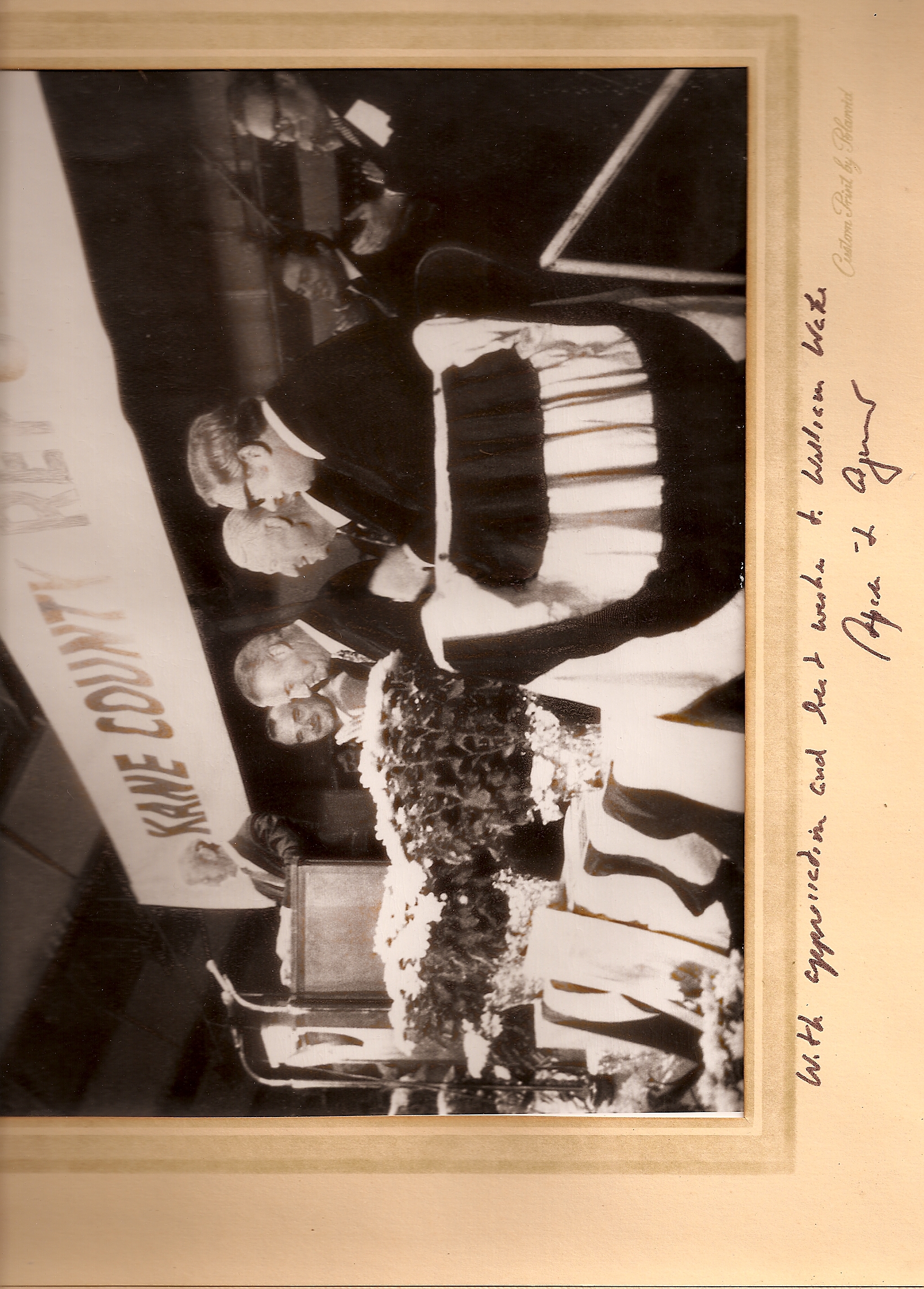
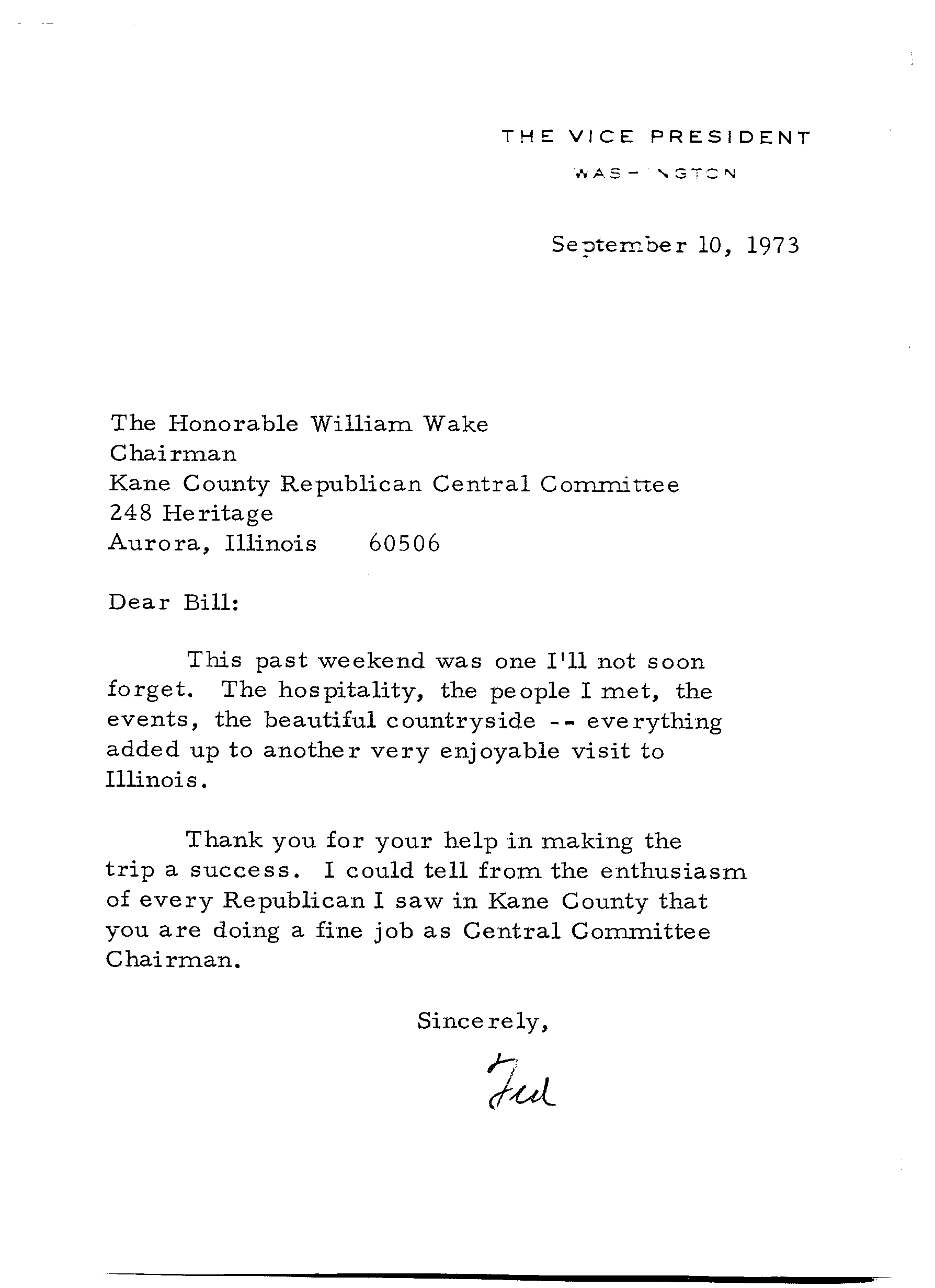
We’re in the midst of basement renovations. Moving boxes out from behind the furnace, my son couldn’t get enough of an unsorted stash of my parents’ photos and memorabilia. He came up with a September 1973 signed thank-you note (boilerplate sentiments typed by a secretary) from then-Vice President Spiro T. Agnew. I’d forgotten about the letter. It goes with the inscribed 8×10 photo which has adorned our fireplace mantle for a while now. My father chaired the Kane County Republicans in the 1970s. Agnew was brought in for a fund-raising speech. (Dad is the guy sitting between Agnew and the podium.) Watergate was in the headlines and Agnew was under indictment in his home state of Maryland for graft. The event was held at the county fair grounds in St. Charles. There was a catered meal, a raffle. Some 2,400 attended. Columnist Joel Weisman, covering the speech for the Chicago Sun-Times, wrote “the vice president is not the same controlled, dynamic speaker he was before his personal grand jury problems became public in August.”
-
The Future of the Book
Jason Epstein in The New York Review of Books assesses with guarded optimism the brave new world of digital literature:
Digitization makes possible a world in which anyone can claim to be a publisher and anyone can call him- or herself an author. In this world the traditional filters will have melted into air and only the ultimate filter—the human inability to read what is unreadable—will remain to winnow what is worth keeping in a virtual marketplace where Keats’s nightingale shares electronic space with Aunt Mary’s haikus.
-
Faulkner’s Rosetta Stone
According to a remarkable article in the New York Times, a nineteenth century Mississippi plantation diary turns out to have been a major source of background material and character detail for William Faulkner’s fiction:The original manuscript, a diary from the mid-1800s, was written by Francis Terry Leak, a wealthy plantation owner in Mississippi whose great-grandson Edgar Wiggin Francisco Jr. was a friend of Faulkner’s since childhood. Mr. Francisco’s son, Edgar Wiggin Francisco III, now 79, recalls the writer’s frequent visits to the family homestead in Holly Springs, Miss., throughout the 1930s, saying Faulkner was fascinated with the diary’s several volumes. Mr. Francisco said he saw them in Faulker’s hands and remembers that he “was always taking copious notes.”
It’s being called “one of the most sensational literary discoveries of recent decades.” I know. Sounds like a Clifford Irving hoax, or something along the lines of the fake Hitler diaries. But it appears to be true. The Emory University professor and Faulkner scholar responsible for the discovery, Sally Wolff-King, has a book coming out in June from Louisiana State University Press, Ledgers of History: William Faulkner, an Almost Forgotten Friendship, and an Antebellum Diary. Material from the diary shows up in major works from The Sound and the Fury to Go Down, Moses and Absalom, Absalom!
[Update: Explosive allegations in an April 24, 2014 article at the Awl.com suggest Ledgers of History might be a hoax.]
-
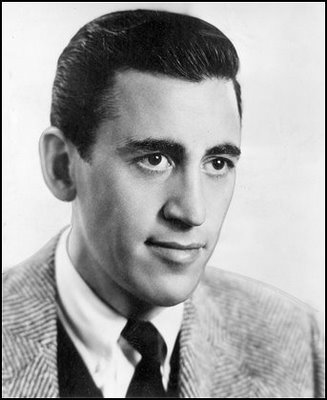
J. D. Salinger (1919-2010)
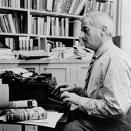
The best appraisal I’ve read of Salinger’s legacy is Walter Kirn’s tribute in the February 18th issue of Rolling Stone. Kirn writes that Salinger “single-handedly invented the great American teenager” with the character of Holden Caulfield in The Catcher in the Rye (1951). And this is perfect: “As a model for genuine rebellion, Holden has always been overrated. He’s more like the kid who makes rebellion unnecessary by rendering grumbling and snickering sufficient.”
Also essential reading is Lillian Ross writing about their long friendship in the February 8th New Yorker. She quotes Salinger: “I started writing and making up characters in the first place because nothing or not much away from the typewriter was reaching my heart at all.”
As for the “dark side” of J. D. Salinger, look no further than Gay Davidson-Zielske’s review of Joyce Maynard’s 1998 memoir, At Home in the World.